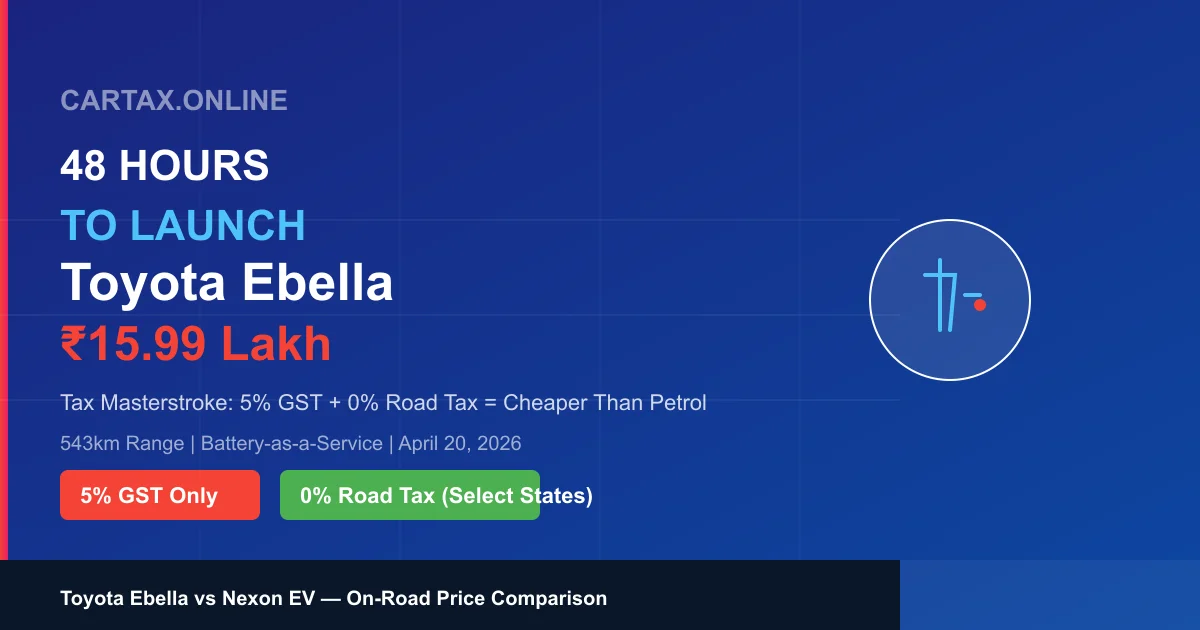
Toyota is launching its first major electric vehicle in India on April 20, 2026, with the Ebella SUV priced at an aggressive ₹15.99 lakh (ex-showroom). Industry watchers are calling the pricing a "tax masterstroke" because the combination of 5% GST and road tax exemptions in select states makes the total cost of ownership comparable to, or even lower than, equivalent petrol vehicles.
As of April 18, 2026, just 48 hours before the official reveal, anticipation has reached fever pitch. Car enthusiasts and potential buyers have been closely following Toyota's communications around the "Battery-as-a-Service" (BaaS) rental model, which could revolutionise how Indian consumers access and afford electric vehicles. The BaaS model separates the battery cost from the vehicle price, potentially reducing the upfront purchase price significantly.
Why the ₹15.99 Lakh Price is a Game-Changer
The Toyota Ebella's ex-showroom price of ₹15.99 lakh positions it directly against the Tata Nexon EV (priced from ₹14.49 lakh) and the MG Windsor EV (priced from ₹12.90 lakh). However, when road tax and GST are factored in, the Ebella's effective on-road price in states like Delhi, Maharashtra, and Gujarat becomes surprisingly competitive with petrol-powered compact SUVs.
Under India's GST framework, electric vehicles attract a concessional 5% GST rate compared to 18% for small petrol cars and 28% for larger SUVs. For a vehicle priced at ₹15.99 lakh, the GST saving alone amounts to approximately ₹2.08 lakh compared to a petrol vehicle in the same price category. Combined with road tax exemptions in select states, the total on-road price advantage for the Ebella can exceed ₹3 lakh over a comparable petrol vehicle.
The Battery-as-a-Service (BaaS) Model Explained
Toyota's Battery-as-a-Service approach separates the battery ownership from the vehicle itself. Under this model, buyers pay a lower upfront price for the Ebella without the battery included, then pay a monthly rental for the battery. This reduces the ex-showroom price by approximately ₹3 to ₹4 lakh, bringing the effective purchase price down to under ₹12 lakh before taxes.
The BaaS model has several advantages for Indian consumers. First, it reduces the upfront financial burden significantly, making the Ebella accessible to a broader audience. Second, battery replacement costs are eliminated since the battery remains Toyota's asset. Third, as battery technology improves, buyers automatically benefit from upgraded battery packs without additional purchase costs. The monthly rental is expected to range from ₹8,000 to ₹12,000 depending on usage patterns and the battery pack size chosen.
Toyota Ebella: Specifications and Range
The Toyota Ebella is built on Toyota's innovative e-TNGA platform, providing a low centre of gravity and spacious interior despite its compact SUV dimensions. The vehicle offers a certified range of 543 kilometres on a single charge under standard test conditions, making it one of the longest-range electric vehicles in its price segment in India.
The electric motor delivers approximately 150 horsepower with instant torque available from the first press of the accelerator. The battery pack is sourced from Toyota's partnership with Panasonic and BYD, ensuring reliable performance and thermal management across India's diverse climate conditions. Fast charging capability allows the battery to reach 80% charge in approximately 45 minutes using a DC fast charger, while home AC charging takes around 8 to 10 hours for a full charge.
On-Road Price Comparison: Ebella vs Nexon EV
Comparing the on-road price of the Toyota Ebella with the Tata Nexon EV in Delhi reveals the tax advantage clearly. The Toyota Ebella at ₹15.99 lakh ex-showroom attracts GST of approximately ₸0.80 lakh (5% on ₹16 lakh), road tax exemption of approximately ₹0.96 lakh (8% in Delhi), making the total on-road price approximately ₹16.75 lakh. The Tata Nexon EV LR priced at ₹14.49 lakh attracts GST of approximately ₹2.61 lakh (18%), road tax exemption of approximately ₹0.87 lakh (8%), bringing the total to approximately ₹17.97 lakh. The Toyota Ebella effectively costs less than the Nexon EV on road in Delhi.
For buyers in states without road tax exemptions, the calculus changes but remains competitive. In states where EV road tax exemptions do not apply, the Ebella's 5% GST advantage over a petrol vehicle in the same price bracket still provides meaningful savings. Use our India car tax calculator to compare the exact on-road cost of the Ebella versus any petrol or electric vehicle in your state.
States with 0% Road Tax for Electric Vehicles
As of April 2026, the following Indian states offer road tax exemption for electric vehicles, making the Toyota Ebella's total ownership cost significantly lower than equivalent petrol vehicles: Delhi (10-year exemption), Maharashtra (5-year exemption), Gujarat (5-year exemption), Karnataka (5-year exemption), Tamil Nadu (10-year exemption), and Rajasthan (5-year exemption). In these states, the road tax savings on a ₹16 lakh vehicle can exceed ₹1 lakh over the exemption period.
For government employees and those with stable incomes, the combination of the 8th Pay Commission's expected salary increase and the favourable tax treatment of electric vehicles makes purchasing a premium EV like the Toyota Ebella increasingly affordable. The reduced GST and road tax exemptions effectively make the Ebella a petrol-car-priced electric vehicle in many Indian states.
Toyota's Reliability Advantage
Toyota's reputation for reliability and low maintenance costs is a significant factor in the Ebella's appeal. Indian consumers have historically prioritised brand reliability over specification sheet advantages, and Toyota's extensive service network across India provides peace of mind that newer EV brands cannot match. The company's established relationship with local dealerships and service centres means that maintenance, repairs, and spare parts availability will be significantly better than for imported EV brands.
For buyers comparing the Ebella against Chinese EV brands that are entering the Indian market, Toyota's service infrastructure and brand trust represent meaningful advantages beyond the specification sheet. The combination of competitive pricing driven by GST savings, road tax exemptions, and Toyota's reliability reputation creates a compelling case for the Ebella as the first mass-market electric SUV from a trusted global brand in India.
Frequently Asked Questions
What is the Toyota Ebella launch date in India?
The Toyota Ebella is scheduled to launch in India on April 20, 2026. The vehicle will be available at Toyota dealerships across all major cities, with first deliveries expected to begin within 2 weeks of the launch announcement.
What is the ex-showroom price of Toyota Ebella?
The Toyota Ebella is priced at ₹15.99 lakh (ex-showroom). With 5% GST and road tax exemption in select states, the total on-road price in Delhi and other EV-friendly states is approximately ₹16.75 lakh, making it competitive with petrol vehicles in the same segment.
What is the Battery-as-a-Service (BaaS) model for Toyota Ebella?
The BaaS model separates battery ownership from the vehicle, reducing the upfront purchase price by approximately ₹3 to ₹4 lakh. Buyers pay a monthly rental for the battery ranging from ₹8,000 to ₹12,000, eliminating battery replacement concerns and enabling automatic upgrades as battery technology improves.
What is the range of Toyota Ebella?
The Toyota Ebella offers a certified range of 543 kilometres on a single charge, making it one of the longest-range electric vehicles in its price segment in India. Actual range will vary depending on driving conditions, climate control usage, and terrain.
Which states offer road tax exemption for electric vehicles?
Delhi, Maharashtra, Gujarat, Karnataka, Tamil Nadu, and Rajasthan offer road tax exemption for electric vehicles, with exemption periods ranging from 5 to 10 years. In these states, the Toyota Ebella's total cost of ownership is significantly lower than equivalent petrol vehicles.
Official Resources: Parivahan Portal | Vahan Road Tax | India GST Portal | FAME-III Scheme
Frequently Asked Questions
Q: What is the current road tax rate for cars in India 2026?
Road tax rates in India vary by state and vehicle category. For new cars, GST is charged at 5% for EVs, 18% for hybrids under 1,200cc, and up to 28% for petrol/diesel SUVs. State road tax is charged separately and varies from Rs3,000-15,000 annually depending on the state's slab system. Check your specific state's RTO website for current rates.
Q: How do I calculate my car road tax online in India?
You can calculate your car road tax using online calculators available on state RTO portals and CarTax.online. The calculation considers your vehicle's ex-showroom price, fuel type, engine capacity, and state of registration. Road tax is payable annually or for the vehicle's lifetime depending on your state's rules.
Q: Is GST included in the road tax for new cars in India?
No — GST and road tax are separate charges. GST is a central tax charged by the vehicle manufacturer at the time of purchase. State road tax is a separate annual or one-time charge levied by your state's transport department. Both apply at the time of first registration, and annual road tax continues for subsequent years.
Q: Do electric vehicles get tax benefits in India 2026?
Yes — electric vehicles in India qualify for a reduced GST rate of 5% (down from 28% for petrol cars). Under FAME-III subsidies, EVs may also qualify for additional state-level incentives, reduced road tax, and free registration in many states. The exact benefits vary by state.
Q: What happens if I don't pay my car road tax on time?
If you don't pay road tax, your vehicle's registration can be flagged in the Vahan database, preventing renewal of fitness certificates and creating legal liability during police checks. Penalties range from Rs200-500 per day of default in most states. Road tax is a legal requirement under the Motor Vehicles Act.