Focus keyword: India car tax calculator
India Car Tax Calculator 2026
Last Updated: April 15, 2026
Calculate your estimated car tax and total on-road price in India. This page includes location-specific rates, detailed tax breakdown, and practical tips for smarter budgeting.
Instant Car Tax Calculator
Results update automatically as you type
Enter a price to see your tax breakdown
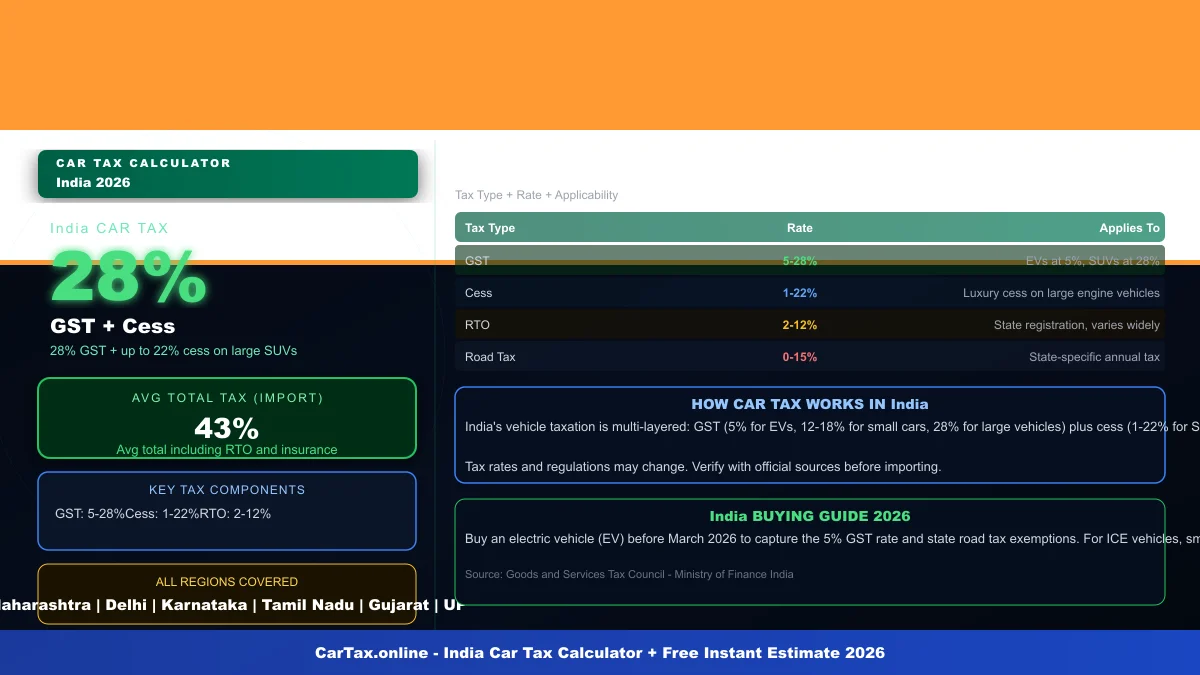
India's vehicle taxation system is among the world's most complex, combining Central GST (Goods and Services Tax) ranging from 5% for electric vehicles to 28% plus cess for large SUVs, State RTO registration fees of 2-12% varying by state, and annual road taxes that differ significantly across India's 28 states and 8 union territories. The India car tax calculator for 2026 integrates all these layers to provide accurate on-road price estimates.
GST Council decisions have progressively incentivised electric vehicle adoption, with EVs attracting just 5% GST compared to 28% for large SUVs. Several states have gone further by exempting EVs from road tax entirely through 2025, creating dramatic regional variations in total vehicle cost between states offering incentives and those that don't.
Mumbai (Maharashtra), Delhi, Bangalore (Karnataka), Chennai (Tamil Nadu), and Ahmedabad (Gujarat) are the primary markets for new vehicle registrations, accounting for over 40% of national sales. Each state's RTO fees and road tax rates significantly influence purchase decisions, with many buyers registering vehicles in home states despite purchasing in dealer-dense metropolitan areas.
GST Rates: The Foundation of India's Vehicle Tax System
From 5% for EVs to 28% plus cess for luxury SUVs
India's GST (Goods and Services Tax) structure for vehicles is tiered by vehicle type and engine specification. Electric vehicles (EVs) attract the lowest rate at 5% GST with no cess, making them significantly cheaper than equivalent petrol vehicles before state taxes are considered.
Small cars with engine capacity under 1200cc (petrol) or 1500cc (diesel) attract 18% GST. Larger petrol cars and SUVs with engine capacity over 1200cc, and diesel vehicles over 1500cc, attract the full 28% GST.
The cess applies specifically to vehicles with engine capacity over 1500cc (petrol) or 1800cc (diesel), or with length over 4 metres and ground clearance over 170mm (the SUV definition). A large sedan with 2000cc petrol engine and length over 4 metres could face 28% GST plus 22% cess, totalling 50% on the ex-showroom price before state taxes.
State RTO Registration and Road Tax
The significant regional variations in vehicle taxation
State RTO (Regional Transport Office) registration fees range from 2-12% of the vehicle's ex-showroom price depending on the state. Delhi charges approximately 4-8% for registration plus fixed fees, while Maharashtra charges approximately 6-12%.
Annual road tax (formed as vehicle tax or road cess) is assessed by each state and ranges from 0% for EVs in incentive states to 15% of vehicle value annually for conventional vehicles in some states. Most states charge between 3-8% annually, with Sikkim, Mizoram, and Meghalaya offering particularly competitive rates.
For EVs, states including Delhi, Maharashtra, Karnataka, Tamil Nadu, Gujarat, and Uttar Pradesh have exempted road tax through various dates (typically 2025 or 2026), creating significant savings. Maharashtra's EV road tax exemption is particularly valuable given the state's high vehicle density.
Electric Vehicles: India's Green Mobility Opportunity
How EV policies are reshaping vehicle economics
India's EV policy creates dramatic cost advantages for electric vehicles. At 5% GST versus 28% GST plus cess, a Tata Nexon EV priced at INR 1,499,000 ex-showroom costs approximately INR 1,574,000 on-road (with 5% GST) versus INR 2,099,000+ for the petrol Nexon (with 28% GST plus 15% cess), a difference of over INR 500,000.
State-specific EV subsidies add further advantage. Delhi offers purchase subsidies of up to INR 150,000 for EVs under the Delhi EV Policy, Maharashtra offers up to INR 150,000, and Gujarat up to INR 100,000.
The FAME II (Faster Adoption and Manufacturing of Electric Vehicles) subsidy programme provides up to INR 250,000 for electric four-wheelers based on battery capacity, administered through the NITI Aayog. For a vehicle meeting all FAME II criteria, total government support can reach INR 400,000+.
Buying Guide: Best Vehicles for India
2026 market recommendations by segment
For buyers prioritising lowest total cost of ownership, the Tata Tiago EV and MG Comet represent exceptional value at approximately INR 800,000-1,200,000 on-road. Both qualify for 5% GST, state EV subsidies, and road tax exemptions in most major states.
For families needing larger vehicles, the Tata Nexon EV Max, Mahindra XUV400, and Hyundai Ioniq 5 offer practical space with 400-500km range at on-road prices of INR 1,800,000-3,500,000. These compete with petrol SUVs at similar price points when GST advantages are factored.
For conventional vehicle buyers, Maruti Dzire (petrol, under 1200cc, 18% GST) and Hyundai Creta (diesel, 28% GST, cess applies) represent opposite ends of the tax spectrum. Choosing the smaller engine option where possible saves significantly on GST.
Regional State-by-State Tax Comparison
Why registration location matters
Registering a vehicle in Goa versus Mumbai for the same vehicle can save INR 80,000-150,000 in total registration and road tax. Goa charges approximately 2-3% total at registration versus Maharashtra's 8-12%, making Goa an attractive registration destination despite potentially higher dealer prices in the state.
Delhi offers particularly competitive EV economics with 5% GST plus INR 150,000 state subsidy plus road tax exemption, making it the cheapest major market for EV purchases. Karnataka (Bangalore) similarly offers excellent EV incentives and is India's largest EV market by volume.
For commercial vehicle registrations, several states offer reduced road tax for vehicles used in goods transport, reflecting their contribution to state logistics networks. This makes the choice of registration state even more significant for business fleet operators.
Using the India Car Tax Calculator
Getting accurate on-road estimates for 2026
Enter the vehicle's ex-showroom price in INR and select the state where the vehicle will be registered. The calculator applies the correct GST rate based on vehicle type and engine capacity, adds cess where applicable, and applies state-specific RTO fees and road tax.
Select the fuel type (Electric, Petrol, Diesel, CNG, Hybrid) and engine capacity for precise GST bracket determination. The calculator automatically applies EV incentives where applicable, including reduced GST rates and state subsidies for qualifying vehicles.
Review the complete breakdown including ex-showroom price, GST, cess, RTO registration fee, state road tax, and insurance. The calculator shows the full on-road price and annual road tax renewal cost for the selected state.
India Car Tax FAQs
What is the GST rate on electric vehicles in India?
Electric vehicles attract 5% GST in India, compared to 12% for small cars, 18% for mid-size cars, and 28% plus cess (up to 22%) for large SUVs. This creates significant EV cost advantages.
Which Indian state has the lowest vehicle registration tax?
Goa and Puducherry have among the lowest registration fees at 2-3% of ex-showroom price. Sikkim, Mizoram, and Meghalaya also offer competitive rates. Maharashtra and Karnataka have higher rates but offer more EV subsidies.
Are electric vehicles exempt from road tax in India?
Many states have exempted EVs from annual road tax through 2025-2026 as part of their EV policies. Major states including Delhi, Maharashtra, Karnataka, Gujarat, Tamil Nadu, and Uttar Pradesh offer EV road tax exemptions.
What cess applies to large SUVs in India?
A cess of 1-22% applies to vehicles with engine capacity over 1500cc (petrol) or 1800cc (diesel), or SUVs defined by length over 4 metres and ground clearance over 170mm. The highest cess applies to the largest luxury SUVs.
What government subsidies are available for EVs in India?
FAME II provides up to INR 250,000 per vehicle based on battery capacity. State EV policies add further subsidies of INR 50,000-150,000. Combined with 5% GST versus 28% GST, total EV advantages can exceed INR 500,000.
Is it worth registering a car in a different state to save on tax?
Yes, registering in a low-tax state like Goa can save INR 80,000-150,000 in total registration costs. However, you must physically register in your state of residence, and registering in a different state to avoid taxes is illegal.
Related Car Tax Calculators
More Car Tax Calculators
⚠ Financial & Legal Disclaimer
All information provided in this article is for educational and informational purposes only. The content is synthesized based on verbal communications, extensive internet research, and official government website data as of the date of publishing. Tax laws and insurance policies are subject to frequent changes by the authorities. We strive for accuracy, but we recommend that you consult a qualified professional (CA, CPA, or Tax Consultant) before making any financial decisions. For personalized assistance, you can also connect with our in-house experts through our Contact Us page.
⚠ वित्तीय एवं कानूनी डिस्क्लेमर
इस लेख में दी गई सभी जानकारी केवल शिक्षा और सूचना के उद्देश्य से है। यह कंटेंट इंटरनेट रिसर्च, सरकारी वेबसाइटों के आंकड़ों और मौखिक चर्चाओं पर आधारित है। टैक्स नियम और इंश्योरेंस पॉलिसियां सरकार द्वारा समय-समय पर बदली जा सकती हैं। हालांकि हम सटीकता का पूरा ध्यान रखते हैं, फिर भी हम सलाह देते हैं कि कोई भी वित्तीय निर्णय लेने से पहले आप किसी योग्य विशेषज्ञ (CA, CPA या टैक्स सलाहकार) से परामर्श जरूर लें। व्यक्तिगत सहायता के लिए आप हमारे विशेषज्ञों से हमारे संपर्क करें (Contact Us) पेज के माध्यम से भी जुड़ सकते हैं।