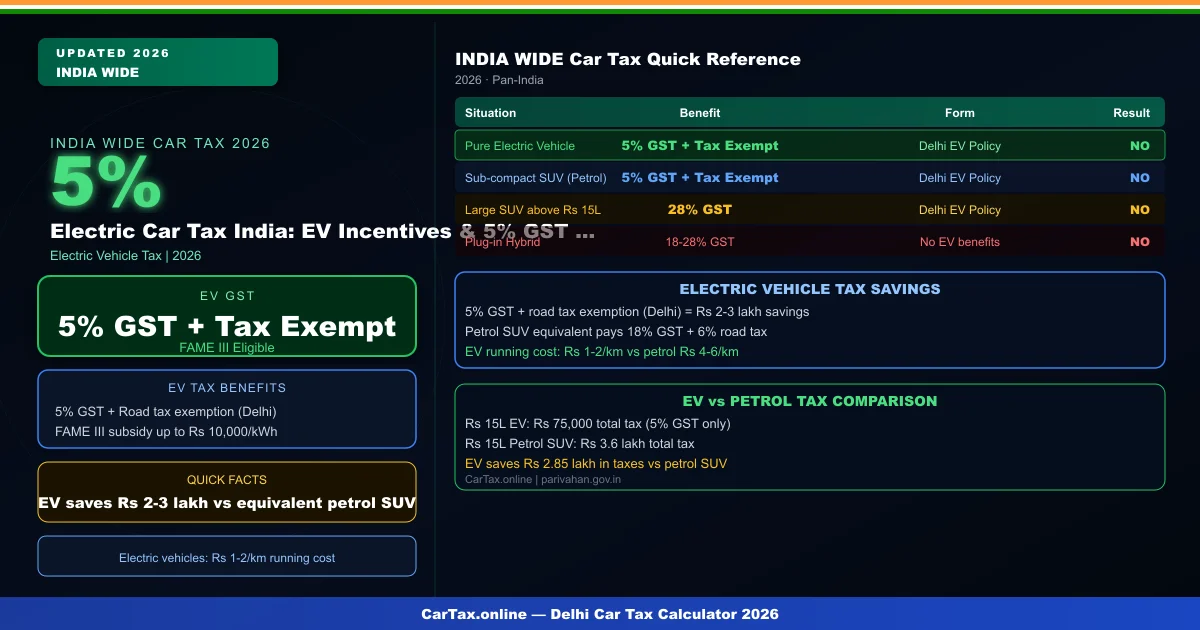
April 12, 2026 in India — Electric car tax in India has never been more attractive. With 5% GST, FAME III subsidies, and state incentives, buying an EV can save you up to Rs 5 lakh or more compared to equivalent petrol/diesel vehicles. This comprehensive guide covers all EV incentives available for car buyers.
India's push toward electric mobility has resulted in one of the world's most attractive incentive structures for EV buyers. The combination of central and state subsidies makes electric cars significantly cheaper than their ICE counterparts.
Electric Car Tax Benefits
1. 5% GST — The Biggest Saver
Electric vehicles attract only 5% GST compared to 18-28% for petrol/diesel cars. For a Rs 15 lakh EV:
- EV GST (5%): Rs 75,000
- Petrol car GST (18%): Rs 2,70,000
- Your savings: Rs 1,95,000 just on GST!
2. Road Tax Exemption
Most Indian states offer complete road tax exemption for EVs:
| State | Road Tax on EV | Savings on Rs 15L EV |
|---|---|---|
| Delhi | 0% | Rs 90,000 |
| Maharashtra | 0% | Rs 2,25,000 |
| Karnataka | 0% | Rs 1,95,000 |
| Tamil Nadu | 0% | Rs 1,80,000 |
| Gujarat | 0% | Rs 30,000 |
| Rajasthan | 0% | Rs 1,35,000 |
3. FAME III Subsidies
The FAME III (Faster Adoption and Manufacturing of EVs) scheme provides direct subsidies:
- Expected subsidy: Up to Rs 10 lakh for premium EVs
- For EVs above 4m length: Higher subsidies
- Linked to PLI scheme compliance: Stringent quality requirements
4. State EV Incentives
| State | Additional Incentive |
|---|---|
| Delhi | Rs 1.5 lakh subsidy |
| Maharashtra | Rs 2.5 lakh subsidy |
| Gujarat | Rs 1.5 lakh + registration waiver |
| Karnataka | Rs 1.5 lakh + priority registration |
| Punjab | Rs 1.5 lakh subsidy |
| Tamil Nadu | Rs 25,000 + road tax waiver |
Popular EV Models and Total Savings
Tata Nexon EV Prime
- Ex-showroom: Rs 14.5 lakh
- GST (5%): Rs 72,500
- Road tax (exempt): Rs 0
- State subsidy (if applicable): Up to Rs 1.5 lakh
- Total savings vs petrol Nexon: Rs 3+ lakh
MG Windsor EV
- Ex-showroom: Rs 15 lakh
- GST (5%): Rs 75,000
- Road tax (exempt): Rs 0
- Total on-road vs petrol SUV: Save Rs 4+ lakh
Hyundai Creta EV
- Ex-showroom: Rs 18 lakh
- GST (5%): Rs 90,000
- Road tax (exempt): Rs 0
- Total savings vs petrol Creta: Rs 5+ lakh
Additional EV Benefits
- Green tax exemption: No green tax for EVs in most states
- Lower running cost: Rs 0.80-1.20 per km vs Rs 3-5 for petrol
- Reduced maintenance: No oil changes, fewer moving parts
- Priority registration: Faster RTO processing in many states
How to Claim EV Incentives
- GST savings: Automatic — dealer applies 5% GST at purchase
- Road tax exemption: Apply at RTO with EV certification
- State subsidy: Apply through state EV portal after purchase
- FAME III: Check official scheme announcements for application process
Frequently Asked Questions
What is the GST rate on electric cars in India?
Electric cars attract only 5% GST in India, compared to 18% for small cars and 28% for large vehicles. This is a significant reduction that makes EVs much more affordable.
Is road tax exemption available for EVs in all states?
Most Indian states offer complete road tax exemption for EVs. However, some states may have limited or conditional exemptions. Check with your state transport department.
What is FAME III subsidy amount?
FAME III subsidies are expected to range from Rs 50,000 to Rs 10 lakh depending on vehicle type, battery capacity, and localization requirements. Official scheme details are awaited after parliamentary approval.
Are EV incentives available for used electric cars?
Incentives like 5% GST and road tax exemption apply to new purchases. Used EV purchases may qualify for some state subsidies but typically not the full FAME benefits.
Conclusion
Electric vehicles offer substantial tax savings through 5% GST, road tax exemptions, and state subsidies. Use our EV tax calculator to see your total savings on any electric vehicle.
Disclaimer: This article is for informational purposes only. Subsidies and incentives are subject to state budgets and government approvals. Verify current schemes before purchasing.
अस्वीकरण: यह लेख केवल सूचनात्मक उद्देश्यों के लिए है। प्रोत्साहन राशि राज्य बजट और सरकारी अनुमोदन के अधीन हैं।
Official Resources: Parivahan Portal | Vahan Road Tax | India GST Portal