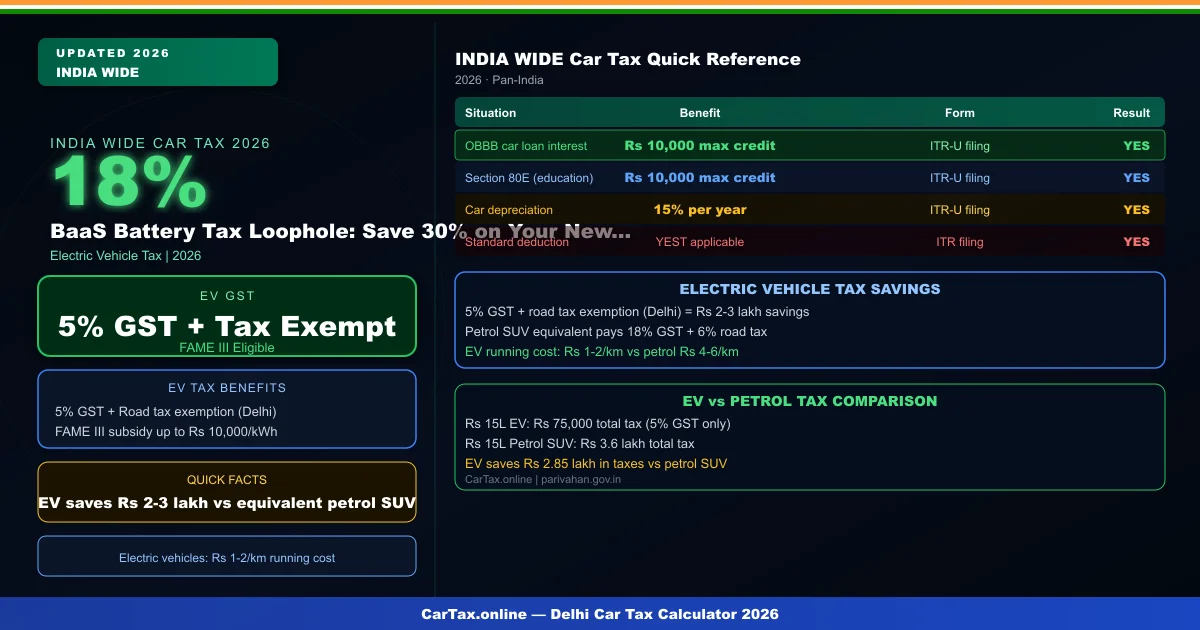
As of April 7, 2026, the most powerful cost-reduction strategy for buying an electric vehicle in India is not a government subsidy or a dealership discount — it is the Battery-as-a-Service (BaaS) model, a purchasing structure that allows buyers to own the vehicle while leasing the battery separately. The result is a dramatically lower base price for GST and road tax calculation, cutting the on-road cost of some popular EVs by 25–35% compared to full ownership. Here is the complete breakdown of how the BaaS tax structure works, which vehicles offer it, and whether it makes financial sense for your situation.
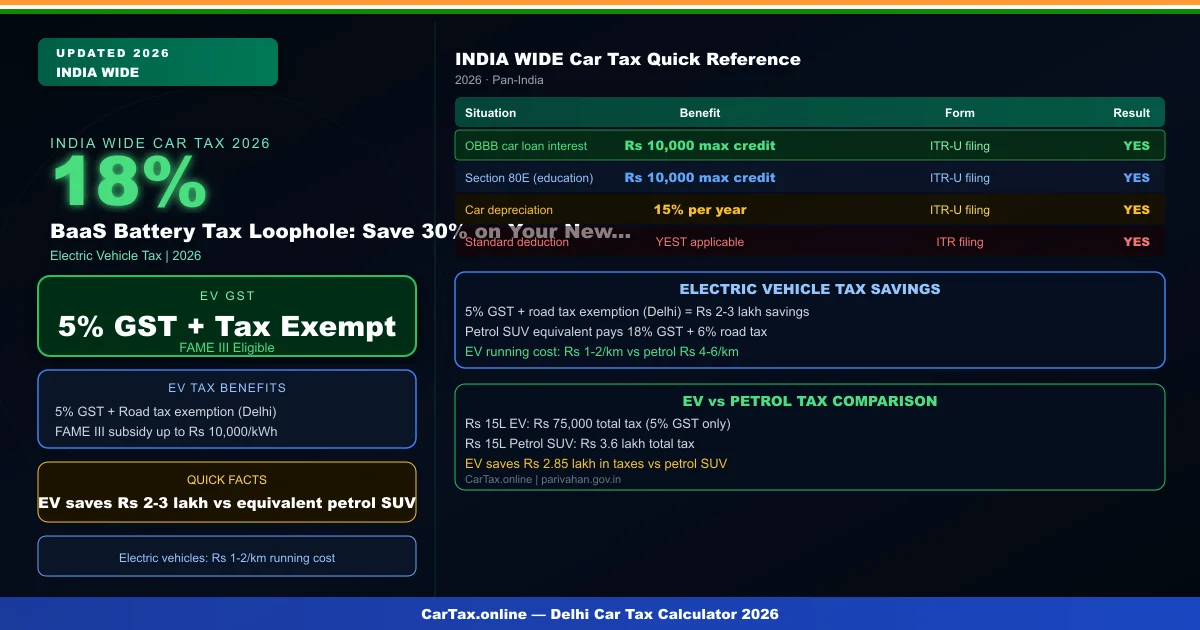
What Is BaaS and Why Does It Cut Your Tax Bill?
In a standard EV purchase, you buy the complete vehicle — car body, electronics, motor, and battery pack — as a single unit. GST at 5% and road tax (9–14% depending on state) are both calculated on the full vehicle price, which includes the battery. The battery typically represents 35–55% of an EV's total cost.
Under the Battery-as-a-Service model, the structure changes entirely:
- You purchase only the vehicle (without battery) — a lower ex-showroom price
- You pay GST (5%) and road tax on this lower battery-excluded price
- The battery is leased from the manufacturer or a third-party battery lessor at a fixed monthly rental
- The battery rental attracts 18% GST (service rate) rather than 5% (EV product rate) — but the base is the rental cost, not the full battery value
The net result: GST and road tax are calculated on a significantly smaller base — typically 45–65% of the full EV price — producing substantial upfront savings on the on-road cost.
The BaaS Tax Math: MG Windsor Example
The MG Windsor EV pioneered the BaaS model in India in 2023 and has refined it through 2026. Here is the current tax comparison for the Windsor EV Excite+ variant in Karnataka:
Full ownership (traditional purchase):
- Ex-showroom price: ₹15,00,000
- GST at 5%: ₹75,000
- Road tax (Karnataka, 13%): ₹1,95,000
- Registration + other fees: ₹18,000
- On-road total: ₹17,88,000
BaaS purchase (vehicle only, battery on rental):
- Vehicle (ex-battery) price: ₹9,90,000
- GST at 5%: ₹49,500
- Road tax (Karnataka, 13%): ₹1,28,700
- Registration + other fees: ₹14,000
- Upfront on-road total: ₹11,82,200
- Monthly battery rental: ₹3,500/month (includes insurance and replacement warranty)
Upfront saving: ₹6,05,800 (34% cheaper on-road)
Over 5 years, battery rental at ₹3,500/month totals ₹2,10,000. Even adding that back, the 5-year total cost of BaaS is ₹3,95,800 less than full ownership if you factor in the lower registration loan and lower insurance IDV.
Top 5 EVs Available on BaaS Model in India 2026
- MG Windsor EV (all variants): Battery rental ₹2,500–₹4,000/month depending on pack. Best established BaaS program in India. Battery includes 8-year warranty and free replacement on capacity fade below 70%.
- Tata Tiago EV (selected dealers): Tata Motors launched a pilot BaaS program in Q1 2026 in 12 cities. Rental ₹1,800–₹2,200/month. Vehicle-only price approximately ₹5.5–6.5 lakh (vs ₹8.69–10.99 lakh full ownership).
- Ola S1 Pro Electric Scooter: Two-wheeler BaaS model — vehicle ₹95,000 + ₹999/month battery rental. Saves ₹35,000–₹40,000 on road tax vs full ownership price in most states.
- Ampere Nexus Electric Scooter: BaaS rental program launched in partnership with Greaves Finance — ₹750/month battery rental, available in 18 cities.
- BYD Atto 3 (pilot, Delhi-NCR): BYD India is piloting a BaaS program for the Atto 3 specifically for corporate fleet buyers. Individual buyers expected to gain access in Q3 2026.
The Hidden Costs: What BaaS Does NOT Save You
The BaaS model has real advantages but also genuine trade-offs that every buyer should understand:
- You never own the battery: If you want to sell the vehicle after 3 years, buyers may be reluctant to take over the battery rental obligation — potentially affecting resale value and liquidity.
- Battery rental is a long-term commitment: Most BaaS contracts run 5–8 years with exit clauses that charge a lump-sum battery buyout fee (typically ₹2–3 lakh) if you want to end the rental early.
- The 18% GST on battery rental: Your monthly battery rental of ₹3,500 includes 18% GST (₹535) — you pay service tax on the rental every month. This partially offsets the upfront GST saving.
- Financing complexity: Some banks are reluctant to finance the vehicle-only price under BaaS because the loan-to-value ratio and hypothecation of a battery-less vehicle is unusual. HDFC Bank and IDFC First have announced BaaS-specific loan products in 2026, but not all lenders are equipped.
🧮 Calculate Your EV's On-Road Price With and Without BaaS
Road tax and registration costs vary significantly by state. See exactly how much BaaS saves in Karnataka, Maharashtra, Delhi, or your state.
Who Should Choose BaaS — and Who Should Not
BaaS makes most sense if you:
- Plan to drive the vehicle for at least 5 years (to amortize setup benefits)
- Prioritize a low upfront on-road cost over minimizing total cost of ownership
- Are in a high road tax state (Karnataka, Kerala, Maharashtra) where the savings are largest
- Are buying for personal daily use — not planning to resell within 2–3 years
BaaS may not suit you if you:
- Plan to sell the vehicle within 3 years — resale value hit from battery rental obligation can wipe out upfront savings
- Live in Delhi — where road tax on EVs is already very low (around 0–2%), making the BaaS tax saving minimal
- Are buying for a taxi or rideshare fleet — the battery rental contracts typically prohibit commercial use
Frequently Asked Questions
What happens to my BaaS battery if the company goes out of business?
This is a legitimate concern. MG Windsor's BaaS program is backed by SAIC (the parent company) and the battery remains your vehicle's operational component. If the BaaS lessor fails, Indian consumer protection law under the Consumer Protection Act 2019 provides recourse, and the CBIC has clarified that the vehicle cannot be repossessed by a battery lessor — only the battery rental agreement is terminated. The government is expected to introduce specific BaaS consumer protection regulations by end-2026.
Is the BaaS model available for home delivery in all cities?
As of April 2026, the MG Windsor BaaS program is available across all MG dealerships nationwide. Tata's BaaS pilot is operational in Bengaluru, Mumbai, Delhi, Chennai, Hyderabad, Pune, Ahmedabad, Kolkata, and 4 other cities. Availability is expanding quarterly.
For the latest BaaS-specific pricing and road tax calculations, use our India on-road price calculator and check official program details at mgmotor.co.in for Windsor BaaS terms.
Frequently Asked Questions
Q: What is the current road tax rate for cars in India 2026?
Road tax rates in India vary by state and vehicle category. For new cars, GST is charged at 5% for EVs, 18% for hybrids under 1,200cc, and up to 28% for petrol/diesel SUVs. State road tax is charged separately and varies from Rs3,000-15,000 annually depending on the state's slab system. Check your specific state's RTO website for current rates.
Q: How do I calculate my car road tax online in India?
You can calculate your car road tax using online calculators available on state RTO portals and CarTax.online. The calculation considers your vehicle's ex-showroom price, fuel type, engine capacity, and state of registration. Road tax is payable annually or for the vehicle's lifetime depending on your state's rules.
Q: Is GST included in the road tax for new cars in India?
No — GST and road tax are separate charges. GST is a central tax charged by the vehicle manufacturer at the time of purchase. State road tax is a separate annual or one-time charge levied by your state's transport department. Both apply at the time of first registration, and annual road tax continues for subsequent years.
Q: Do electric vehicles get tax benefits in India 2026?
Yes — electric vehicles in India qualify for a reduced GST rate of 5% (down from 28% for petrol cars). Under FAME-III subsidies, EVs may also qualify for additional state-level incentives, reduced road tax, and free registration in many states. The exact benefits vary by state.
Q: What happens if I don't pay my car road tax on time?
If you don't pay road tax, your vehicle's registration can be flagged in the Vahan database, preventing renewal of fitness certificates and creating legal liability during police checks. Penalties range from Rs200-500 per day of default in most states. Road tax is a legal requirement under the Motor Vehicles Act.