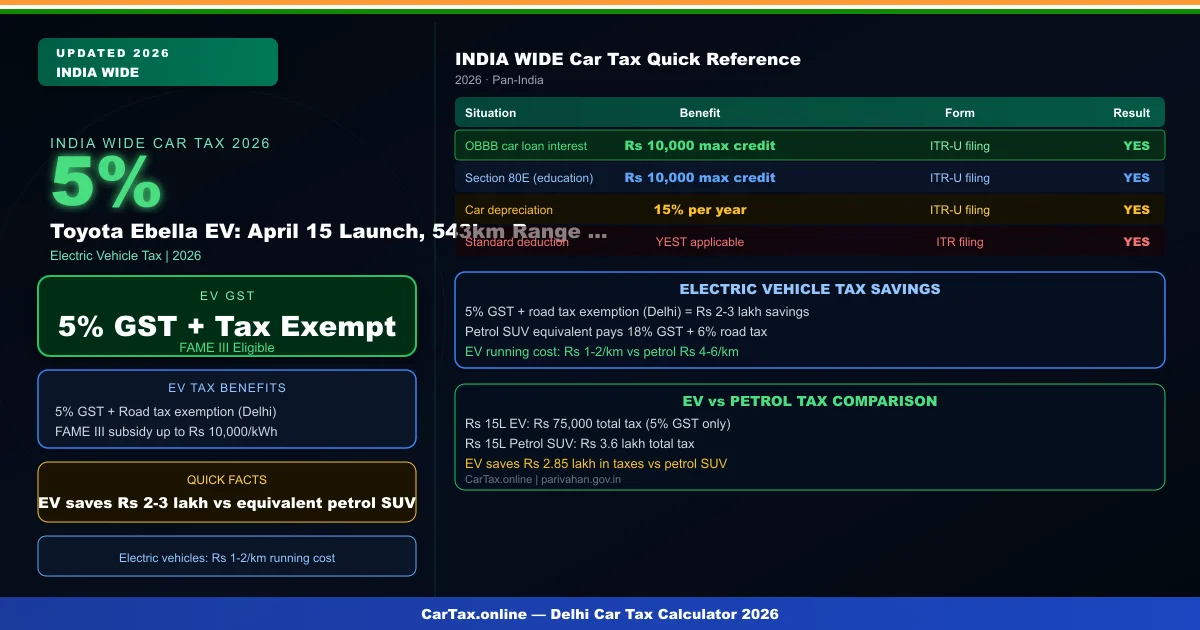
As of April 10, 2026 in India, the countdown to the Toyota Ebella EV launch is just 5 days away — set for April 15, which is also the IRS tax deadline in the US. Toyota India's first homegrown electric SUV has been generating enormous buzz for its unprecedented combination: a 543km WLTP-claimed range, a Battery-as-a-Service (BaaS) business model that could make the upfront price competitive with petrol SUVs, and the all-important 5% GST advantage that makes every EV in India structurally cheaper than its diesel equivalent. Here is the complete pre-launch guide.
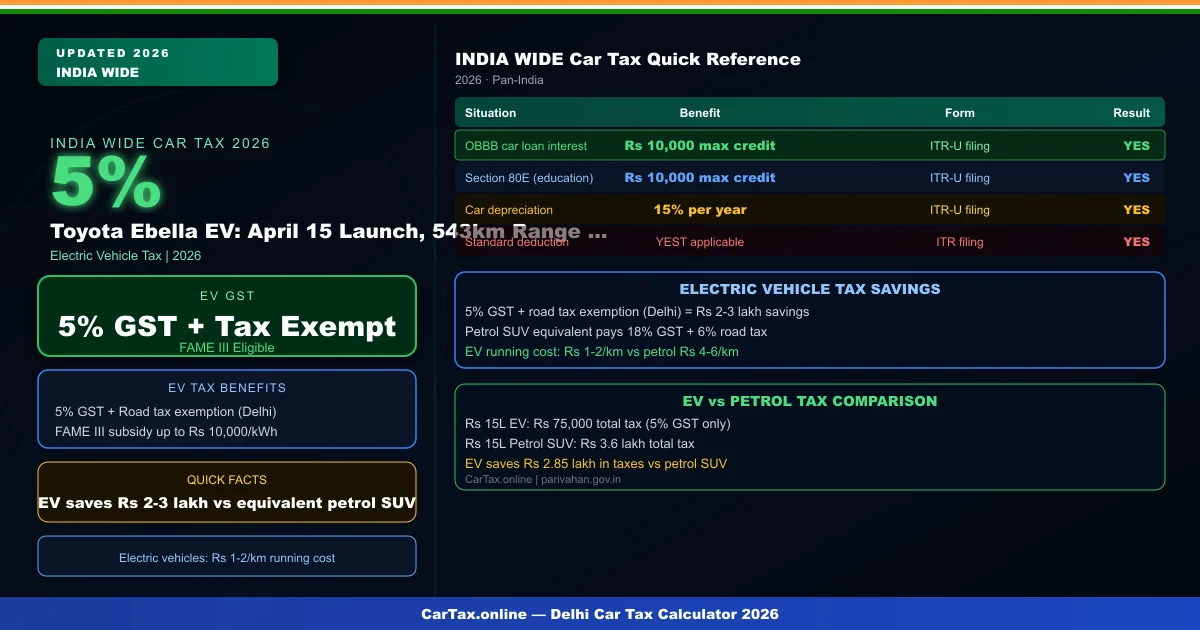
Toyota Ebella EV: What We Know Before the April 15 Launch
The Ebella is Toyota's first made-in-India electric SUV, developed on the BEV-specific e-TNGA architecture (same platform as the bZ4X). Key confirmed specifications ahead of the launch:
- Battery: 72.8 kWh lithium-iron-phosphate (LFP) — longer life cycles, better thermal stability in Indian heat
- Claimed range: 543 km WLTP (real-world estimated: 420–470 km in mixed conditions)
- Motor: Single front-wheel-drive: 201 bhp / AWD dual-motor option: 268 bhp
- Charging: DC fast charge: 0–80% in 28 minutes (150 kW DC) · AC home charging: 7.2 kW
- Length: 4,690 mm — puts it squarely in the mid-size SUV segment against Fortuner and Harrier EV
The 5% GST Advantage — Why This Matters More Than You Think
India's GST structure heavily favours electric vehicles. The Ebella, as an EV, attracts 5% GST. Compare this to its closest diesel competitors:
- Toyota Fortuner 2.8D: 28% GST + 22% cess = 50% total tax rate on base price
- Hyundai Creta diesel 1.5: 28% GST + 17% cess = 45% total tax rate
- Toyota Ebella EV: 5% GST = 5% total tax rate
On a base price of ₹25 lakh, the EV buyer pays ₹1.25 lakh in GST, while a diesel SUV buyer at the same price pays ₹11.25–12.5 lakh in GST and cess. The structural tax advantage alone is ₹10+ lakh per vehicle. This is why Toyota can price the Ebella competitively despite the higher manufacturing cost of the battery pack.
⚡ Toyota Ebella EV vs Diesel SUVs — 5-Year Cost Comparison
| Vehicle | On-Road (Delhi) | Fuel/Charge 5yr | 5yr Total |
|---|---|---|---|
| Toyota Ebella EV (BaaS) | ~₹25–28L | ₹0.9/km × 75k km = ₹67,500 | ~₹27.1L |
| Hyundai Creta diesel 1.5 | ₹21–28L | ₹6.2/km × 75k km = ₹4.65L | ~₹27.6L |
| Toyota Fortuner 2.8 Diesel | ₹44–52L | ₹8.5/km × 75k km = ₹6.37L | ~₹50.4L |
Battery-as-a-Service (BaaS) — How Toyota's Game-Changing Pricing Model Works
The most disruptive aspect of the Ebella launch is the rumoured Battery-as-a-Service (BaaS) pricing option. Under this model:
- You buy only the car body — excluding the battery pack
- The battery is leased separately for a monthly fee (estimated ₹3,500–5,000/month)
- The upfront purchase price drops by ₹10–12 lakh compared to the own-battery model
- When battery technology improves, you can swap to a newer higher-capacity pack
- Toyota covers battery health and guarantees a minimum 80% capacity retention
Under the BaaS model, the Ebella could be priced as low as ₹22–24 lakh (ex-showroom), making it directly competitive with the Hyundai Creta EV (₹17.99–23.49L) and Tata Harrier EV (₹21.49–25.49L).
Is This the Last Nail for Diesel SUVs?
The combination of 543km real-world range, 28-minute fast charging, and sub-₹1/km running cost eliminates the three most common objections to EV ownership in India: range anxiety, charging time, and running cost. The Ebella directly targets the ₹22–35 lakh segment where diesel SUVs currently dominate.
With FAME-III subsidies expected to cover ₹50,000–1,00,000 of the purchase price, state EV policies offering additional ₹1–1.5 lakh in Delhi and Maharashtra, and petrol prices at ₹98/litre in Mumbai — the economic case for the Ebella over a diesel SUV is now overwhelming for buyers covering 12,000+ km per year.
For the latest FAME-III eligibility and EV subsidy details, refer to the official FAME scheme portal at fame2.heavyindustries.gov.in. Use our India Car Tax Calculator to calculate the Ebella EV on-road price in your specific state.
Frequently Asked Questions
What is the expected Toyota Ebella EV price in India?
The BaaS (Battery-as-a-Service) variant is expected to be priced between ₹22–26 lakh (ex-showroom), while the own-battery variant may range from ₹30–36 lakh. Official prices will be announced on April 15, 2026 at the formal launch event.
Does the Toyota Ebella EV qualify for FAME-III subsidy?
Yes — the Ebella EV, being manufactured in India with localised battery components (per FAME-III guidelines), is expected to qualify for the FAME-III subsidy. The exact subsidy amount depends on the battery capacity and ex-showroom price band as notified under the scheme.
How does the Ebella EV compare to the Tata Harrier EV?
The Ebella has a clear range advantage (543km vs Harrier EV's claimed 500km). The Harrier EV starts at ₹21.49 lakh, making it potentially cheaper in the base variant. However, if the Ebella BaaS pricing comes in at ₹22 lakh, the gap narrows significantly. The Ebella also benefits from Toyota's stronger service network in tier-2 and tier-3 cities.
Frequently Asked Questions
Q: What is the current road tax rate for cars in India 2026?
Road tax rates in India vary by state and vehicle category. For new cars, GST is charged at 5% for EVs, 18% for hybrids under 1,200cc, and up to 28% for petrol/diesel SUVs. State road tax is charged separately and varies from Rs3,000-15,000 annually depending on the state's slab system. Check your specific state's RTO website for current rates.
Q: How do I calculate my car road tax online in India?
You can calculate your car road tax using online calculators available on state RTO portals and CarTax.online. The calculation considers your vehicle's ex-showroom price, fuel type, engine capacity, and state of registration. Road tax is payable annually or for the vehicle's lifetime depending on your state's rules.
Q: Is GST included in the road tax for new cars in India?
No — GST and road tax are separate charges. GST is a central tax charged by the vehicle manufacturer at the time of purchase. State road tax is a separate annual or one-time charge levied by your state's transport department. Both apply at the time of first registration, and annual road tax continues for subsequent years.
Q: Do electric vehicles get tax benefits in India 2026?
Yes — electric vehicles in India qualify for a reduced GST rate of 5% (down from 28% for petrol cars). Under FAME-III subsidies, EVs may also qualify for additional state-level incentives, reduced road tax, and free registration in many states. The exact benefits vary by state.
Q: What happens if I don't pay my car road tax on time?
If you don't pay road tax, your vehicle's registration can be flagged in the Vahan database, preventing renewal of fitness certificates and creating legal liability during police checks. Penalties range from Rs200-500 per day of default in most states. Road tax is a legal requirement under the Motor Vehicles Act.