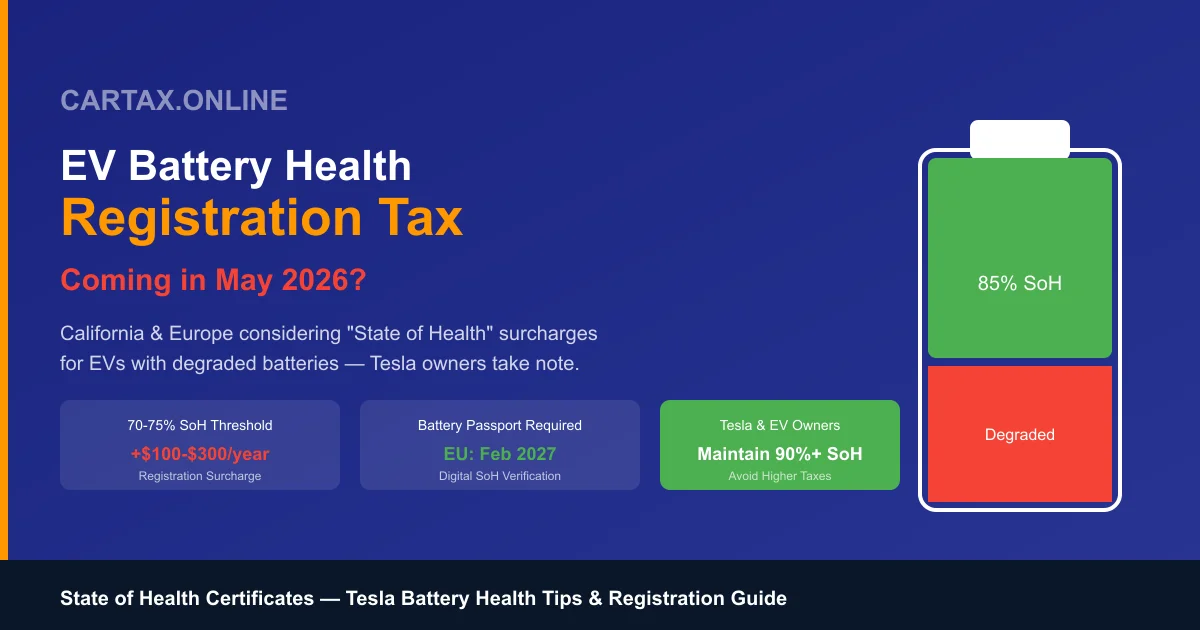
As of April 18, 2026, a new debate is intensifying across the United States and Europe about whether electric vehicle owners should pay registration surcharges based on battery health. Several European countries and US states, including California, are exploring "State of Health" (SoH) based registration taxes that would surcharge older EVs with degraded batteries to fund recycling infrastructure and compensate for declining battery tax contributions.
The proposed system would assess EV batteries at annual registration renewal and apply an additional surcharge for vehicles whose battery capacity has fallen below a certain threshold, typically 70% to 75% of original capacity. While no legislation has been passed as of April 2026, the proposals are gaining serious attention from policymakers concerned about the long-term sustainability of EV fiscal frameworks as the first wave of mass-market EVs ages.
Why Governments Are Considering Battery Health Taxes
Electric vehicles are typically exempt from or pay reduced road tax, fuel tax, and registration fees compared to petrol vehicles, because they do not contribute to fuel excise revenue and are seen as environmentally beneficial. However, as EVs age and their batteries degrade, the environmental rationale for reduced taxation weakens, and governments are seeking ways to ensure these vehicles contribute appropriately to road maintenance and infrastructure funding.
California, which has the highest EV adoption rate in the United States with over 2 million registered electric vehicles, is particularly focused on the sustainability of its EV fee structure. The state currently charges EV owners a $100 annual registration fee in lieu of fuel taxes, but policymakers are exploring a sliding scale based on battery health that could range from $50 for vehicles with 90%+ SoH to $250 for vehicles with less than 70% SoH.
In Europe, France and Germany are both considering similar SoH-based registration surcharges as part of broader revisions to vehicle taxation frameworks. The European Union's battery regulation, which requires all EV batteries to have a digital battery passport by 2027, is creating the technical infrastructure that would enable such a system, making battery health-based taxation technically feasible for the first time.
What Is "State of Health" (SoH) Certification?
State of Health (SoH) certification measures a battery's current capacity relative to its original design capacity. It is expressed as a percentage — a new EV battery typically has 100% SoH, while a battery at 75% SoH has lost a quarter of its original capacity. SoH is determined through diagnostic testing that measures the battery's maximum charge capacity against its rated capacity under standardised conditions.
Battery passports, which the EU is requiring for all batteries over 2kWh capacity from February 2027, will contain the data necessary to verify SoH without dedicated testing. These digital records will track charge cycles, temperature exposure, charging patterns, and other factors that affect battery degradation, providing a verifiable SoH reading accessible to registration authorities, insurance companies, and potential buyers.
How Battery Health Affects Vehicle Value and Taxation
The proposed degradation surcharge adds a new dimension to EV ownership economics. For Tesla owners and others with vehicles approaching the 5 to 8 year mark, battery degradation has already reduced their battery capacity, and the proposed SoH surcharges could add $100 to $300 per year to their vehicle costs. For a vehicle that has already seen significant range reduction from a 90% to 75% SoH, this additional annual cost compounds the financial impact of the degraded battery on resale value.
The combination of registration surcharges for degraded batteries and reduced range means older EVs with poor battery health face a double financial impact: lower resale value in the used market and higher annual operating costs through SoH-based registration fees. This creates a stronger incentive for EV owners to maintain battery health through optimal charging practices and to consider battery replacement as a value-preserving investment.
Tips to Maintain EV Battery Health and Avoid Higher Taxes
Whether or not SoH-based registration surcharges become law, maintaining your EV battery's health is financially beneficial for resale value and longevity. First, avoid consistently charging to 100% unless necessary for long trips, as high states of charge accelerate degradation. Most manufacturers recommend daily charging to 80% for optimal longevity. Second, minimise exposure to extreme temperatures, as both very hot and very cold conditions accelerate battery degradation. Parking in shade in summer and garages in winter helps maintain optimal battery temperature.
Third, use slow AC charging rather than fast DC charging when possible, as the high currents involved in DC fast charging generate more heat and stress the battery chemistry. Fourth, avoid letting the battery consistently discharge to very low levels, as deep discharge cycles accelerate capacity loss. Staying above 20% charge as a regular minimum is better for battery health than regularly draining to near-zero. Fifth, keep your vehicle's battery management system updated, as manufacturers release software updates that optimise charging and thermal management algorithms.
Impact on Used EV Market and Buyer's Decisions
The prospect of battery health-based registration surcharges has implications for the used EV market. Buyers should increasingly factor in battery SoH when evaluating used EVs, as a vehicle with 85% SoH will face lower future registration costs than one with 70% SoH. Battery health reports should become a standard part of used EV evaluations, similar to how service history is evaluated for petrol vehicles.
For those considering a used EV purchase, vehicles with documented battery health above 80% SoH represent the best value proposition, offering reliable range, lower future operating costs, and better resale potential as SoH-based taxation becomes more prevalent. Purchasing an older EV with degraded battery health below 75% SoH may prove to be a false economy as registration surcharges compound over the ownership period.
Frequently Asked Questions
What is the EV battery health tax proposal?
Several US states and European countries are considering registration surcharges based on battery State of Health (SoH). Vehicles with degraded batteries below certain thresholds would pay higher annual registration fees to fund recycling infrastructure and road maintenance, as degraded batteries reduce the environmental justification for EV tax exemptions.
When could the battery health tax come into effect?
As of April 2026, no legislation has been passed. California's proposed system is in the discussion phase with potential implementation in 2027 or later. European proposals are at earlier stages of consultation. Used EV buyers should monitor developments in their state or country but should not factor these costs into current purchase decisions until legislation is confirmed.
What is State of Health (SoH) certification?
State of Health (SoH) measures a battery's current capacity as a percentage of its original design capacity. A battery at 75% SoH has retained 75% of its original capacity and lost 25%. SoH is determined through diagnostic testing and will be verifiable through battery passports required under EU regulations from February 2027.
How can I maintain my EV battery health?
Maintain battery health by charging to 80% daily rather than 100%, avoiding extreme temperatures through shade parking and garage storage, preferring slow AC charging over DC fast charging, keeping charge levels above 20% as a regular minimum, and maintaining updated battery management system software. These practices significantly slow degradation and preserve vehicle value.
Will battery health taxes affect my used EV purchase decision?
Yes, buyers should factor battery SoH into used EV purchase decisions. Vehicles with documented SoH above 80% represent better long-term value as future registration costs will be lower. Always request battery health documentation when evaluating used EVs. For more information about total EV ownership costs including registration and tax implications, use our USA car tax calculator.
Official Resources: IRS Tax Information | IRS Clean Vehicle Credit | Federal Highway Administration | State DMV Links
Frequently Asked Questions
Q: Can I deduct car payments on my taxes in 2026?
You cannot deduct car loan payments directly. However, you can deduct vehicle-related expenses if you use your car for business purposes — either through the standard mileage rate or by tracking actual expenses. The IRS allows Section 179 deductions for certain business vehicles up to their full purchase price.
Q: What is the federal tax credit for electric vehicles 2026?
The IRS Clean Vehicle Credit offers up to $7,500 for new EVs meeting domestic battery content requirements. Used EVs qualify for up to $4,000. Income limits and MSRP caps apply. Not all EVs qualify — check the IRS at irs.gov/cleanvehicle for the current list of eligible models.
Q: How does the IRS mileage rate work for car deductions?
The standard mileage rate for business use is 67 cents per mile for 2026. You can either use this flat rate (which includes depreciation) or track actual expenses including gas, insurance, repairs, and depreciation. The mileage method is simpler; the actual expense method is better for high-mileage drivers with expensive vehicles.
Q: Is sales tax on a car deductible?
Sales tax on a vehicle is not separately deductible if you use the standard deduction. However, if you itemize deductions and use your car for business, the sales tax may be partially included in your business use calculation. The IRS does not allow a direct deduction for sales tax on personal vehicle purchases.
Q: What records do I need for car tax deductions?
Keep a mileage log with date, destination, and business purpose for each trip. Save receipts for gas, insurance, repairs, and registration fees. Maintain your vehicle's purchase documents and depreciation records. The log should be maintained contemporaneously — a reconstructed log at tax time is not acceptable to the IRS.