HMRC treats the private use of a company car as a benefit provided by the employer, valued according to the vehicle's P11D value and its CO2 emissions profile. The value of this benefit is reported on the employee's P11D form and converted to an annual Income Tax charge through the employee's tax code or PAYE calculation.
## Benefit in Kind Tax Rates and Regulations
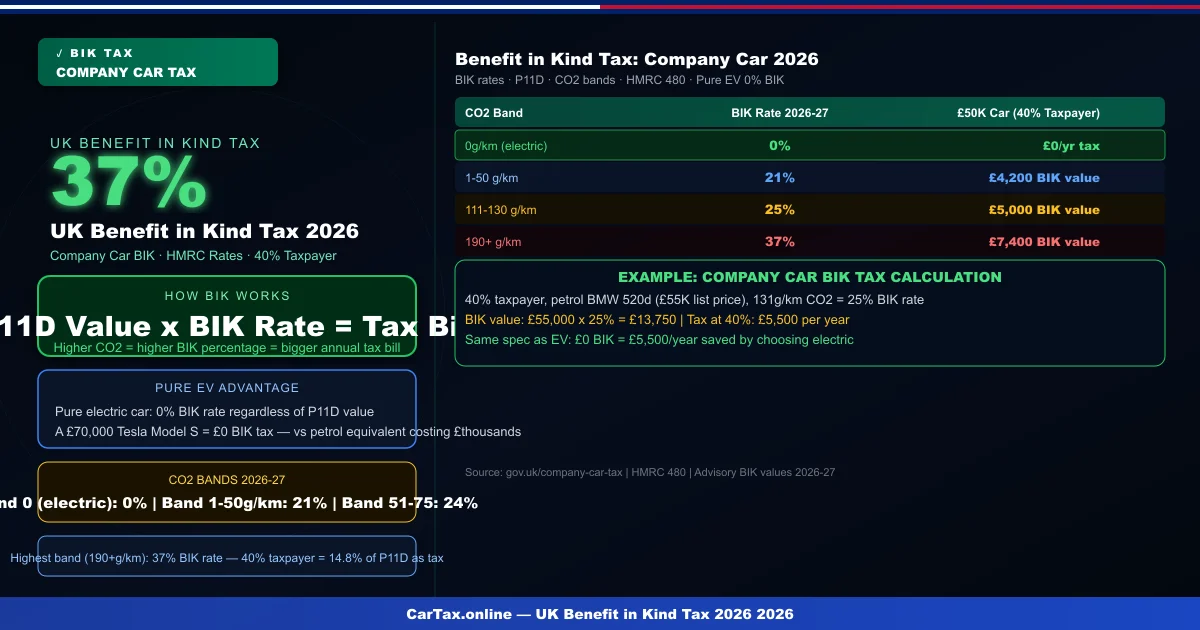
The BIK rate for pure electric vehicles is 0 percent for the 2026-27 tax year, making all electric company cars completely free of BIK tax regardless of their list price. For other vehicles, BIK rates range from 21 percent at 1-50g/km CO2 to 37 percent at over 190g/km CO2.
### How to Calculate Your BIK Tax Bill
The annual BIK Income Tax charge is calculated in three steps. First, establish the vehicle's P11D value from your employer's P11D form. Second, multiply the P11D value by the applicable BIK percentage based on the vehicle's CO2 emissions. Third, multiply this cash equivalent by your marginal Income Tax rate.
For a 40 percent taxpayer provided with a petrol SUV valued at £50,000 and emitting 131g/km CO2 (25 percent BIK rate), the calculation is: £50,000 multiplied by 25 percent equals £12,500, multiplied by 40 percent equals £5,000 annual Income Tax charge. This £5,000 is added to the employee's tax code and collected through monthly PAYE deductions.
### Why Pure Electric Vehicles Dominate BIK Planning
The 0 percent BIK rate for pure electric vehicles makes them the most tax-efficient company car choice available. A 40 percent taxpayer choosing a £70,000 Tesla Model S over an equivalent £70,000 diesel saloon saves the full £5,000 annual BIK tax charge on the diesel alternative, while also enjoying zero VED and reduced fuel costs.
This tax advantage has driven dramatic growth in electric company car provision across UK businesses, with fleet managers reporting that the tax efficiency argument has made EV provision financially compelling even before considering environmental benefits.
### P11D Value and Optional Extras
The P11D value includes all standard equipment and factory-fitted optional extras, delivery charges, and VAT. Employer-fitted accessories added after initial registration may generate their own separate BIK liability based on the accessory value, creating an additional consideration for fleet managers specifying high-specification vehicles.
## Frequently Asked Questions
**Does the BIK rate change if I do low annual mileage in the company car?**
No. The BIK rate is based entirely on the vehicle's CO2 emissions and list price, not on the actual annual mileage or proportion of business to private use. Even a company car driven almost exclusively for business attracts the full BIK charge.
**Can I reduce my BIK by paying something toward the car?**
Capital contributions reduce the P11D value if paid by the employee to the employer before the vehicle is first registered. Regular monthly contributions toward the lease or loan do not reduce the P11D value for BIK purposes.
**How does the BIK system affect salary negotiations?**
Job offers specifying a company car should be evaluated net of the BIK tax liability. A package offering a £55,000 salary with a £40,000 petrol company car at 25 percent BIK may be worth less than a £60,000 salary without a company car for a higher-rate taxpayer.
**What BIK rate applies to plug-in hybrids?**
Plug-in hybrids with CO2 emissions between 1 and 50g/km attract the 21 percent BIK rate, which is substantially lower than the 25-37 percent rates applying to conventional vehicles. However, the 0 percent pure EV rate remains significantly more advantageous.
Disclaimer: CarTax.online provides general information for guidance purposes only. Tax rules and rates are subject to change. Always verify current rates with gov.uk or HMRC before making financial decisions. This guide was last reviewed in 2026.
Frequently Asked Questions
Q: How much is car tax (VED) in the UK 2026?
Car tax rates in the UK depend on your vehicle's CO2 emissions and list price. Standard rates start from £190 per year for petrol and diesel cars, with zero-rated VED for EVs. First-year rates vary from £0 to £2,605 depending on emissions. Additional premiums apply for vehicles over £40,000.
Q: How do I check if my car is taxed online?
You can check your vehicle's tax status for free on the Gov.uk website at gov.uk/check-vehicle-tax. You'll need your vehicle's registration number (number plate). You can also check via the Motor Insurance Database to verify road tax and insurance status simultaneously.
Q: Can I get a refund on car tax if I sell my vehicle?
Yes — if you sell or scrap your vehicle, you can claim a refund on any full months of remaining road tax. Contact DVLA with the V11 reminder letter or apply online at gov.uk. Refunds are usually processed within 4-6 weeks. Related: UK Company Car Benefit 2026 | Big Car Tax Changes Coming to UK 2026 | 5 Clever Ways to Tax My Car Online and Save Money | Check Car Tax and MOT Status UK.
Q: Is road tax refund available when transferring ownership?
No — road tax does not transfer with the vehicle. When you sell your car, the tax is automatically cancelled and any remaining months are refunded to you by DVLA. The new owner must tax the vehicle immediately. As a buyer, always verify the vehicle's tax status before purchasing.
Q: What is the luxury car tax threshold in the UK 2026?
The additional rate for vehicles over £40,000 (list price) adds £410 per year to standard VED rates for years 2-6 of registration. This surcharge brings the annual cost for high-emission vehicles over £40,000 to around £600-690 per year. Pure EVs under £40,000 pay zero VED.
⚠ Financial & Legal Disclaimer
All information provided in this article is for educational and informational purposes only. The content is synthesized based on verbal communications, extensive internet research, and official government website data as of the date of publishing. Tax laws and insurance policies are subject to frequent changes by the authorities. We strive for accuracy, but we recommend that you consult a qualified professional (CA, CPA, or Tax Consultant) before making any financial decisions. For personalized assistance, you can also connect with our in-house experts through our Contact Us page.
Ready to calculate your car tax?
Use our free calculator to get an instant, accurate estimate for your country and state.
Open Car Tax Calculator →