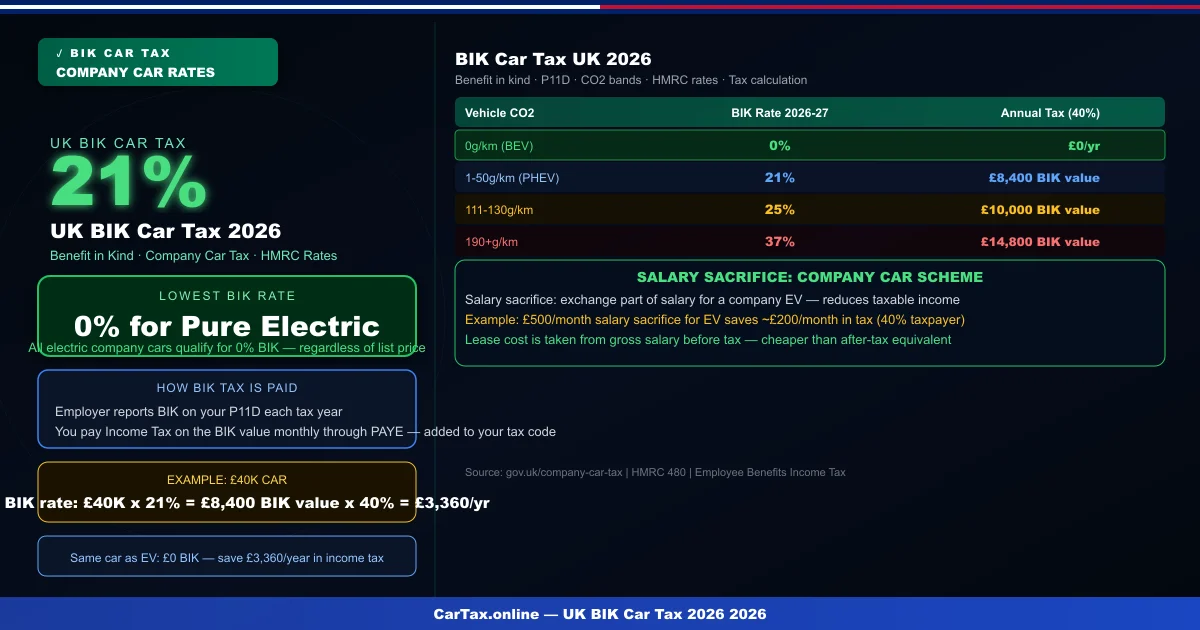
The BIK system was designed to align the tax treatment of company cars with the principle that non-cash benefits provided by employers should be treated as taxable income. The CO2-based banding structure additionally serves as an environmental incentive, encouraging employees and employers to select lower-emission vehicles.
## BIK Car Tax Rates and Regulations
Pure electric vehicles: 0 percent BIK rate. 1-50g/km CO2: 21 percent BIK rate. 51-75g/km: 24 percent. 76-94g/km: 25 percent. 95-99g/km: 26 percent, rising to 37 percent at over 190g/km.
### Company Car BIK Rates by CO2 Band
The BIK percentage increases in 1 percent increments through the CO2 bands, creating strong financial incentives to reduce vehicle emissions. The 0 percent EV rate represents the most dramatic incentive, but even a modest reduction in CO2 emissions can generate meaningful tax savings over the vehicle's three to four year typical company car cycle.
For a 40 percent taxpayer, moving from a 131g/km CO2 vehicle at 25 percent BIK to a 50g/km plug-in hybrid at 21 percent BIK saves approximately £800 annually on a £50,000 vehicle. This differential strengthens every year as the BIK rate gap between bands compounds.
### Impact of the New 2026-27 Tax Thresholds
The introduction of new Income Tax rates and thresholds affects the marginal cost of BIK charges for higher-rate taxpayers. The £5,000 saving from choosing an EV over a 25-percent BIK diesel applies at 40 percent Income Tax, making it equivalent to approximately £20,000 in gross salary before the tax position of the two vehicles would be equivalent.
For basic-rate taxpayers at 20 percent Income Tax, the same vehicle choice saves only £2,500 annually, meaning basic-rate employees should weigh the total remuneration package more carefully when evaluating the company car versus cash allowance decision.
### The P11D Form and Your Tax Code
The P11D form is issued by your employer and must be provided to you by 6 July following the end of the tax year. Your tax office uses the P11D to update your tax code for the following tax year, spreading the BIK charge across the next 12 months through PAYE. If your employment ends before the new tax year, HMRC will assess any outstanding BIK liability through a P800 assessment or self-assessment return.
## Frequently Asked Questions
**Is the BIK charge the same if I only use the company car for business?**
Yes. Even 100 percent business use of a company car attracts the full BIK charge. Only vehicles provided exclusively for business purposes by an employer who is not a connected person for tax purposes can escape BIK liability.
**How does BIK interact with salary sacrifice?**
Salary sacrifice arrangements reduce the BIK by replacing the benefit (and its BIK charge) with a cash salary reduction. For EVs, the salary sacrifice converts the BIK-exempt company car into a tax-efficient benefit while the salary reduction reduces Income Tax and NICs.
**What happens if I return the company car mid-year?**
Your employer must notify HMRC of the change using a revised P11D or payroll submission. The BIK charge will be pro-rated for the period of vehicle provision, and HMRC will adjust your tax code accordingly.
**Does private fuel BIK apply separately from the car BIK?**
Yes. If your employer provides fuel for both business and private use, the fuel BIK is calculated separately using HMRC's fuel-only multiples. The private fuel benefit can be particularly costly, often adding £1,000 to £2,000 annually to the employee's total BIK tax charge.
Disclaimer: CarTax.online provides general information for guidance purposes only. Tax rules and rates are subject to change. Always verify current rates with gov.uk or HMRC before making financial decisions. This guide was last reviewed in 2026.
Frequently Asked Questions
Q: How much is car tax (VED) in the UK 2026?
Car tax rates in the UK depend on your vehicle's CO2 emissions and list price. Standard rates start from £190 per year for petrol and diesel cars, with zero-rated VED for EVs. First-year rates vary from £0 to £2,605 depending on emissions. Additional premiums apply for vehicles over £40,000.
Q: How do I check if my car is taxed online?
You can check your vehicle's tax status for free on the Gov.uk website at gov.uk/check-vehicle-tax. You'll need your vehicle's registration number (number plate). You can also check via the Motor Insurance Database to verify road tax and insurance status simultaneously.
Q: Can I get a refund on car tax if I sell my vehicle?
Yes — if you sell or scrap your vehicle, you can claim a refund on any full months of remaining road tax. Contact DVLA with the V11 reminder letter or apply online at gov.uk. Refunds are usually processed within 4-6 weeks. Related: Big Car Tax Changes Coming to UK 2026 | 5 Clever Ways to Tax My Car Online and Save Money | Check Car Tax and MOT Status UK | Car Tax Renewal UK 2026.
Q: Is road tax refund available when transferring ownership?
No — road tax does not transfer with the vehicle. When you sell your car, the tax is automatically cancelled and any remaining months are refunded to you by DVLA. The new owner must tax the vehicle immediately. As a buyer, always verify the vehicle's tax status before purchasing.
Q: What is the luxury car tax threshold in the UK 2026?
The additional rate for vehicles over £40,000 (list price) adds £410 per year to standard VED rates for years 2-6 of registration. This surcharge brings the annual cost for high-emission vehicles over £40,000 to around £600-690 per year. Pure EVs under £40,000 pay zero VED.
⚠ Financial & Legal Disclaimer
All information provided in this article is for educational and informational purposes only. The content is synthesized based on verbal communications, extensive internet research, and official government website data as of the date of publishing. Tax laws and insurance policies are subject to frequent changes by the authorities. We strive for accuracy, but we recommend that you consult a qualified professional (CA, CPA, or Tax Consultant) before making any financial decisions. For personalized assistance, you can also connect with our in-house experts through our Contact Us page.
Ready to calculate your car tax?
Use our free calculator to get an instant, accurate estimate for your country and state.
Open Car Tax Calculator →