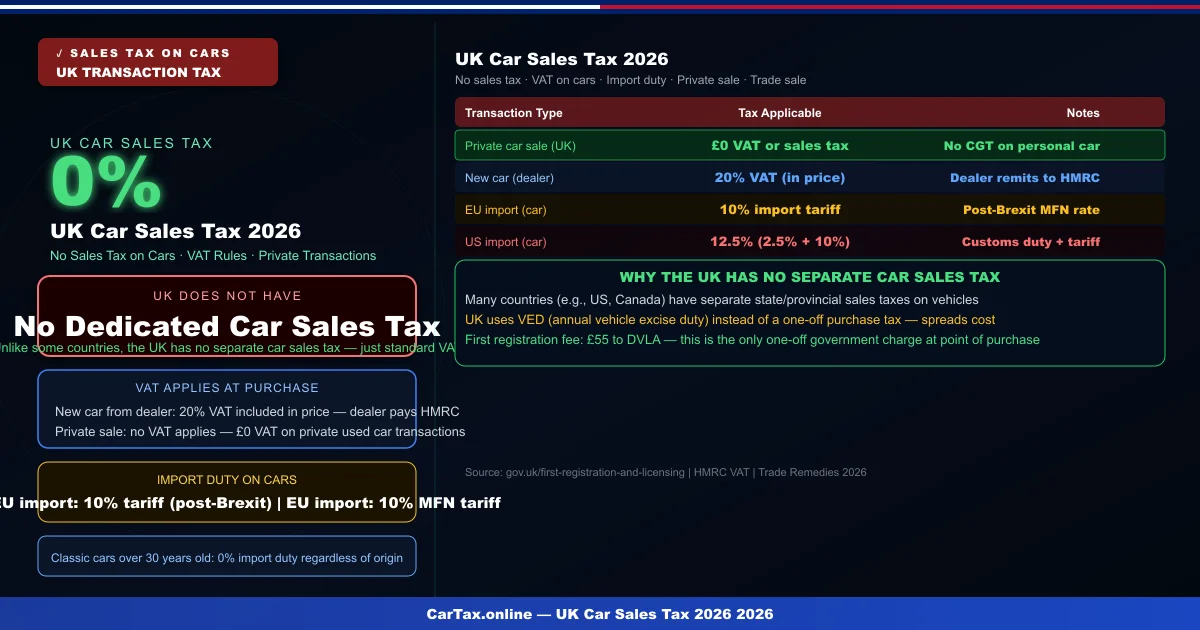
The UK's approach to vehicle taxation relies primarily on recurring annual charges through Vehicle Excise Duty rather than a one-off purchase tax. This system spreads the tax burden over the vehicle's lifetime rather than concentrating it at the point of first purchase, which policymakers argued provides a more equitable approach to vehicle taxation.
## Car Sales Tax Rates and Regulations
New cars purchased from dealers include 20 percent VAT. Private used car sales attract no VAT or sales tax. First registration fee is £55 paid to DVLA on first registration of a new vehicle in the keeper's name.
### Why the UK Has No Separate Car Sales Tax
Several factors contributed to the UK's decision not to introduce a car sales tax equivalent to those operating in other countries. The existing VED system already generated substantial annual revenue from vehicle owners, making the introduction of an additional purchase tax potentially duplicative. The automotive industry's historical lobbying also played a role in resisting new taxes on vehicle transactions.
The absence of a car sales tax means that buyers purchasing from private sellers effectively complete tax-free transactions, while buyers purchasing from dealers bear 20 percent VAT. This creates a pricing differential between dealer and private sales that can amount to thousands of pounds on high-value vehicles.
### Import Duty: The Brexit Change That Acts as a Purchase Tax
The most significant change to vehicle transaction costs following Brexit is the introduction of import tariffs on vehicles arriving from the European Union. Previously, EU vehicles entered the UK duty-free, meaning a buyer could purchase a car in Germany and import it to the UK at no additional customs cost. Post-Brexit, a 10 percent tariff applies to EU vehicle imports.
This tariff functions as a de facto purchase tax for EU vehicle imports, adding thousands of pounds to the cost of vehicles sourced from European dealers. Combined with shipping costs, IVA compliance requirements, and registration fees, EU imports have become significantly less attractive compared to domestically supplied vehicles.
### First Registration Fee: The Only Fixed Purchase Charge
The DVLA first registration fee of £55 is the only mandatory government charge applied at the point of first vehicle registration in the UK. This modest fee covers the administrative cost of establishing the vehicle's registration record and producing the V5C logbook. Unlike many other countries that apply substantial one-off registration fees based on vehicle value, the UK fee is fixed regardless of the vehicle's price.
## Frequently Asked Questions
**Why do new cars cost more in the UK than in Europe?**
New car prices in the UK reflect UK-specific pricing by manufacturers, VAT at 20 percent on the full retail price, higher specification requirements for the UK market, and dealer margin structures that differ from mainland Europe. Brexit-related tariffs on EU imports have further affected competitive dynamics.
**Is VAT charged on private used car sales?**
No. VAT applies only to supplies made by VAT-registered businesses in the course of their business activities. Private individuals are not VAT-registered and cannot charge VAT on private sales, regardless of the sale price.
**Do car dealers have to show prices including VAT?**
Yes. All displayed prices from VAT-registered motor traders must include VAT at 20 percent. Private sellers do not need to display any tax information as no tax applies to their transactions.
**Are classic car sales taxed differently?**
Classic car sales by VAT-registered dealers may qualify for the VAT margin scheme, which taxes only the dealer's profit margin rather than the full sale price, potentially allowing lower effective prices than standard VAT on the full value.
Disclaimer: CarTax.online provides general information for guidance purposes only. Tax rules and rates are subject to change. Always verify current rates with gov.uk or HMRC before making financial decisions. This guide was last reviewed in 2026.
Frequently Asked Questions
Q: How much is car tax (VED) in the UK 2026?
Car tax rates in the UK depend on your vehicle's CO2 emissions and list price. Standard rates start from £190 per year for petrol and diesel cars, with zero-rated VED for EVs. First-year rates vary from £0 to £2,605 depending on emissions. Additional premiums apply for vehicles over £40,000.
Q: How do I check if my car is taxed online?
You can check your vehicle's tax status for free on the Gov.uk website at gov.uk/check-vehicle-tax. You'll need your vehicle's registration number (number plate). You can also check via the Motor Insurance Database to verify road tax and insurance status simultaneously.
Q: Can I get a refund on car tax if I sell my vehicle?
Yes — if you sell or scrap your vehicle, you can claim a refund on any full months of remaining road tax. Contact DVLA with the V11 reminder letter or apply online at gov.uk. Refunds are usually processed within 4-6 weeks. Related: Big Car Tax Changes Coming to UK 2026 | 5 Clever Ways to Tax My Car Online and Save Money | Check Car Tax and MOT Status UK | Car Tax Renewal UK 2026.
Q: Is road tax refund available when transferring ownership?
No — road tax does not transfer with the vehicle. When you sell your car, the tax is automatically cancelled and any remaining months are refunded to you by DVLA. The new owner must tax the vehicle immediately. As a buyer, always verify the vehicle's tax status before purchasing.
Q: What is the luxury car tax threshold in the UK 2026?
The additional rate for vehicles over £40,000 (list price) adds £410 per year to standard VED rates for years 2-6 of registration. This surcharge brings the annual cost for high-emission vehicles over £40,000 to around £600-690 per year. Pure EVs under £40,000 pay zero VED.
⚠ Financial & Legal Disclaimer
All information provided in this article is for educational and informational purposes only. The content is synthesized based on verbal communications, extensive internet research, and official government website data as of the date of publishing. Tax laws and insurance policies are subject to frequent changes by the authorities. We strive for accuracy, but we recommend that you consult a qualified professional (CA, CPA, or Tax Consultant) before making any financial decisions. For personalized assistance, you can also connect with our in-house experts through our Contact Us page.
Ready to calculate your car tax?
Use our free calculator to get an instant, accurate estimate for your country and state.
Open Car Tax Calculator →