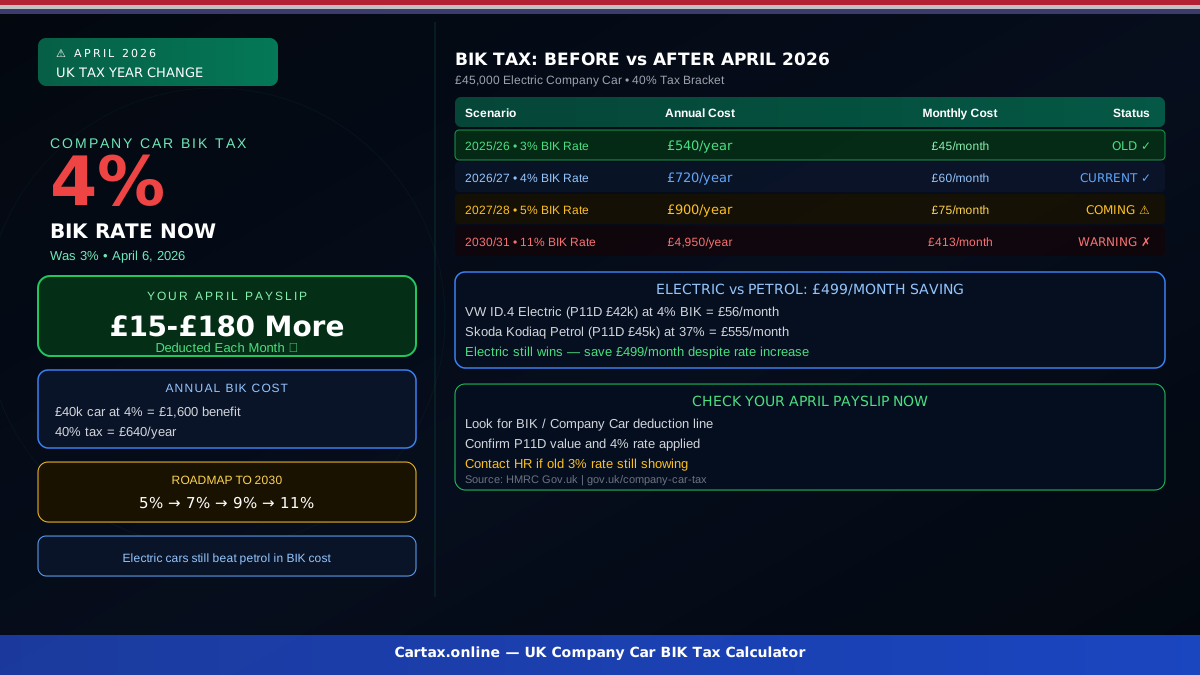
If you drive a company car in the United Kingdom, your April 2026 payslip may have surprised you with a higher deduction than usual. The Benefit-in-Kind (BIK) tax rate for company cars — particularly electric vehicles — increased from 3% to 4% on April 6, 2026, marking the end of a five-year freeze. This change directly impacts anyone who receives a company car as part of their employment package and will affect monthly take-home pay from this point forward.
What Changed on April 6, 2026 — BIK Rate Update
The April 6, 2026 date marks the start of the new tax year 2026/27, and with it comes a significant shift in how company car taxation works. The previous BIK rate of 3% for zero-emission vehicles — which had been frozen since 2020 — has now increased to 4%. This applies to all company cars with emissions of 0g/km, meaning fully electric vehicles provided by employers.
For context, the 3% rate was introduced as an incentive to accelerate electric vehicle adoption. The government now considers the EV market mature enough to begin phasing out this preferential treatment. The gradual increase schedule is clear: 4% in 2026/27, rising to 5% in 2027/28, and eventually reaching 11% by 2030 before converging with petrol and diesel company car rates.
Understanding BIK Tax: The Fundamentals
How BIK Tax Works
Benefit-in-Kind tax is charged on the value of any non-cash benefit you receive through your employment. For company cars, this value is based on the car's list price, known as the P11D value, multiplied by the BIK percentage rate. The resulting figure is added to your taxable income, and you pay income tax on it at your marginal rate.
The key formula is simple: P11D Value × BIK Rate = Taxable Benefit. Your employer reports this to HMRC through the P11D form, and the tax is collected through PAYE.
Why April Payslips Show the Impact
April payslips reflect the change because the new tax year begins on April 6, and payroll systems recalculate tax deductions from this date. If your company car was already in place before April 6, your employer should have adjusted the BIK rate accordingly. If you're getting a new company car delivered in April or after, the 4% rate applies from the delivery date.
Real Numbers: How Much Does the 4% BIK Cost You?
Example 1: £40,000 Electric Company Car
- Car value (P11D): £40,000
- BIK rate: 4% (April 2026 onwards)
- Annual BIK value: £1,600
- Tax at 20% (basic rate): £320/year = £27/month
- Tax at 40% (higher rate): £640/year = £53/month
- Tax at 45% (additional rate): £720/year = £60/month
Example 2: £55,000 Petrol SUV Company Car
- Car value (P11D): £55,000
- BIK rate (petrol, 130g/km): 37%
- Annual BIK value: £20,350
- Tax at 40%: £8,140/year = £678/month
- This is why electric company cars still make financial sense despite the rate increase
The April Payslip Comparison: Before and After
For a £45,000 Electric Company Car Driver
| Tax Year | BIK Rate | Annual BIK Value | Cost at 40% Tax | Monthly Cost |
|---|---|---|---|---|
| 2025/26 (Previous) | 3% | £1,350 | £540 | £45 |
| 2026/27 (Current) | 4% | £1,800 | £720 | £60 |
| Increase per year | +1% | +£450 | +£180 | +£15 |
What's Coming: The BIK Rate Roadmap to 2030
The government has published a clear schedule showing how company car BIK rates will increase over the next four years. Planning ahead is essential for both employees negotiating their packages and employers structuring fleet offerings.
Electric Car BIK Rate Schedule
- April 2025 to April 2026: 3% → 4% (current change)
- April 2027: 5%
- April 2028: 7%
- April 2029: 9%
- April 2030: 11%
- April 2031 onwards: Full standard rate applies (18-37% depending on CO2 emissions)
The trajectory is steep, and employees who locked into three or four-year company car agreements at the 3% rate should review their contracts now. The financial advantage of an electric company car diminishes each year as the BIK rate increases, though it remains significantly cheaper than petrol or diesel alternatives until at least 2030.
Electric vs Petrol Company Car: The Real Comparison in 2026
Why Electric Still Wins Despite 4% Rate
Even with the increase to 4%, electric company cars remain dramatically cheaper in terms of BIK taxation compared to petrol or diesel equivalents. Here's the comparison for two cars of similar size and specification:
- Volkswagen ID.4 (electric, P11D £42,000): BIK at 4% = £1,680/year. Tax at 40% = £672/year or £56/month
- Skoda Kodiaq (petrol, P11D £45,000): BIK at 37% = £16,650/year. Tax at 40% = £6,660/year or £555/month
- Annual saving by choosing electric: £5,988/year (£499/month)
That £499 monthly difference is substantial. For an employee in the 40% tax bracket, the electric company car advantage is still enormous — even after the rate increased to 4%. The key is to choose a car with a lower P11D value to minimize the BIK charge while enjoying the lower rate.
What Should You Do With Your Current Company Car?
If You Have an Existing Electric Company Car
If your electric company car lease is ending in the next 12-18 months, consider renegotiating now. Employers are increasingly aware of the financial impact of rising BIK rates and may be willing to adjust terms. Some key actions:
- Review your current lease agreement end date and negotiate an extension if rates are about to increase significantly
- Discuss with your fleet manager whether switching to a lower-P11D electric model makes sense for both you and the company
- Check if your employer offers a salary sacrifice arrangement for electric cars, which can sometimes be more tax-efficient
If You're Choosing a New Company Car Now
Selecting a new company car in April 2026 requires careful consideration of the P11D value. The lower the car price, the lower your BIK charge. Some strategies:
- Look for electric cars in the £30,000-£40,000 range to minimize the 4% BIK charge
- Consider newer models from brands like MG, BYD, or Vauxhall that offer good electric range at lower price points
- Avoid adding expensive options packages that increase the P11D value above £50,000, which triggers the luxury car supplement
How to Check Your April Payslip for BIK Deduction
On your April 2026 payslip, look for these entries:
- Box/Field: Look for 'BIK' or 'Company Car' or 'Benefit in Kind' line item
- Code: Usually shown as a deduction reducing your net pay
- Amount: Should reflect the new 4% rate calculation
- P11D Reference: Some payslips show the P11D value and rate used
If your payslip shows the old 3% rate after April 6, contact your HR or payroll department immediately. The change should have been applied from the start of the new tax year, and any delay could result in incorrect calculations for subsequent months.
Planning for the Future: BIK Rate Awareness
The key message for all UK company car drivers is awareness of the rising BIK trajectory. With rates increasing every year until 2030, the financial case for electric company cars strengthens with each year of remaining at a lower rate. Even at 11% in 2030, a £35,000 electric car at 11% BIK = £3,850/year benefit (£1,540 at 40% tax) compared to a petrol equivalent at 37% of a £45,000 car = £16,650 benefit (£6,660 at 40% tax).
The April payslip shock is real, but it's the beginning of a longer journey. Employees should review their company car choices annually, calculate the true cost of different fuel types, and make decisions based on both current and projected BIK rates. Your employer's fleet department or a financial advisor can help model the optimal company car choice for your tax situation.