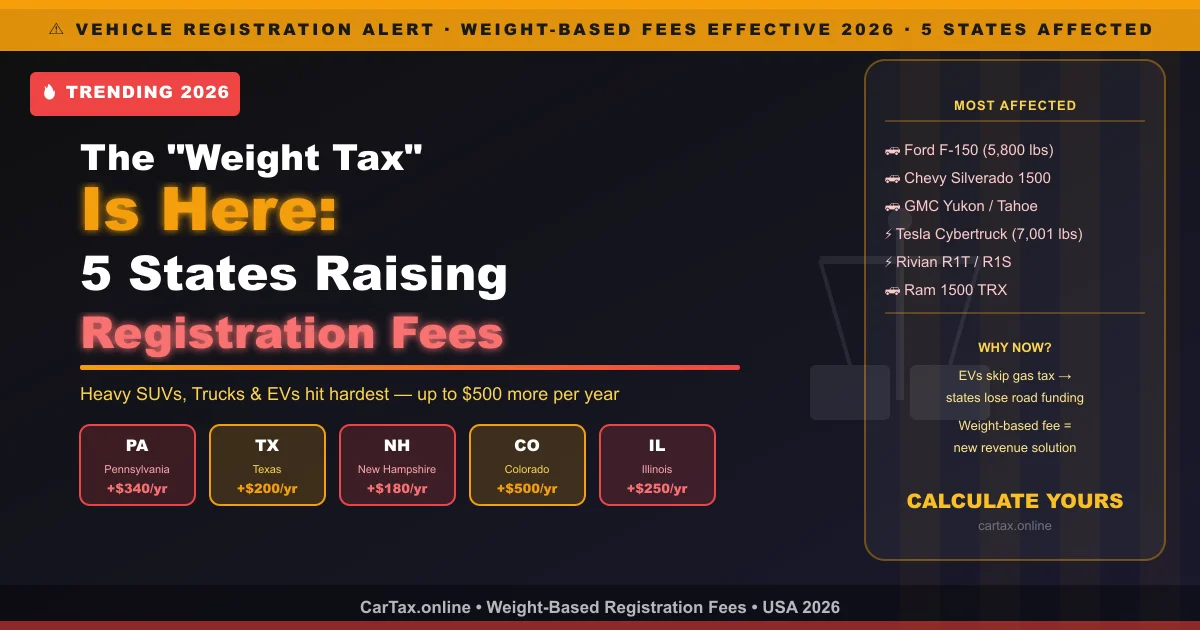
For most of automotive history, vehicle registration fees in the United States were flat or modestly graduated — a simple annual fee of $30–$200 that most drivers barely noticed. That era is ending. Driven by crumbling road infrastructure, exploding EV adoption (which eliminates gas tax revenue), and post-pandemic budget pressures, five states have now adopted weight-based or consumption-indexed registration fee formulas that are sending bills to SUV, truck, and EV owners that are $180 to $500 higher per year than what they paid just 12 months ago.
This is not a future policy proposal — it is happening right now in 2026. If you own a heavy SUV, a pickup truck, or an electric vehicle in Pennsylvania, Texas, New Hampshire, Colorado, or Illinois, here is exactly what you will pay.
Why States Are Moving to Weight-Based Fees
The policy rationale is straightforward and, frankly, hard to argue with from an infrastructure standpoint. Road damage is not linear — it scales roughly with the fourth power of axle weight. A 6,000-pound pickup truck causes approximately 16 times more road wear per mile than a 3,000-pound compact car. Yet both were paying essentially the same flat registration fee.
The second driver is the EV problem. Electric vehicles pay no federal or state gasoline taxes — which fund the Highway Trust Fund and state road maintenance programs. As EVs have grown from a curiosity to 8–10% of new vehicle sales, states are facing a measurable and growing hole in road funding. Weight-based fees serve double duty: they charge heavier vehicles (including heavy EVs like the Rivian R1S at 7,000 lbs or the Tesla Cybertruck at 7,001 lbs) proportionally more, while also recouping some of the lost gas tax revenue from EV owners.
State-by-State: What's Changing in 2026
Pennsylvania — The Most Aggressive Reform
Pennsylvania enacted its Vehicle Registration Modernization Act, replacing the old flat $42 annual fee with a two-factor formula based on vehicle weight and vehicle value (purchase price or current market value):
| Vehicle Weight | Base Fee | Value Surcharge | Total (Example: $45K SUV) |
|---|---|---|---|
| Under 3,000 lbs | $55 | $0.50 per $1,000 of value | ~$77.50 |
| 3,001–4,500 lbs | $95 | $0.80 per $1,000 of value | ~$131 |
| 4,501–6,000 lbs | $175 | $1.20 per $1,000 of value | ~$229 |
| 6,001–8,000 lbs | $280 | $1.80 per $1,000 of value | ~$361 |
| Over 8,000 lbs | $380 | $2.00 per $1,000 of value | ~$470+ |
Most affected vehicles in Pennsylvania: Ford F-150 (4,700–5,800 lbs, ~$50K average) — up from $42 to approximately $235–$320/year. Chevy Tahoe (5,600 lbs, ~$60K) — up to approximately $295/year. Tesla Cybertruck (7,001 lbs, ~$80K) — up to approximately $424/year.
Texas — Weight Threshold Surcharges
Texas implemented a simpler approach: a flat annual surcharge applied to vehicles exceeding specific weight thresholds, on top of the existing base registration fee:
| Vehicle GVWR | Additional Annual Surcharge | Total Fee Increase |
|---|---|---|
| Under 4,000 lbs | $0 (no change) | Base $70.75 unchanged |
| 4,001–6,000 lbs | +$75/year | ~$145.75/year |
| 6,001–8,500 lbs | +$150/year | ~$220.75/year |
| EV surcharge (all weights) | +$200/year | Added on top of weight tier fee |
Texas EV owners note: The $200 EV surcharge applies on top of the weight-tier surcharge. A Tesla Model Y owner (4,555 lbs) in Texas now pays $70.75 + $75 (weight tier) + $200 (EV surcharge) = $345.75/year — up from $70.75 in 2024.
New Hampshire — Inflation-Indexed Registration
New Hampshire took a different approach: rather than a new weight formula, it indexed its existing weight-based registration schedule to the Consumer Price Index (CPI). The state already used weight-based fees, but the schedule had not been updated since 2009. The 2026 indexed update resulted in across-the-board increases of approximately 28–35%:
| Vehicle Weight | Old Annual Fee | New 2026 Fee (CPI-indexed) | Increase |
|---|---|---|---|
| Under 3,000 lbs | $31.20 | $39.90 | +$8.70 |
| 3,001–4,000 lbs | $43.20 | $55.30 | +$12.10 |
| 4,001–5,000 lbs | $55.20 | $70.70 | +$15.50 |
| 5,001–6,000 lbs | $79.20 | $101.40 | +$22.20 |
| 6,001–8,000 lbs | $132.00 | $169.00 | +$37.00 |
| Over 8,000 lbs | $168.00 | $215.00 | +$47.00 |
Colorado — The EV Weight Fee Pioneer
Colorado implemented a Road Usage Charge (RUC) framework specifically targeting EVs and plug-in hybrids, calculated on vehicle weight to approximate the gas tax contribution they would otherwise make. Additionally, Colorado introduced a Vehicle Weight Fee for conventional vehicles above 5,001 lbs:
| Vehicle Category | Annual Fee Change | Rationale |
|---|---|---|
| EV under 5,000 lbs | +$250/year Road Usage Charge | Replaces lost gas tax contribution |
| EV 5,001–8,000 lbs | +$350/year Road Usage Charge | Weight-adjusted RUC |
| EV over 8,000 lbs | +$500/year Road Usage Charge | Maximum tier — Rivian/Cybertruck |
| PHEV (any weight) | +$100/year | Partial gas tax offset |
| Gas/diesel over 5,001 lbs | +$75/year vehicle weight fee | Road wear equity fee |
| Gas/diesel over 8,000 lbs | +$150/year vehicle weight fee | Heavy vehicle surcharge |
Colorado impact examples: Rivian R1S owner (7,000 lbs EV) — new total annual registration: $350+ additional = ~$550/year total. Chevy Tahoe owner (5,600 lbs gas) — +$75 surcharge = ~$200/year total.
Illinois — Heavy Vehicle Registration Surcharge
Illinois added a progressive surcharge to its existing registration fee structure for vehicles at or above the 6,001 lb GVWR threshold:
| Vehicle Weight | 2025 Fee | 2026 Fee | Increase |
|---|---|---|---|
| Under 6,000 lbs | $151/year | $151/year | No change |
| 6,001–8,000 lbs | $151/year | $301/year | +$150/year |
| Over 8,000 lbs | $151/year | $401/year | +$250/year |
| EV (all weights) | $251/year | $401/year | +$150/year |
Which Vehicles Are Hit Hardest Across All 5 States?
| Vehicle | Weight (lbs) | Old Avg Fee | New 2026 Fee Range | Annual Increase |
|---|---|---|---|---|
| Tesla Cybertruck | 7,001 | $70–$150 | $350–$570 | +$280–$500 |
| Rivian R1S | 7,100 | $70–$150 | $350–$570 | +$280–$500 |
| Ford F-150 (Super Crew) | 5,500–5,800 | $42–$100 | $220–$320 | +$150–$280 |
| Chevy Silverado HD | 6,100–6,400 | $42–$100 | $280–$380 | +$200–$340 |
| Chevy Tahoe / GMC Yukon | 5,500–5,800 | $42–$100 | $220–$350 | +$150–$300 |
| Ram 1500 TRX | 6,350 | $42–$100 | $280–$380 | +$200–$340 |
| Tesla Model Y | 4,555 | $70–$150 | $250–$420 | +$150–$300 |
| Honda Civic (compact) | 2,900 | $42–$150 | $55–$170 | +$0–$20 |
| Toyota Camry | 3,350 | $42–$150 | $95–$170 | +$0–$40 |
Is This Legal? Can States Really Do This?
Yes, unambiguously. Vehicle registration is a state function — states have broad authority to set registration fees and structures under their police powers. Federal law does not preempt state registration fee structures. The weight-based approach has actually been used for commercial trucks at the federal and state level for decades — the 2026 reforms simply extend the principle to personal vehicles.
Several legal challenges have been filed in Colorado and Pennsylvania arguing that the EV-specific surcharges discriminate against EV owners in violation of federal clean energy policy. Legal experts rate these challenges as unlikely to succeed, given the broad deference courts extend to state taxing authority over vehicle registration.
How to Calculate Your New Registration Fee
To find your vehicle's exact 2026 registration fee in one of the five affected states:
- Find your vehicle's GVWR: The Gross Vehicle Weight Rating is on a label inside the driver's door jamb. Note that GVWR (maximum loaded weight) differs from curb weight — most states use curb weight for registration fee calculation, but Pennsylvania and Colorado use GVWR. Confirm which your state uses.
- Look up your state's fee schedule: Each state DMV publishes an updated fee schedule. Pennsylvania's is at dmv.pa.gov, Texas at txdmv.gov, New Hampshire at nh.gov/dmv, Colorado at dmv.colorado.gov, and Illinois at cyberdriveillinois.com.
- Factor in EV/PHEV surcharges: If you own an EV or plug-in hybrid, apply the additional surcharge on top of the base weight tier.
- Use our calculator: Our Car Tax Calculator now includes updated 2026 registration fee estimates for all five affected states.
Frequently Asked Questions
Does the weight tax apply to my existing registered vehicle or only new purchases?
In all five states, the new fee structure applies to the annual registration renewal of all eligible vehicles — not just new purchases. If your F-150 is already registered and comes up for renewal in 2026, you will pay the new higher fee. There is no grandfather protection for existing vehicle owners.
Will other states follow with weight-based fees?
Legislative proposals are actively pending in Virginia, Oregon, Minnesota, Michigan, and Georgia. Oregon has operated a voluntary Vehicle Miles Traveled (VMT) pilot for years and is moving toward a mandatory program. The trend is clearly toward usage- and weight-based fees nationally, driven by deteriorating federal Highway Trust Fund solvency.
Is the weight fee deductible on my federal taxes?
Vehicle registration fees are deductible on your federal Schedule A (itemized deductions) only to the extent they are based on the value of the vehicle — not the weight-based portion. Under IRS guidance, the portion of a registration fee based on vehicle weight is not deductible as a personal property tax. This is an important nuance: the value-based component of Pennsylvania's fee (the per-$1,000 of value surcharge) is potentially deductible; the flat weight-tier base fee is not.
If I buy a lighter car to avoid the fee, how much do I save?
Choosing a compact car (under 3,000 lbs) over a full-size truck or SUV (6,000+ lbs) in a high-impact state like Pennsylvania or Colorado can save $250–$500 per year in registration fees alone — on top of lower fuel costs and insurance premiums that also favor lighter vehicles. Over a 5-year ownership period, the total cost-of-ownership difference between a compact and a full-size SUV has grown meaningfully in 2026 due to these combined factors.
Conclusion: The Era of Flat Registration Fees Is Over
The weight-based registration fee movement reflects a broader shift in how states fund infrastructure — away from flat fees and gas taxes toward more closely usage- and weight-correlated charges. For owners of heavy SUVs, trucks, and electric vehicles in the five states leading this change, the financial impact in 2026 is real and immediate.
If you are in the market for a new vehicle and live in Pennsylvania, Texas, New Hampshire, Colorado, or Illinois, the annual registration cost differential is now significant enough to factor into your buying decision. A buyer choosing a 6,500-lb truck over a 4,000-lb crossover in Colorado or Pennsylvania is now committing to an extra $200–$400 per year in registration fees — every year they own the vehicle.
Use our Car Tax Calculator to get the full 2026 on-road cost — including updated state registration fees, sales tax, and any applicable federal credits — for the vehicle you are considering.