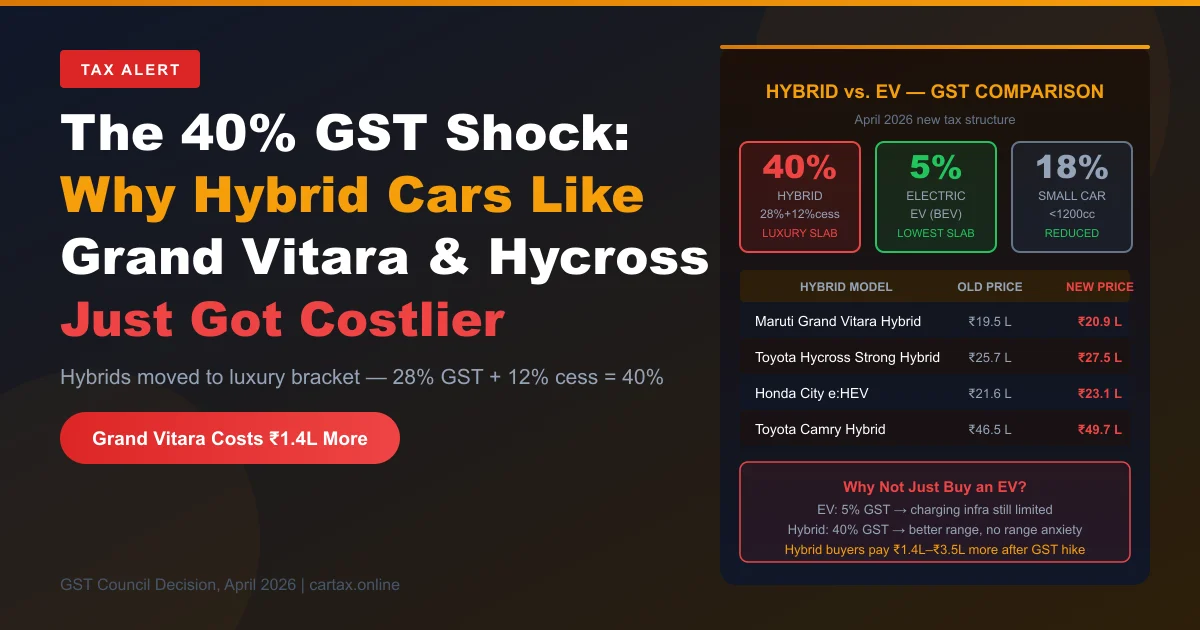
The Union Budget 2026 handed small car buyers a significant gift — a 10-percentage-point GST cut bringing their tax burden down to 18%. But it came with an equal and opposite shock for hybrid car buyers. In a move that caught the automotive industry off guard, the GST Council reclassified strong hybrid vehicles into the luxury slab: 28% GST + 12% compensation cess, totalling an effective tax rate of 40%. That is the same rate applied to large petrol SUVs and luxury sedans.
The Maruti Suzuki Grand Vitara Strong Hybrid, Toyota Hycross Strong Hybrid, Honda City e:HEV, and Toyota Camry Hybrid are the most visible victims. The price increases are not minor — they range from ₹1.4 lakh to ₹3.2 lakh depending on the model. For a buyer who was weighing a hybrid against a full EV or a petrol SUV, the calculus has changed dramatically.
The New GST Structure: Every Fuel Type Compared
| Vehicle Type | Engine / Category | GST Rate | Cess | Effective Tax | Direction in 2026 |
|---|---|---|---|---|---|
| Electric Vehicle (BEV) | Battery electric | 5% | Nil | 5% | Unchanged (best rate) |
| Small Petrol Car | <1200cc, <4m | 18% | Nil | 18% | Reduced (from 28%) |
| Mild Hybrid (MHEV) | Belt-starter, 48V | 28% | 1–3% | 29–31% | Unchanged |
| Strong Hybrid (SHEV) | Toyota THS, Maruti e-Drive | 28% | 12% | 40% | Increased (luxury slab) |
| Plug-in Hybrid (PHEV) | External charging capable | 28% | 12% | 40% | Increased (luxury slab) |
| Large Petrol SUV | >1500cc, >4m | 28% | 22% | 50% | Unchanged |
| CNG Car (<1200cc) | Under-1200cc CNG | 18% | Nil | 18% | Reduced (from 28%) |
The result is a stark tiered structure: EVs at 5%, small cars at 18%, strong hybrids at 40%, and large petrol SUVs at 50%. The government's intent is unmistakable — accelerate EV adoption by making every alternative expensive. Whether that intent makes sense when EV charging infrastructure outside major metros is still patchy is a separate debate.
Model-by-Model: How Much Costlier?
| Model | Hybrid Type | Pre-April 2026 Price | Post-April 2026 Price | Increase |
|---|---|---|---|---|
| Maruti Grand Vitara Strong Hybrid | Strong (e-Drive) | ₹19,49,000 | ₹20,89,000 | +₹1,40,000 |
| Toyota Urban Cruiser Hyryder Strong Hybrid | Strong (THS) | ₹20,20,000 | ₹21,66,000 | +₹1,46,000 |
| Toyota Hycross Strong Hybrid | Strong (THS) | ₹25,69,000 | ₹27,52,000 | +₹1,83,000 |
| Honda City e:HEV | Strong (i-MMD) | ₹21,60,000 | ₹23,14,000 | +₹1,54,000 |
| Toyota Innova Hycross Strong Hybrid | Strong (THS) | ₹28,47,000 | ₹30,50,000 | +₹2,03,000 |
| Toyota Camry Hybrid | Strong (THS) | ₹46,52,000 | ₹49,84,000 | +₹3,32,000 |
| Lexus ES 300h | Strong (THS) | ₹63,90,000 | ₹68,45,000 | +₹4,55,000 |
Toyota takes the hardest hit as a brand — their entire strong hybrid lineup (which is effectively their most advanced technology) is now priced into the luxury bracket. The Innova Hycross, positioned as a premium family MPV for upper-middle-class buyers, crosses ₹30 lakh after the change. The Hycross non-hybrid variant (regular petrol) remains unaffected and is suddenly a significantly better value proposition than it was last month.
The Hybrid Logic That No Longer Works
Before April 2026, the hybrid car purchase argument was relatively clear: you pay a ₹3–5 lakh premium over the petrol variant, but you recover it over 5–7 years through better fuel efficiency. The math was tightest in city driving — exactly the environment where hybrids excel, since they harvest braking energy and run on the electric motor at low speeds.
That math has now been disrupted. With ₹1.4–₹1.8 lakh added to the hybrid's price while the petrol variant's price is unchanged, the payback period extends by 2–3 years depending on driving patterns. On a Grand Vitara, the fuel saving of approximately ₹25,000–₹40,000 per year (assuming 15,000 km, ₹100/litre petrol, hybrid at 19 kmpl vs. petrol at 14 kmpl) now takes 7–10 years to recover the full premium — by which time the vehicle is old and depreciated. The hybrid's advantage has become marginal at best in financial terms.
EV vs. Hybrid: The New Math
| Factor | Strong Hybrid (Post-April 2026) | Full EV (Comparable) |
|---|---|---|
| Purchase price (comparable segment) | ₹20–₹27 lakh (Grand Vitara / Hycross) | ₹15–₹25 lakh (Nexon EV / MG ZS EV) |
| GST rate | 40% | 5% |
| Running cost per km | ₹5.2–₹6.5 (hybrid, petrol) | ₹1.2–₹1.8 (EV, home charging) |
| Charging infrastructure needed | None — standard petrol pumps | Home charger or public EVSE |
| Range anxiety | None | Significant outside metros |
| Maintenance cost | Moderate (dual powertrain) | Low (no engine oil, fewer parts) |
| Resale value (3-year outlook) | Strong (proven technology) | Uncertain (battery depreciation) |
The EV beats the hybrid on purchase price and running cost — but only if you have reliable home charging. For buyers in independent houses or ground-floor flats in metros, an EV is genuinely the better option now. For apartment dwellers without dedicated parking, or buyers in Tier 2 and Tier 3 cities where public charging remains sparse, the hybrid's independence from charging infrastructure still has value — even at the higher post-April price.
Who Should Still Buy a Hybrid in 2026?
Despite the GST hike, there is still a specific buyer profile for whom a hybrid makes sense:
- High-mileage city commuters (20,000+ km/year): The fuel saving is larger and the payback period shrinks. A buyer doing 25,000 km/year in city conditions saves ₹55,000–₹70,000/year on fuel, recovering the premium in 5–6 years.
- Buyers without charging access: If you cannot install a home charger and live far from reliable public charging, the hybrid eliminates range anxiety entirely while still offering substantially better fuel economy than a petrol car.
- Long-distance interstate travelers: EVs lose their advantage on highway driving (efficiency drops, charging stops add time). The hybrid's advantage is less pronounced on highways, but it remains better than petrol and doesn't require detours for charging.
- Buyers who want the Innova Hycross specifically: There is no EV alternative to a 7-seat MPV at this segment. The Hycross strong hybrid, despite the price hike, has no direct EV competitor in India as of April 2026.
The Industry's Response
Toyota India, the company most affected by this change, has publicly stated that it believes the hybrid classification as a luxury item is counterproductive and plans to continue lobbying the GST Council for reclassification. The argument: strong hybrids consume 30–40% less fuel than equivalent petrol cars and produce proportionally fewer emissions — taxing them at the same rate as a large petrol engine is environmentally inconsistent with the government's climate commitments.
Maruti Suzuki, Toyota's joint venture partner on the Grand Vitara and Hyryder platforms, has been more circumspect publicly but is understood to be a party to the same industry representations. Whether the GST Council will reconsider in the next budget cycle is unclear — but given the government's stated EV-first approach, a correction before January 2027 seems unlikely.
Frequently Asked Questions
Does the 40% GST apply to mild hybrids (MHEV) too?
No. Mild hybrids — belt-integrated starter-generators (BISG) and 48V systems that only assist the engine and cannot drive the wheels independently — are classified under a different GST category. They attract 28% GST + 1%–3% cess depending on engine size. The 40% (28% + 12% cess) applies specifically to strong hybrids and plug-in hybrids that have traction motors capable of propelling the vehicle independently, at least at low speeds. Check your specific model's GST classification with your dealer if you're buying a 48V mild hybrid — they have not been moved to the luxury slab.
Is it better to wait for the next GST Council meeting to see if hybrids get reclassified?
The next GST Council meeting is likely in June or July 2026. Historically, once a reclassification into a higher slab happens, reversal in the next meeting is rare — the revenue implications make it politically difficult to undo in the short term. If you need a car before mid-2026, waiting for a possible reclassification that may not come is a risk. If your timeline is flexible and you specifically want a hybrid, waiting 3–4 months to see whether industry lobbying produces a correction is reasonable.
What is the GST on a plug-in hybrid (PHEV)?
Plug-in hybrids are also classified in the luxury slab at 28% + 12% cess (40% total). There are currently no mass-market PHEVs sold in India, but the classification would affect any PHEV launched here. The BMW X1 xDrive25e and similar European PHEVs, if formally launched in India after April 2026, would face 40% GST rather than the 5% applied to pure EVs — a significant pricing disadvantage.
I already ordered a hybrid before April. Am I protected?
If your vehicle was invoiced (delivery invoice issued) before the GST rate change notification date, you pay the old rate. If you merely paid a booking amount before April but the invoice is generated after the change, the new 40% rate applies. This is exactly what happened during previous GST rate changes — check your dealer's invoice date carefully if you booked recently.
Calculate the full on-road cost of any hybrid, EV, or petrol car — including the new April 2026 GST rates — using our India Car Tax Calculator.