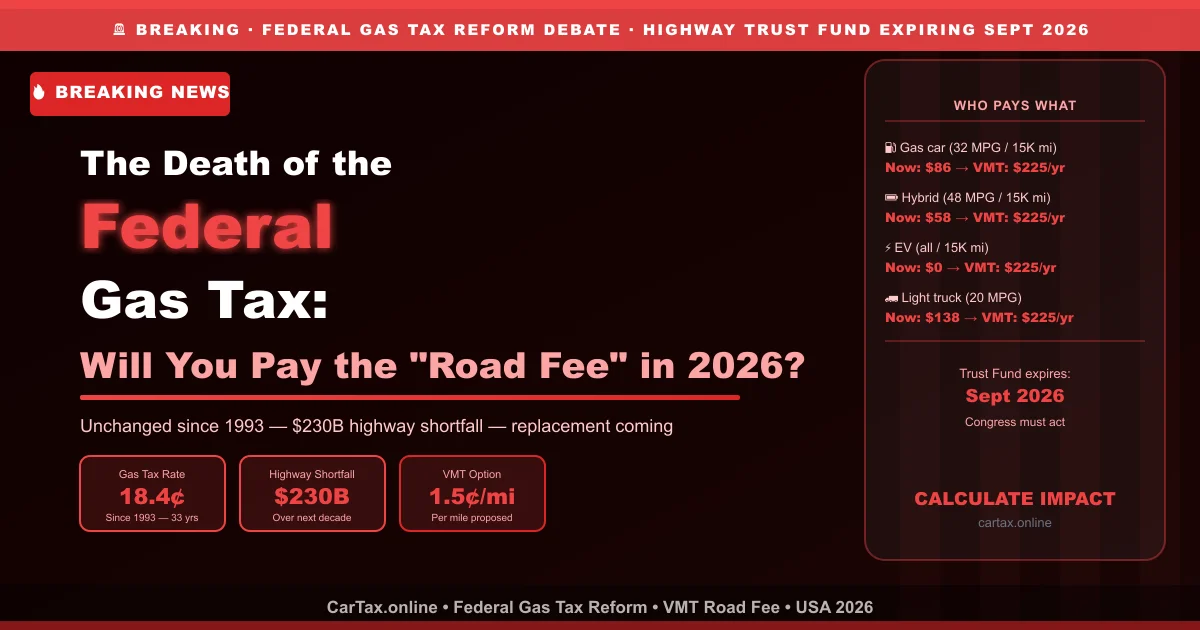
The federal gas tax has not changed since 1993. It sits at 18.4 cents per gallon for gasoline and 24.4 cents per gallon for diesel — rates set during the Clinton administration when the average new car got about 28 miles per gallon and electric vehicles were science fiction. Today, federal gas tax revenue covers less than half of annual federal highway spending, and the gap widens every year as fuel-efficient vehicles — and especially EVs — pay a shrinking share of what it actually costs to maintain the roads they use.
Something is going to give. The question for 2026 is whether Congress acts before the Highway Trust Fund authorization expires, and what replaces the gas tax when it eventually goes. Here is the realistic picture of where this debate stands — and how the outcome will affect what every American driver pays in the coming years.
Why the Federal Gas Tax Is Effectively Dying
The math is not subtle. In 1993, 18.4 cents per gallon was meaningful revenue from a fleet of roughly 200 million registered vehicles averaging about 28 mpg. Today's fleet averages closer to 32 mpg for new vehicles, hybrids routinely exceed 45–50 mpg, and there are now over 4 million registered EVs on U.S. roads paying zero federal fuel tax. The Congressional Budget Office projects the Highway Trust Fund will face a $230 billion shortfall over the next decade without reform.
Meanwhile, infrastructure costs have not stood still. Construction materials, labor, and the sheer volume of deferred maintenance have compounded dramatically. The bipartisan Infrastructure Investment and Jobs Act of 2021 provided significant one-time funding, but it did not fix the structural revenue problem — it delayed it. The Highway Trust Fund authorization runs through September 2026, which creates a hard congressional deadline this year.
Three Replacement Frameworks on the Table
Option 1: Raise the Gas Tax (The Path of Least Technical Resistance)
The American Society of Civil Engineers and multiple transportation advocacy groups have proposed raising the gas tax to 32–37 cents per gallon and indexing it to inflation going forward. This is the simplest technical fix — it requires no new enforcement infrastructure, no privacy trade-offs, and no behavioral tracking. But it faces near-zero political support in the current Congress. Nobody wants to vote for a visible gas tax increase, and Republicans and many Democrats have explicitly ruled it out. The political window for a clean gas tax hike is effectively closed for this legislative cycle.
Option 2: Vehicle Miles Traveled (VMT) Fee
A VMT fee charges drivers per mile driven rather than per gallon consumed. This concept has been piloted in Oregon (the OReGO program), Utah, and California, and has been studied extensively by the Federal Highway Administration. A flat federal VMT fee of 1.5 to 2.5 cents per mile would theoretically replace gas tax revenue while making every vehicle — including EVs — pay proportionally to actual road use.
| Vehicle Type | Annual Miles | Federal Gas Tax Paid Today | Under 1.5¢/mi VMT | Under 2.0¢/mi VMT |
|---|---|---|---|---|
| Gas car (32 MPG) | 15,000 | $86 | $225 | $300 |
| Hybrid (48 MPG) | 15,000 | $58 | $225 | $300 |
| EV (any efficiency) | 15,000 | $0 | $225 | $300 |
| Light truck (20 MPG) | 15,000 | $138 | $225 | $300 |
Notice what a VMT fee does: it raises costs significantly for the most fuel-efficient gas vehicles and hybrids while keeping EV drivers paying the same as everyone else for the first time. That is why EV advocates have been deeply uncomfortable with the proposal — it eliminates one of the implicit financial advantages of owning an electric vehicle.
Option 3: Annual Registration Surcharge by Fuel Type
This is the middle-ground approach — and it is exactly what states have been doing while the federal government debates. Instead of tracking miles, states simply add a flat annual fee at registration time: higher for EVs and hybrids (since they pay less or no gas tax) and lower for standard gas vehicles. As of 2026, 38 states have enacted some form of EV registration surcharge, ranging from $51/year in Colorado to $250/year in Georgia.
| State | EV Annual Surcharge | PHEV Annual Surcharge |
|---|---|---|
| Georgia | $250 | $125 |
| Illinois | $251 | $100 |
| Texas | $200 | $100 |
| Pennsylvania | $290 | $145 |
| Washington | $225 | $112 |
| Florida | $135 | $67 |
| California | $100 + DMV fee | $50 |
| North Carolina | $180 | $90 |
| Ohio | $200 | $100 |
| Colorado | $51 | $25 |
What Congress Is Actually Doing in 2026
Three bills were in various stages of committee review as of Q1 2026:
- The DRIVE Act: Proposes a federal VMT pilot program for commercial vehicles and EVs over 26,000 lbs, while maintaining the gas tax for light vehicles. Not a full replacement — more of a foot in the door for the concept.
- The Highway Revenue Act of 2026: Proposes indexing the gas tax to construction cost inflation (effectively raising it by 4–6 cents without a direct rate-increase vote). Still politically contentious.
- The Transportation User Fee Modernization Act: A flat $180/year federal registration surcharge for all non-commercial vehicles. EVs, hybrids, and gas vehicles would all pay the same amount. The gas tax would be simultaneously reduced to 10 cents per gallon.
The September 2026 Highway Trust Fund authorization expiration is the hard forcing event. Some form of legislation must pass by then or highway funding goes into crisis — something neither party can afford politically before midterm elections.
What This Means for Your Wallet
Honest answer: federal road funding reform will not dramatically change what you pay in 2026. The most likely near-term outcome is a combination of modest measures — a small gas tax increase, inflation indexation, and expanded state-level EV surcharges — rather than a wholesale replacement. But the direction is unmistakable:
- EV owners will face increasing annual registration fees in nearly every state over the next 3–5 years
- Gas vehicle owners face either higher fuel costs (via gas tax increases) or higher annual registration fees
- The era of EV drivers paying essentially nothing to use public roads is over — only the structure of replacement fees remains to be settled
Frequently Asked Questions
If I own an EV, how much more will I pay under a VMT system?
At 1.5 cents per mile and 15,000 miles per year, that's $225 annually — compared to the federal gas tax equivalent a 30 MPG gas car currently pays ($92/year). Many EV advocates argue this is fair; others argue EVs should retain a discount given their environmental benefit. The debate continues, but direction is clear: EV drivers will pay more to use public roads going forward.
When will the federal gas tax actually be replaced?
The September 2026 Highway Trust Fund authorization deadline creates a congressional forcing event — some legislation must pass by then. The most realistic outcome is a temporary patch combined with a pilot VMT program for commercial vehicles, rather than an immediate full replacement of the gas tax for all drivers. A complete transition is more likely a 5–10 year process.
Do VMT programs track where I drive?
This is the biggest public objection to VMT systems. Oregon's OReGO program and similar pilots offer multiple mileage reporting options: plug-in OBD devices, odometer reporting at inspection time, or smartphone apps. Location-based tracking is typically optional, while simpler odometer reporting is the default. Privacy advocates have raised legitimate concerns, and any federal VMT system would face significant political pressure to include privacy protections.
Stay ahead of every vehicle tax and fee change with our Car Tax Calculator — updated as new federal and state rules are enacted throughout 2026.