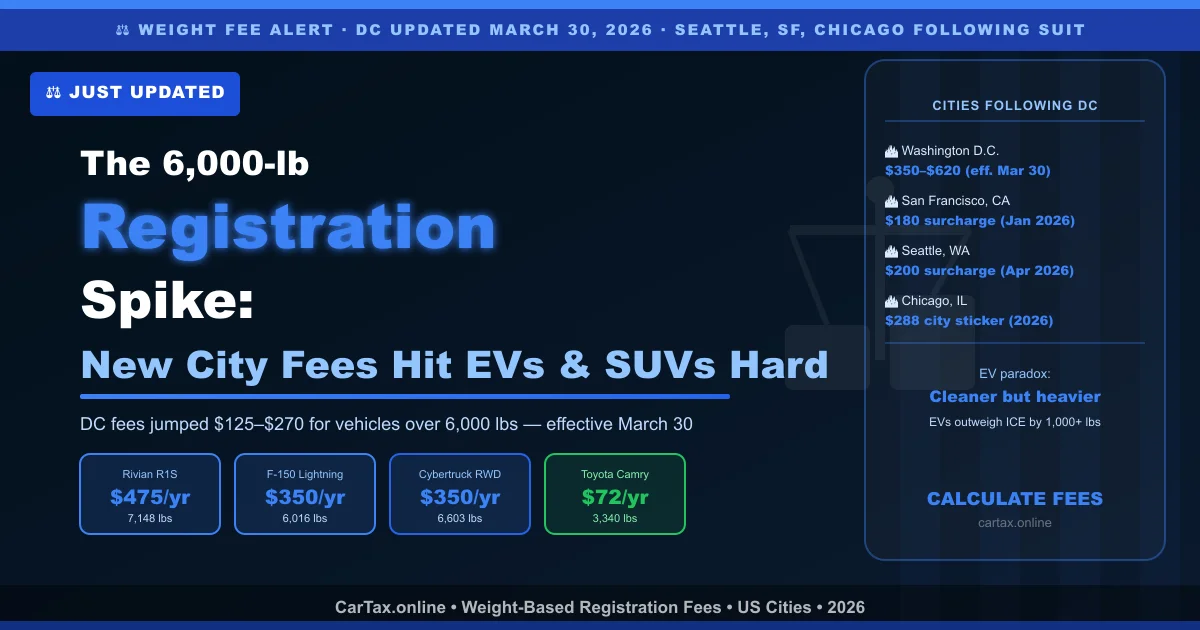
There is a specific number that matters to anyone driving a heavy SUV or an electric vehicle in certain U.S. cities right now: 6,000 pounds. Cross that curb weight threshold, and your annual registration fee in an increasing number of jurisdictions jumps significantly — sometimes by $300 to $500 per year. The idea that a vehicle's weight should determine how much you pay to register it is not new, but the number of jurisdictions adopting or updating weight-based fee schedules has accelerated in 2026, driven by two converging pressures: the growing population of heavy EVs on roads not designed for them, and the revenue vacuum left by declining gas tax receipts.
Washington D.C. just updated its weight-based registration fee schedule effective March 30, 2026. Several other major cities are following. If you own or are considering buying a full-size SUV, a heavy-duty pickup, or an electric vehicle with a large battery pack, here is exactly what the new fee schedules look like and how to calculate what you owe.
Washington D.C.: The Updated 2026 Weight Fee Schedule
The District of Columbia has operated a weight-based registration system for years, but the tiers and rates were last substantially updated in 2019. The March 30, 2026 revision raised rates in the upper weight classes significantly:
| Vehicle Weight | Annual Fee (Pre-March 2026) | Annual Fee (Post-March 30, 2026) | Increase |
|---|---|---|---|
| Under 3,500 lbs | $72 | $72 | No change |
| 3,500–4,999 lbs | $115 | $130 | +$15 |
| 5,000–5,999 lbs | $175 | $210 | +$35 |
| 6,000–6,999 lbs | $225 | $350 | +$125 |
| 7,000–7,999 lbs | $275 | $475 | +$200 |
| 8,000+ lbs | $350 | $620 | +$270 |
The jump at 6,000 lbs is particularly significant: $140 more per year compared to the tier just below it. This is where many full-size SUVs and large EVs land — and the placement is not accidental. The policy intent is to discourage the heaviest vehicles in dense urban areas, where road wear, pedestrian safety concerns, and parking pressure are most acute.
What Popular Vehicles Weigh — And Where They Land in DC
| Vehicle | Curb Weight | DC Fee Tier | Annual DC Fee |
|---|---|---|---|
| Toyota Camry | 3,340 lbs | Under 3,500 | $72 |
| Tesla Model 3 | 3,862 lbs | 3,500–4,999 | $130 |
| Honda CR-V | 3,637 lbs | 3,500–4,999 | $130 |
| Tesla Model Y | 4,416 lbs | 3,500–4,999 | $130 |
| Ford Explorer | 4,516 lbs | 3,500–4,999 | $130 |
| Chevrolet Tahoe | 5,680 lbs | 5,000–5,999 | $210 |
| Cadillac Escalade | 5,803 lbs | 5,000–5,999 | $210 |
| GMC Yukon XL | 5,993 lbs | 5,000–5,999 | $210 |
| Ford F-150 Lightning | 6,016 lbs | 6,000–6,999 | $350 |
| Tesla Cybertruck (RWD) | 6,603 lbs | 6,000–6,999 | $350 |
| RAM 1500 TRX | 6,343 lbs | 6,000–6,999 | $350 |
| Rivian R1S (Standard) | 7,148 lbs | 7,000–7,999 | $475 |
Notice something striking: the Rivian R1S, at 7,148 lbs, pays nearly 7 times the annual registration fee of a Toyota Camry in DC. And the Ford F-150 Lightning — a vehicle heavily marketed on sustainability credentials — pays $350/year, almost 5 times the compact car rate.
Other Cities Updating Weight-Based Fee Schedules in 2026
| Jurisdiction | Effective Date | Fee at 6,000+ lbs | Notes |
|---|---|---|---|
| Washington D.C. | March 30, 2026 | $350–$620/yr | Updated tiered schedule |
| San Francisco, CA | January 1, 2026 | $180 surcharge | City-level fee on top of state registration |
| Seattle, WA | April 1, 2026 | $200 surcharge | City vehicle license fee indexed to weight over 5,500 lbs |
| Chicago, IL | January 1, 2026 | $288 | Updated city sticker fee for heavy vehicles |
| Portland, OR | July 1, 2026 (proposed) | $150 surcharge | Pending city council vote |
The EV Paradox: Cleaner Air, Heavier Roads
Here is the uncomfortable tension that weight-based registration fees expose: electric vehicles are substantially heavier than their gasoline equivalents, because battery packs are dense and heavy. The Ford F-150 Lightning weighs about 1,600 lbs more than a comparable gasoline F-150. The Rivian R1S weighs nearly 1,000 lbs more than a gas-powered Chevrolet Tahoe.
Road damage is proportional to vehicle weight raised to the fourth power — meaning a vehicle that weighs twice as much causes not twice the road damage but sixteen times more. This is established transportation engineering, not politics. An EV may produce zero tailpipe emissions, but it is disproportionately hard on pavement compared to a lighter gas vehicle of similar size.
The policy implication is that weight-based registration fees will continue to expand for EVs — precisely because the same physics that makes road damage weight-dependent also makes EVs heavier than their ICE counterparts. If you are buying an EV, budget for gradually escalating registration costs in urban areas over the vehicle's lifetime.
How to Find Your Vehicle's Weight and Calculate Your Fee
- Check the driver's side door jamb sticker — it typically lists the GVWR and sometimes the curb weight
- Search your vehicle's full name + "curb weight" online — manufacturer spec sheets are widely published
- Use the NHTSA vehicle specs database or your owner's manual
- Once you have the curb weight, look up your city/county registration fee schedule at the relevant DMV website
Frequently Asked Questions
Why are cities targeting heavier vehicles now specifically?
Two converging reasons. First, pavement damage: heavier vehicles cause disproportionate road wear — a well-established engineering reality. Second, revenue: as EVs grow in popularity and pay no fuel tax, cities need alternative revenue sources to fund road maintenance. Weight-based fees solve both problems simultaneously — they discourage the heaviest vehicles and capture revenue from EVs that otherwise contribute nothing to road funding through fuel taxes.
Is my registration fee based on GVWR or curb weight?
It varies by jurisdiction. Washington D.C. uses curb weight (the weight of the vehicle empty, with standard equipment but no passengers or cargo). Some states use GVWR (the maximum weight the vehicle is rated to carry, including payload and passengers). GVWR is always higher than curb weight. If your jurisdiction uses GVWR, your fee tier may be higher than you'd expect from the curb weight alone. Always check your specific jurisdiction's definition before budgeting.
Can I register my vehicle in a different city to avoid the higher fee?
No — legally, you must register your vehicle where it is primarily domiciled. Registering in a different jurisdiction to avoid fees is registration fraud and can result in fines, registration invalidation, and coverage problems with your insurance policy (which is tied to your registration state and address).
Are these fees permanent or might cities roll them back?
Weight-based fees tend to become permanent once enacted, and they tend to increase rather than decrease over time. The underlying revenue pressures — growing EV adoption reducing gas tax income, aging infrastructure requiring expensive repairs — are structural, not temporary. Plan for these fees to increase, not decrease, over your vehicle's ownership period.
Use our Car Tax Calculator to calculate your total first-year and ongoing annual registration and tax costs for any vehicle in your zip code.