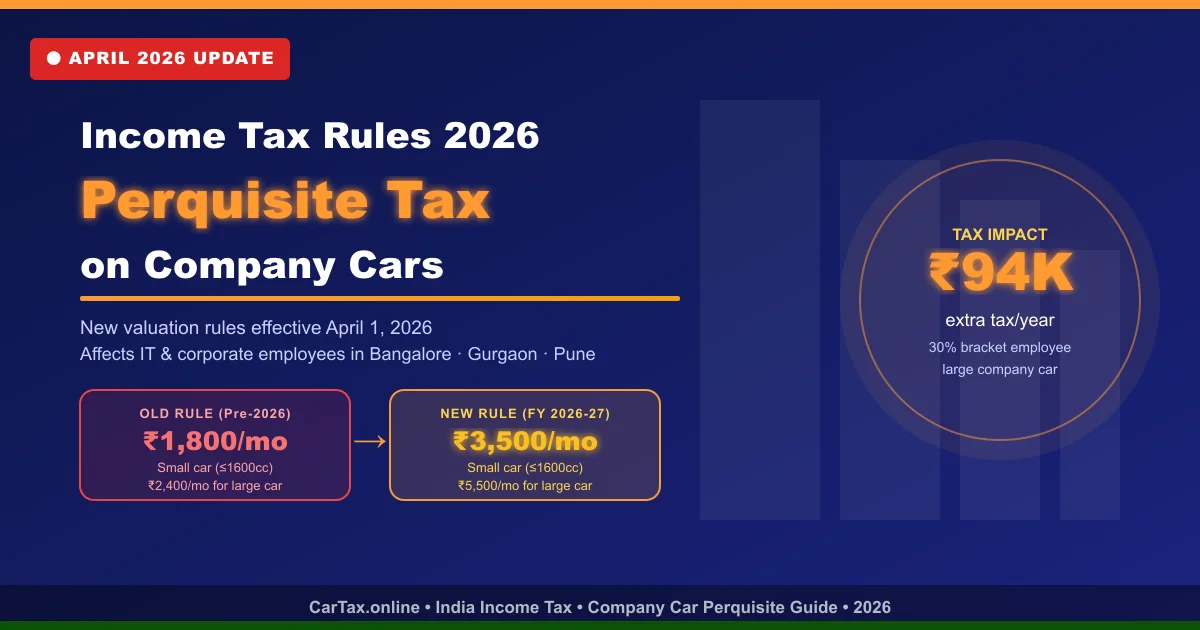
If your employer provides you with a car — or pays for fuel and a driver — your income tax liability just increased from April 1, 2026. The Central Board of Direct Taxes (CBDT) has revised Rule 3 of the Income Tax Rules, 1962, which governs how the monetary value of a company car is calculated as a taxable perquisite.
For IT employees in Bangalore and Hyderabad, corporate managers in Gurgaon, and executives in Mumbai and Pune with company cars, this change affects your take-home salary and Form 16 starting FY 2026-27. Here is everything you need to know.
What Is a Perquisite? A Quick Refresher
Under the Income Tax Act, a perquisite is any benefit or amenity provided by an employer to an employee over and above their basic salary. Company cars are a common perquisite. The "value" of this benefit is added to your taxable income and taxed at your applicable income tax slab rate.
The key question is: how much value is assigned to the company car? That is what Rule 3 answers — and what has now changed.
The Old Rule (Up to March 31, 2026)
Until March 31, 2026, the perquisite value of a company-owned car was a flat monthly amount that had not been revised in over a decade:
| Car Type | Monthly Perquisite Value | With Driver (add) |
|---|---|---|
| Small car (engine ≤ 1,600cc) | ₹1,800/month | +₹900/month |
| Large car (engine > 1,600cc) | ₹2,400/month | +₹900/month |
So an employee with a large company car and a driver was taxed on a perquisite value of only ₹3,300/month (₹39,600/year) — regardless of whether the car was a Toyota Camry or a BMW 5 Series worth ₹60 lakh. This flat rate was widely seen as unrealistically low.
The New Rule: Revised from April 1, 2026 (FY 2026-27)
Under the revised Rule 3, effective April 1, 2026, the flat monthly amounts have been significantly revised upward to better reflect current market realities:
| Car Type | Old Monthly Value | New Monthly Value (FY 2026-27) | Increase |
|---|---|---|---|
| Small car (engine ≤ 1,600cc) | ₹1,800 | ₹3,500 | +₹1,700/mo |
| Large car (engine > 1,600cc) | ₹2,400 | ₹5,500 | +₹3,100/mo |
| Driver provided (add to above) | ₹900 | ₹1,800 | +₹900/mo |
Important: These values apply when the car is owned/leased by the employer and used partly or fully for personal purposes. If the car is used exclusively for official purposes (with proper logbook maintained), it remains fully exempt from tax.
How Much Extra Tax Will You Pay? Calculation Examples
Example 1: IT Employee in Bangalore (30% Tax Bracket, Small Car)
Ravi works at a large IT firm in Bangalore. His employer provides a Maruti Suzuki Ciaz (1,462cc engine) with a driver for both personal and official use.
| Item | Old Rule | New Rule (2026) |
|---|---|---|
| Car perquisite (monthly) | ₹1,800 | ₹3,500 |
| Driver perquisite (monthly) | ₹900 | ₹1,800 |
| Total monthly perquisite | ₹2,700 | ₹5,300 |
| Annual perquisite added to income | ₹32,400 | ₹63,600 |
| Extra annual perquisite | +₹31,200 | |
| Additional tax at 30% + 4% cess | ₹9,734 extra/year | |
Example 2: Senior Manager in Gurgaon (30% Bracket, Large Car + Driver)
Priya is a Senior VP at a financial services firm in Gurgaon. She has a company-provided Toyota Camry (2,487cc) with a full-time driver.
| Item | Old Rule | New Rule (2026) |
|---|---|---|
| Car perquisite (monthly) | ₹2,400 | ₹5,500 |
| Driver perquisite (monthly) | ₹900 | ₹1,800 |
| Total monthly perquisite | ₹3,300 | ₹7,300 |
| Annual perquisite added to income | ₹39,600 | ₹87,600 |
| Extra annual perquisite | +₹48,000 | |
| Additional tax at 30% + 4% cess | ₹14,976 extra/year | |
Example 3: Executive with Luxury Car (BMW 5-Series, 30% Bracket)
Amit is a CXO at a manufacturing company in Pune. His company provides a BMW 530d (2,993cc) with a driver.
| Item | Old Rule | New Rule (2026) |
|---|---|---|
| Car perquisite (monthly) | ₹2,400 | ₹5,500 |
| Driver perquisite (monthly) | ₹900 | ₹1,800 |
| Total monthly perquisite | ₹3,300 | ₹7,300 |
| Annual perquisite value | ₹39,600 | ₹87,600 |
| Additional tax (30% + cess) | ₹14,976 extra/year | |
Note: The flat-rate perquisite system does not differentiate between a ₹15 lakh car and a ₹1 crore car beyond the engine size threshold. Premium car users are actually undertaxed even under the new rates — a separate percentage-of-cost method applies in some interpretations.
What If the Employer Pays for Fuel Too?
If your employer reimburses fuel expenses for personal use, the actual expenditure is added as a perquisite. To avoid this, many companies have employees maintain a logbook segregating official vs personal trips. Only the personal-use fuel cost is taxable.
Under the revised rules, if no logbook is maintained and fuel is fully reimbursed by the employer, the entire actual fuel expenditure is treated as a taxable perquisite — no cap applies.
When Is a Company Car NOT Taxable?
A company-provided car is fully exempt from perquisite tax in these situations:
- Exclusively official use: The car is used only for business travel and a proper logbook (trip register) is maintained. This must be certified by the employer.
- Employee-owned car, employer pays fuel: If the employee owns the car and the employer reimburses fuel for official use only (with trip records), the reimbursement is fully exempt up to actual official-use cost.
- Driver for official duties only: If a driver is provided exclusively for official engagements (with a logbook), the driver's cost is not treated as a perquisite.
Key action: If you use your company car for mostly official travel, start maintaining a detailed logbook immediately. The logbook should record date, destination, km at start, km at end, and purpose of trip. This is your primary defense against the revised perquisite valuation.
How to Report the Perquisite in Your ITR
You do not need to calculate this yourself. Your employer's payroll team is required to:
- Calculate the perquisite value each month and add it to your taxable salary
- Deduct TDS (tax at source) on the enhanced taxable salary
- Report the perquisite in Part B of your Form 16 under "Value of perquisites under Section 17(2)"
When you file your ITR, this value should already be pre-filled from Form 16 in the "Salary" section under "Perquisites." Verify that the amounts match. If you switched jobs mid-year, ensure both employers' Form 16s are included.
Should You Opt Out of the Company Car?
With the revised perquisite values, here is a quick break-even analysis for a 30% bracket employee:
| Scenario | Annual Tax Cost of Car Perquisite | Market Cost of Equivalent Benefit | Verdict |
|---|---|---|---|
| Small car, no driver (30% bracket) | ~₹13,000/year | ₹60,000–₹80,000/year (lease + insurance) | ✅ Keep the company car |
| Large car + driver (30% bracket) | ~₹27,000/year | ₹1,20,000–₹2,00,000/year (lease + driver) | ✅ Keep the company car |
| Luxury car + driver + fuel (30% bracket) | ~₹30,000–₹50,000/year | ₹3,00,000–₹6,00,000/year (ownership cost) | ✅ Strongly keep the company car |
In nearly every scenario, the after-tax cost of the perquisite is far lower than the cost of providing the same benefit yourself. The revised rule increases your tax burden but does not change the fundamental economics — company cars remain a highly tax-efficient benefit even in 2026.
Frequently Asked Questions
What is the perquisite value of a company car for FY 2026-27?
Under the revised Rule 3 effective April 1, 2026: ₹3,500 per month for cars with engine capacity up to 1,600cc, and ₹5,500 per month for cars with engine capacity above 1,600cc. If a driver is also provided, add ₹1,800 per month. These amounts are added to your taxable income and taxed at your slab rate.
Can I avoid paying tax on my company car perquisite?
Yes — if you use the car exclusively for official duties and maintain a certified logbook, the perquisite value is nil. The logbook must be certified by your employer and record every trip's purpose, start/end odometer reading, and destination. Without a logbook, the flat perquisite rates apply regardless of actual personal use.
Does this affect cars taken under a Car Lease Policy (CLP)?
Yes. Cars provided under a company Car Lease Policy where the employer holds the lease are subject to the same perquisite rules. Cars under an employee-owned lease (where the employee takes the car loan and the company reimburses EMI) are treated differently — the EMI reimbursement may be taxable as salary, not as a perquisite under Rule 3.
Is fuel reimbursement for a company car taxable?
If fuel is reimbursed for both personal and official use without a logbook, the full reimbursement is taxable. If a logbook is maintained, only the personal-use fuel portion is taxable. The official-use portion is fully exempt.
Does the rule apply to electric company cars?
Yes, the Rule 3 perquisite valuation applies to all employer-provided vehicles including EVs, subject to the same engine-equivalent capacity classification. However, the cost of charging an EV at official company charging points is generally not treated as a personal perquisite if usage is logged for official purposes.
Conclusion: Act Now Before Your Next Salary Revision
The revised perquisite rules will increase your tax liability by ₹10,000–₹50,000 per year depending on your car type and tax bracket. The good news: the company car is still one of the most tax-efficient benefits available to salaried employees in India even under the new rates.
Immediate actions to take:
- Ask your HR/payroll team to confirm the perquisite amount on your revised April 2026 payslip
- Start maintaining a trip logbook if you don't already — even a few months of records can help
- If your company offers a "car allowance" alternative, compare the after-tax value with the perquisite cost
- Consult your CA or tax advisor if your car is above ₹25 lakh and determine whether the percentage-of-cost method applies to your situation
For the full on-road cost and tax calculation on any car in India, use our India Car Tax Calculator.