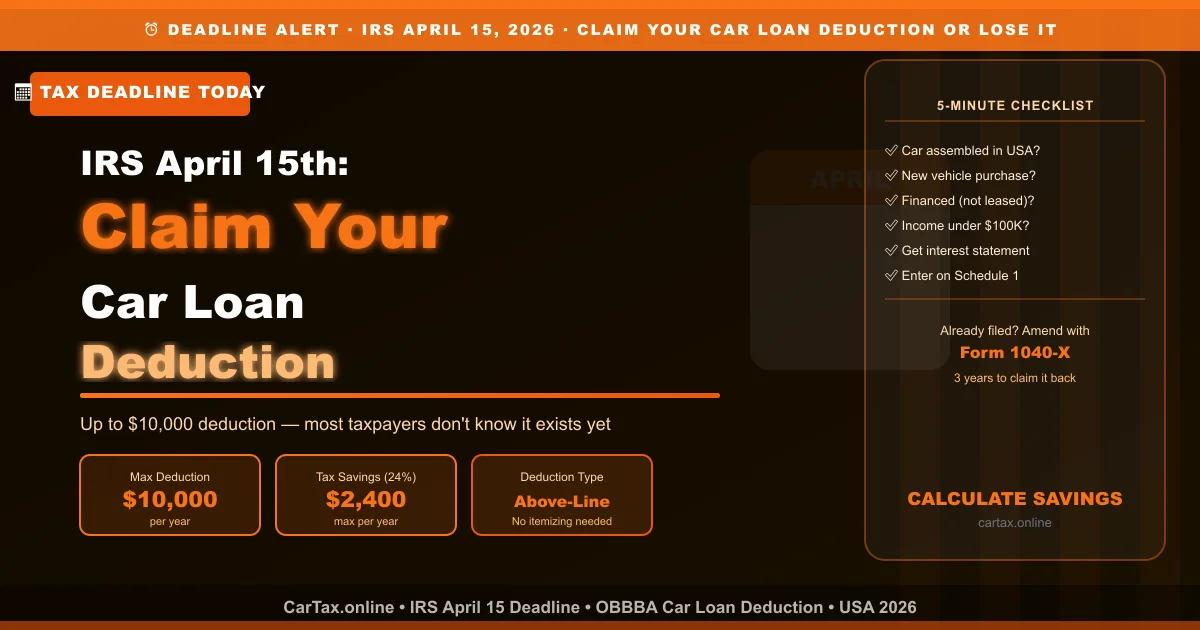
Tax Day is April 15, 2026 — and if you financed a new vehicle in the last 12–18 months, there is a very real chance you are leaving money on the table by not claiming the new auto loan interest deduction introduced by the One Big Beautiful Bill Act. Many taxpayers do not know this deduction exists. Others assume it only applies to business vehicles. Some assume it requires itemizing deductions. None of those things are true.
This is a straight-to-the-point guide for what you need to do today — or, if you have already filed, how to amend your return and recapture the refund before the window closes.
Does Your Vehicle Qualify? A Quick 5-Point Check
Before forms and calculations, the first question is eligibility. The OBBBA auto loan interest deduction requires all five of the following:
- The vehicle must be new — not used or certified pre-owned
- The vehicle must have been purchased after the OBBBA enactment date (vehicles purchased before the law's signing do not qualify for this specific deduction)
- The vehicle's final assembly must have occurred in the United States — verify at vpic.nhtsa.dot.gov or fueleconomy.gov using your VIN
- You must have financed the purchase with a loan secured by the vehicle — leases do not qualify
- Your Modified Adjusted Gross Income (MAGI) must be below $100,000 (single) or $200,000 (married filing jointly) for the full deduction, phasing out at $150,000/$250,000
If all five conditions are met, you're in. If condition 3 is unclear, look up your VIN right now — it takes 30 seconds at the NHTSA vehicle decoder tool.
Step 1: Get Your Annual Interest Statement
Your auto loan lender is required to provide you with a statement showing the total interest you paid during the tax year. It's similar in concept to the mortgage Form 1098 but is not a standardized IRS form for auto loans — it may come as a simple letter, an online account document, or an annual statement PDF.
If you haven't received or located it yet:
- Log into your lender's online portal and download the "Annual Interest Statement" or "Tax Year Summary"
- Call your lender's customer service and ask for the "annual interest paid" figure for the tax year
- For most auto loans, you can also calculate it: add up the interest portion of all 12 monthly payment statements
| Lender | Where to Find Annual Interest Statement |
|---|---|
| Capital One Auto | My Account → Statements → Year-End Interest Statement |
| Chase Auto | Account Activity → Year-End Summary |
| Wells Fargo Auto | Online Banking → Account Details → Tax Documents |
| Credit Unions (most) | Loan portal → Statements → Annual Summary |
| Toyota / Honda / GM Financial | Manufacturer portal → Loan Details → Annual Interest |
| Ally Financial | Ally Auto portal → Statements → Interest Summary |
Step 2: Calculate Your Deductible Amount
The math is straightforward:
- Total auto loan interest paid during the tax year = your deduction amount
- Maximum deduction = $10,000
- If you paid $4,200 in interest → deduct $4,200
- If you paid $12,800 in interest → deduct $10,000 (capped)
If your MAGI falls in the phase-out range, reduce the deductible amount proportionally:
| MAGI (Single) | MAGI (Married Joint) | Deduction Percentage Available |
|---|---|---|
| Under $100,000 | Under $200,000 | 100% — full deduction |
| $110,000 | $210,000 | ~80% of maximum |
| $125,000 | $225,000 | 50% of maximum |
| $140,000 | $240,000 | 20% of maximum |
| $150,000+ | $250,000+ | 0% — fully phased out |
Step 3: Enter the Deduction on Your Return
This is an above-the-line deduction — it reduces your Adjusted Gross Income whether you take the standard deduction or itemize. Most Americans take the standard deduction, and the above-the-line structure means they get the full benefit without itemizing a single other expense.
- Complete the deduction worksheet included in the Schedule 1 instructions for Part II
- Enter the final deductible amount on Schedule 1 (Form 1040), Part II, on the designated auto loan interest deduction line
- The Schedule 1 total feeds into Form 1040 (line 10), reducing your AGI
Using tax software? TurboTax, H&R Block, FreeTaxUSA, and TaxAct all include this field for OBBBA-qualifying vehicles in their 2025/2026 versions. Look for the question about "auto loan interest" in the deductions or adjustments section of the interview flow.
Already Filed? You Can Still Get the Money
If you filed before realizing you could claim this deduction, you have three years from the original filing date to amend and claim it. File Form 1040-X (Amended U.S. Individual Income Tax Return) with a corrected Schedule 1. If you paid $6,000+ in interest and you're in the 24%+ bracket, the refund from an amended return easily exceeds $1,000 — well worth the 20-minute effort.
Need More Time? File an Extension Today
File Form 4868 by April 15 for an automatic 6-month extension to October 15, 2026. The extension gives you more time to file — not more time to pay any tax owed. If you owe additional tax, estimate and pay it by April 15 to avoid interest and penalties. The extension itself does not affect your ability to claim the auto loan interest deduction — you can still claim it on the extended return.
Frequently Asked Questions
Do I need to attach documentation proving my vehicle is U.S.-assembled?
You do not need to attach documentation to the return, but keep the VIN assembly documentation in your records for at least three years in case of audit. Print or save the NHTSA or fueleconomy.gov page showing your VIN's final assembly location. It takes 30 seconds and protects you completely if you're ever asked to substantiate the claim.
My loan started partway through the year. Do I pro-rate?
No pro-rating is required. You deduct the actual interest paid during the tax year — whatever that amount was, from the first payment after loan origination through December 31. If you bought in September 2025 and paid four months of interest totaling $1,400, that $1,400 is your deduction for Tax Year 2025.
Can I claim this if my vehicle is also used for business?
If you use the vehicle exclusively for business and deduct it as a business expense on Schedule C, claim the interest as a business expense rather than the OBBBA personal deduction — you cannot double-dip on the same interest. If the vehicle is used for both personal and business purposes, allocate the interest proportionally: business portion on Schedule C, personal portion as the OBBBA deduction.
What if my car was assembled partly in the U.S. and partly abroad?
The law requires final assembly to occur in the United States. If the NHTSA VIN decoder shows "United States" as the country of final assembly, the vehicle qualifies — regardless of where individual components originated. If the final assembly location is outside the U.S. — even Canada or Mexico — the vehicle does not qualify for this specific deduction.
Calculate your exact deduction amount — and see what you'd save on a new vehicle purchase — using our Car Tax Calculator.