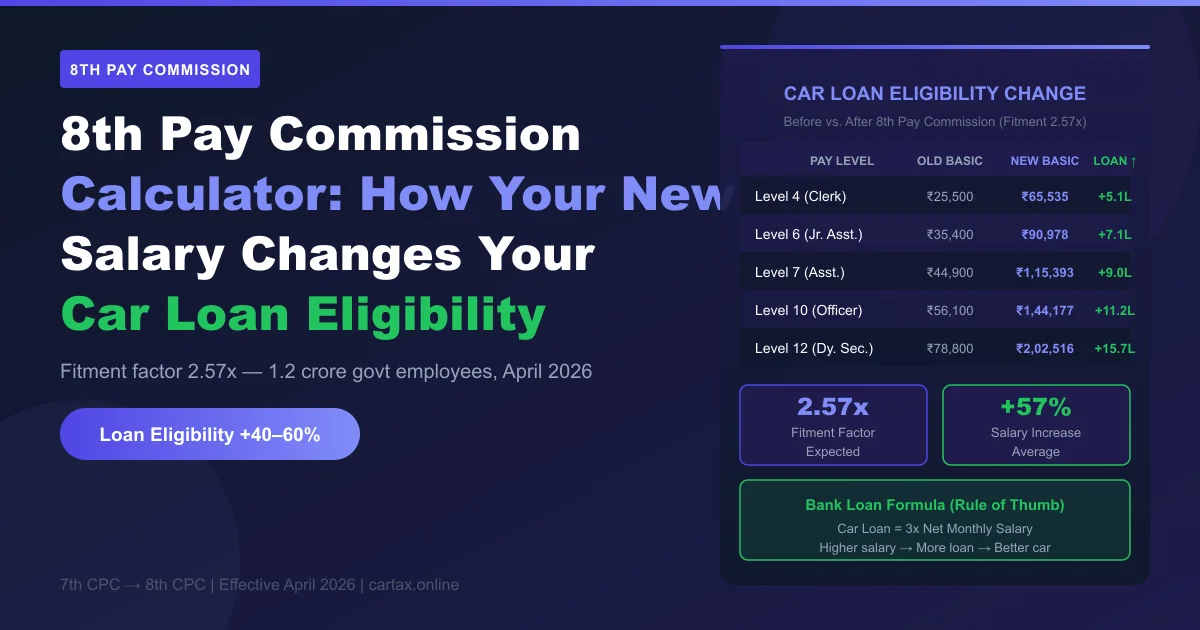
With stakeholder feedback for the 8th Pay Commission due by April 10, 2026, India's 1.2 crore central government employees are running a very specific mental calculation right now: how much will my salary actually go up, and what car can I finally afford? The answer depends almost entirely on one number — the fitment factor. And if early indications hold, the fitment factor of 2.57x (recommended by employee federations) would be the largest salary revision in Central Government history. More importantly for this conversation, it would change car loan eligibility at virtually every pay level by ₹5 to ₹20 lakh.
This is a practical guide. It walks through the expected salary changes level by level, shows you how banks calculate car loan eligibility, and maps the result to actual cars you can afford after the revision takes effect.
What Is the Fitment Factor and When Does It Apply?
The fitment factor is the multiplier applied to your current basic pay to determine your starting basic pay under the new pay commission. The 7th Pay Commission used a fitment factor of 2.57x, which raised the minimum basic pay from ₹7,000 (6th CPC) to ₹18,000 (7th CPC).
For the 8th Pay Commission:
- Employee federations are recommending a fitment factor of 2.57x–3.0x
- Historical precedent suggests the final factor will be in the 2.57x–2.86x range
- This guide uses 2.57x as the base case — conservative and most discussed
- Expected implementation: January 1, 2026, with arrears payable retroactively
- Actual salary revisions typically reach employees 6–18 months after implementation
Level-by-Level Salary Comparison: 7th vs. 8th Pay Commission
| Pay Level | Typical Role | Current Basic Pay (7th CPC) | Expected Basic Pay (8th CPC, 2.57x) | Gross Monthly (est.) |
|---|---|---|---|---|
| Level 1 | Multi-Tasking Staff | ₹18,000 | ₹46,260 | ₹60,000–₹70,000 |
| Level 2 | Lower Division Clerk | ₹19,900 | ₹51,143 | ₹66,000–₹78,000 |
| Level 4 | Upper Division Clerk | ₹25,500 | ₹65,535 | ₹85,000–₹1,00,000 |
| Level 5 | Senior Clerk / Steno | ₹29,200 | ₹75,044 | ₹97,000–₹1,15,000 |
| Level 6 | Junior Assistant / SSC CGL | ₹35,400 | ₹90,978 | ₹1,18,000–₹1,38,000 |
| Level 7 | Section Officer / Assistant | ₹44,900 | ₹1,15,393 | ₹1,50,000–₹1,75,000 |
| Level 10 | Gazetted Officer / Dy. Collector | ₹56,100 | ₹1,44,177 | ₹1,87,000–₹2,20,000 |
| Level 11 | Deputy Secretary | ₹67,700 | ₹1,73,989 | ₹2,26,000–₹2,65,000 |
| Level 12 | Director / Additional Secretary | ₹78,800 | ₹2,02,516 | ₹2,63,000–₹3,08,000 |
| Level 13 | Joint Secretary | ₹1,23,100 | ₹3,16,367 | ₹4,11,000+ |
Gross monthly estimate includes basic pay, DA (expected ~60% post revision), HRA (varies by city), and TA. Does not include perquisites or variable pay. Actual take-home after deductions (NPS, income tax) will be lower.
How Banks Actually Calculate Car Loan Eligibility
Banks do not simply look at your gross salary. They use a standardized formula based on net take-home after mandatory deductions. Here is how most public sector banks (SBI, PNB, Bank of Baroda) and major private banks calculate car loan eligibility for salaried government employees:
- Net Monthly Income (NMI): Gross salary minus income tax deductions, NPS/GPF contribution, loan EMIs, and other statutory cuts
- EMI-to-Income Ratio: Banks typically allow the total EMI burden (all loans combined) to not exceed 50%–55% of NMI
- Car Loan EMI Calculation: Subtract existing EMIs from the allowed EMI amount — what remains is what your car loan EMI can be
- Loan Amount Backward Calculation: At 9% annual interest for 7 years (84 months), every ₹1 lakh of loan costs approximately ₹1,558/month in EMI
| Pay Level | Net Take-Home (est.) | Max EMI Allowed (50%) | Car Loan Eligibility (7-yr @ 9%) | Car You Can Afford |
|---|---|---|---|---|
| Level 4 (Post-8th CPC) | ₹72,000 | ₹36,000 | ~₹23 Lakh | Maruti Brezza / Hyundai Venue |
| Level 6 (Post-8th CPC) | ₹95,000 | ₹47,500 | ~₹30 Lakh | Hyundai Creta / Tata Nexon EV |
| Level 7 (Post-8th CPC) | ₹1,20,000 | ₹60,000 | ~₹38 Lakh | Kia Seltos / Maruti Grand Vitara |
| Level 10 (Post-8th CPC) | ₹1,55,000 | ₹77,500 | ~₹50 Lakh | Hyundai Tucson / Jeep Meridian |
| Level 12 (Post-8th CPC) | ₹2,10,000 | ₹1,05,000 | ~₹67 Lakh | BMW X1 / Mercedes GLA |
Government Employees Get Better Loan Terms — Here's Why
Central government employees receive preferential loan terms from most banks for two reasons: job security (near-zero default risk from the bank's perspective) and salary account verification (the bank can see your salary credits directly). This translates into practical advantages:
- Lower interest rates: SBI offers car loans to central government employees at rates typically 25–50 basis points below market rate. On a ₹15 lakh loan over 7 years, that saves ₹18,000–₹36,000 in total interest.
- Higher LTV (Loan-to-Value): Government employees can often get 100% on-road price financing, where private sector employees typically get 85–90%.
- Simplified documentation: Last 3 salary slips + Form 16 is usually sufficient. No ITRs or extensive bank statements required.
- Longer tenure: Some banks extend 7-year tenures to government employees where private sector borrowers max out at 5 years.
The Perquisite Tax Angle: Company Car or Personal Purchase?
If you are at Level 10 or above and are entitled to a government vehicle or a perquisite car allowance, there is an important tax consideration. The Income Tax Act taxes a company/government vehicle as a perquisite at a fixed rate (₹1,800–₹2,400 per month for personal use, depending on engine size). For senior officers considering whether to use the official vehicle for personal trips versus buying their own, the perquisite tax structure often makes the official vehicle cheaper even after the 8th CPC salary increase — unless the official vehicle is very old and unreliable.
Check our India Car Tax Calculator to compare the true cost of owning a personal vehicle (EMI + insurance + road tax + fuel) versus taking the perquisite benefit on an official car.
Arrears and the One-Time Car Buying Opportunity
One underappreciated aspect of Pay Commission revisions is the arrears payment — the retroactive salary from January 1, 2026 (expected implementation date) to the actual month of salary revision. Based on historical timelines, arrears for 8th CPC could be paid in a lump sum of ₹2–6 lakh for employees in lower pay levels, and substantially more for senior officers.
This creates a genuine one-time opportunity: a government employee at Level 6 with 18 months of arrears could receive ₹3.5–5 lakh in a single payment. Used as a down payment, this dramatically changes the car purchase equation — a 30% down payment on a ₹15 lakh car leaves an EMI of just ₹10,500/month, well within reach of a Level 6 employee's post-revision salary.
Frequently Asked Questions
Has the 8th Pay Commission been officially announced?
The Union Cabinet approved the constitution of the 8th Pay Commission in January 2025. The Commission is in the stakeholder consultation phase as of April 2026, with the April 10 deadline for employee federation submissions. The final recommendations are expected by late 2026, with implementation targeted for January 2026 (retroactive). The fitment factor remains officially undecided — 2.57x is the figure most frequently cited by federation representatives.
Does the salary hike automatically increase my existing car loan limit?
No. If you already have a car loan sanctioned, the approved limit doesn't change. But if you apply for a new loan or a top-up after your revised salary is reflected in your bank account (typically 2–3 months after official gazette notification), lenders will base eligibility on your new salary. Keep your latest salary slips from after the revision before applying.
What about the income tax impact of the higher salary?
A higher gross salary means higher income tax liability. However, many deductions remain unchanged (Section 80C at ₹1.5 lakh, HRA exemption, standard deduction of ₹75,000). The net take-home increase will be somewhat lower than the gross increase. For planning purposes, assume your net take-home increases by roughly 60–65% of the gross basic pay increase. Use our car tax calculator to factor in the income tax effect before committing to an EMI.
State government employees: does this apply?
State government employees are not directly covered by the 8th Pay Commission, which covers central government employees only. However, most states follow the central commission's structure with a 1–2 year lag. If you are a state government employee, expect a comparable revision — typically at the same fitment factor — within 18–24 months of the central notification.