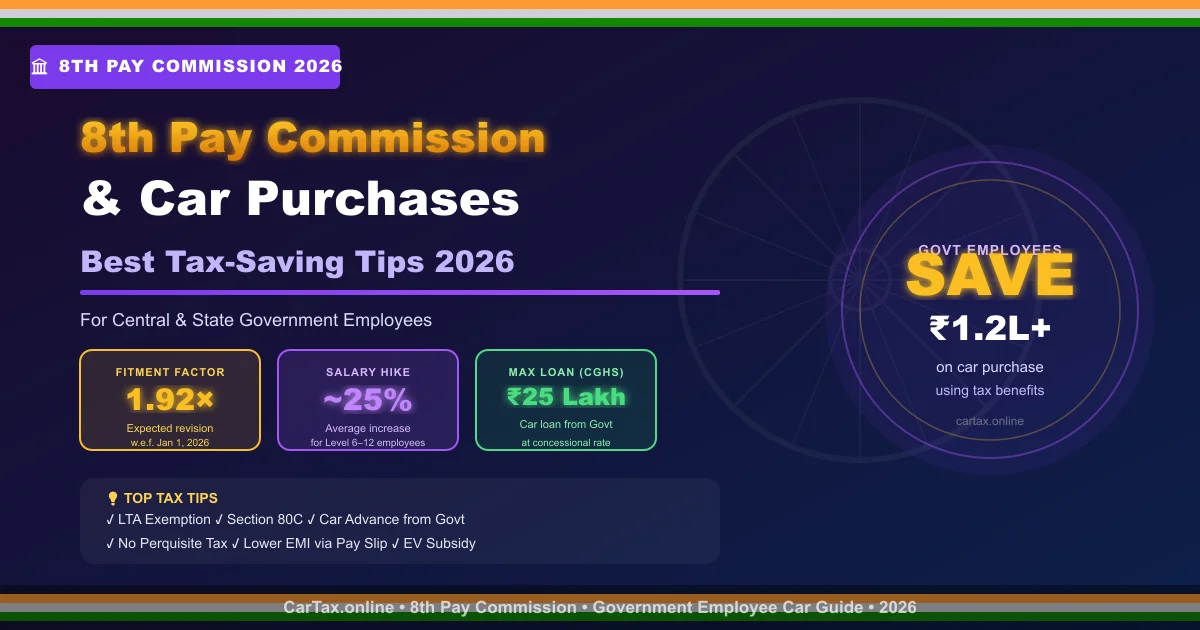
The 8th Pay Commission, implemented with effect from January 1, 2026, has delivered the most significant salary revision for central government employees in nearly a decade. With an expected fitment factor of 1.92× and average salary increases of 20–30% across pay levels, millions of Group B and Group C employees now have the financial capacity to purchase a car — many for the first time.
But buying a car as a government employee is fundamentally different from buying one as a private sector worker. You have access to exclusive car advance schemes, LTA exemptions, and lower-cost borrowing options that private sector employees cannot access. This guide explains exactly how to use every available benefit to minimise your total cost.
What the 8th Pay Commission Means for Your Car Budget
Before the tax-saving strategies, let us establish the financial context. Here is how the 8th CPC affects car loan eligibility for key pay levels:
| Pay Level | Post (Examples) | Old Basic Pay | New Basic Pay (8th CPC est.) | Max Car Loan Eligibility (36× basic) |
|---|---|---|---|---|
| Level 4 | UDC, Constable | ₹25,500 | ~₹48,960 | ~₹17.6 lakh |
| Level 6 | Inspector, Section Officer | ₹35,400 | ~₹67,968 | ~₹24.5 lakh |
| Level 7 | Assistant Prof, SI | ₹44,900 | ~₹86,208 | ~₹31 lakh |
| Level 10 | Gazetted Officer, ACP | ₹56,100 | ~₹1,07,712 | ~₹38.8 lakh |
| Level 12 | Deputy Secretary | ₹78,800 | ~₹1,51,296 | ~₹54.5 lakh |
| Level 14 | Joint Secretary | ₹1,44,200 | ~₹2,76,864 | Premium segment |
Note: The 8th CPC fitment factor of 1.92× is the projected estimate based on Pay Commission trends. Actual numbers will be notified by the government. Figures above are indicative.
Strategy 1: Use the Government Car Advance Scheme (Interest-Free / Concessional)
Central government employees can avail a Motor Car Advance (MCA) directly from the government at highly concessional interest rates — far below market car loan rates. This is the single biggest financial advantage available to government employees buying a car.
Motor Car Advance: Key Facts (Revised Post-8th CPC)
| Parameter | Details |
|---|---|
| Eligibility | All permanent central government employees (confirmed in service) |
| Maximum amount (4-wheeler) | ₹25 lakh or 8 months' basic pay, whichever is less (revised post-8th CPC) |
| Interest rate | Notified by the Ministry of Finance — typically 5.5–7.5% per annum (below market rates of 8.5–10.5%) |
| Repayment period | Up to 84 EMIs (7 years) |
| How to apply | Through your Drawing and Disbursing Officer (DDO) / PAO via Form prescribed by your ministry |
| Key condition | The vehicle must be registered in the employee's name and kept for at least 4 years (cannot sell without permission) |
How Much Do You Save vs a Bank Car Loan?
On a ₹15 lakh car advance at 6.5% (government rate) vs 9.5% (typical bank) over 7 years:
| Loan Type | Rate | Monthly EMI | Total Interest Paid | Saving |
|---|---|---|---|---|
| Government Car Advance | 6.5% p.a. | ₹22,283 | ₹3,71,772 | — |
| Bank Car Loan (SBI/HDFC) | 9.5% p.a. | ₹24,214 | ₹5,33,976 | — |
| Saving from Govt Advance | 3% p.a. | Save ₹1,931/month | Save ₹1,62,204 | ✅ |
Strategy 2: Claim Leave Travel Allowance (LTA) Efficiently
LTA (Leave Travel Allowance) is a salary component available to central government employees for travel expenses. While LTA does not directly subsidise car purchases, it can significantly reduce your annual travel budget — freeing up savings that can be directed toward your car EMI.
More importantly, under the LTA Cash Voucher Scheme (introduced during COVID and periodically extended), government employees can claim LTA tax exemption by spending on goods and services (including fuel at authorised fuel stations) rather than travelling — subject to conditions. Check with your ministry/department whether this scheme is active in the current financial year.
Strategy 3: No Perquisite Tax (Unlike Corporate Employees)
This is a massive advantage that government employees often overlook. When a government employee buys a car using their own money or the car advance, the car is entirely their personal property. There is no perquisite tax — unlike corporate employees who receive company cars and are taxed on their value under Section 17(2) / Rule 3 (recently revised for FY 2026-27).
A corporate employee with a company car pays ₹27,000–₹50,000 per year in additional income tax on the perquisite. A government employee who owns their car pays zero additional tax on it. Over 5 years, this difference alone is worth ₹1.35–₹2.5 lakh.
Strategy 4: Section 80C — Reduce Your Higher Tax Liability First
With the 8th CPC salary hike, many Level 4–8 employees will cross into higher income tax slabs in FY 2026-27. The smartest move before buying a car is to fully utilise Section 80C (₹1.5 lakh limit) and Section 80CCD(1B) (NPS: additional ₹50,000) to reduce taxable income.
| Section | Instrument | Maximum Deduction | Tax Saving (30% bracket) |
|---|---|---|---|
| 80C | GPF / PPF / LIC / ELSS / NSC | ₹1,50,000 | ₹46,800 |
| 80CCD(1B) | NPS Tier 1 (additional contribution) | ₹50,000 | ₹15,600 |
| 80D | Health Insurance Premium | ₹25,000 | ₹7,800 |
| 24(b) | Home Loan Interest (if applicable) | ₹2,00,000 | ₹62,400 |
| Total Maximum Tax Saving | ₹1,32,600/year | ||
Maximising these deductions before buying a car ensures you have maximum monthly cash flow for your EMI and are not overpaying income tax on your enhanced 8th CPC salary.
Strategy 5: Choose an EV and Stack All Available Subsidies
For government employees buying a car in 2026, electric vehicles offer the most stacking of benefits:
- 5% GST (vs 19–48% on petrol/diesel): saves ₹1–₹5 lakh on a ₹15–25 lakh EV
- 0% road tax in most states: saves ₹50,000–₹3 lakh depending on state and car price
- FAME III subsidy (if applicable): up to ₹50,000–₹1.5 lakh on qualifying EVs
- State EV subsidies: Delhi (₹1.5 lakh), Maharashtra (₹1 lakh), Gujarat (₹1.5 lakh), Tamil Nadu (₹1 lakh)
- No fuel cost: if charging from home or government charging infrastructure
- Government Car Advance: can be used to purchase an EV (no restriction on fuel type)
A Level 6 government employee in Delhi buying a Tata Nexon EV at ₹19.49 lakh (ex-showroom) with a government car advance could achieve an effective net cost after all subsidies and tax benefits of approximately ₹15–16 lakh all-in — significantly lower than the listed on-road price.
Strategy 6: Time Your Purchase for Maximum Depreciation Benefit
If you are a government employee running a small business or profession on the side (legal side income), you can claim depreciation on a car used for professional purposes under Section 32. The key timing benefit:
- Buy before September 30 of the financial year → claim full-year depreciation (15–30%) in Year 1
- Buy after October 1 → claim only 50% of the allowable depreciation in Year 1
For salaried government employees with no business income, this does not apply — but it is relevant for employees with freelance/professional income on the side.
Best Cars for Government Employees in 2026 (Budget Tiers)
| Budget Range | Best Picks | Why |
|---|---|---|
| ₹8–12 lakh (Level 4–5) | Maruti Swift, Tata Tiago, Hyundai Grand i10 | Low maintenance, high resale, low insurance. 18% GST (small car). Reliable for long government postings. |
| ₹12–18 lakh (Level 6–7) | Tata Nexon EV, Maruti Ciaz, Honda Amaze | Nexon EV best for those with home charging in Delhi/Maharashtra. Ciaz/Amaze offer maximum comfort for official use perception. |
| ₹18–25 lakh (Level 8–10) | Tata Nexon EV Max, MG ZS EV, Hyundai Creta | EVs dominate in this bracket with subsidy stacking. Creta if EV charging is unavailable at posting. |
| ₹25–40 lakh (Level 12+) | Hyundai Tucson, Toyota Innova Hycross Hybrid, Kia Carens | Innova Hycross hybrid offers best long-term TCO for frequent highway use. Tucson for premium comfort. |
Frequently Asked Questions
Can I use the 8th Pay Commission arrears to buy a car?
Yes. The arrears (difference between old and new pay from January 1, 2026 to the date of implementation) will be paid as a lump sum. This can be used for a down payment on a car, reducing your loan amount and total interest cost. However, the arrears are fully taxable as income in the year of receipt — plan your other deductions (80C, NPS, etc.) accordingly before spending.
Who is eligible for the Government Motor Car Advance?
All permanent central government employees who are confirmed in service and whose basic pay is above the minimum threshold (revised periodically) are eligible. Temporary employees, contractual staff, and probationers may not be eligible. The advance can be taken for a 4-wheeler (car/jeep) or a 2-wheeler — the limits differ. Apply through your DDO/Pay and Accounts Office with supporting documents including car quotation/invoice.
Is it better to take the government car advance or a bank loan?
In almost all cases, the government car advance is cheaper due to the concessional interest rate (typically 2–4% below market rates). The only exception is if the bank is offering a special limited-time promotional rate below the government rate, or if your car advance limit (8× basic pay) is insufficient for your target car and you need to top up with a bank loan for the balance.
Will my car loan EMI increase my income tax?
No. Car loan EMIs (principal + interest) paid on a personal car are not deductible from income for salaried employees. However, they do not increase your taxable income either. Only the car loan interest on a car used for business or professional purposes (not personal commuting) can be claimed as a deduction under the business income head.
Can state government employees also access these benefits?
Yes and no. State government employees have their own versions of the car advance scheme under state government rules — the amounts and interest rates vary by state. The LTA rules, Section 80C, and GST/road tax benefits are the same for all taxpayers regardless of employer. Check with your state finance department or pay accounts office for the specific state government car advance terms applicable to you.
Conclusion: The Government Employee Car Buying Advantage in 2026
The 8th Pay Commission has created a once-in-a-decade opportunity for government employees to enter the car ownership market with maximum financial efficiency. Between the concessional government car advance, zero perquisite tax, LTA benefits, and EV subsidy stacking, a well-planned government employee can buy a car for ₹1–2.5 lakh less in effective cost compared to an equivalent private sector purchase.
The recommended approach: exhaust Section 80C and 80CCD(1B) deductions first, use the government car advance for the primary loan, target an EV (especially in Delhi, Gujarat, or Maharashtra where state subsidies are available), and buy before the end of the financial year to maximise the benefit of having a full year of ownership.
Use our India Car Tax Calculator to calculate the exact on-road price, GST, and road tax for your target car in your city.