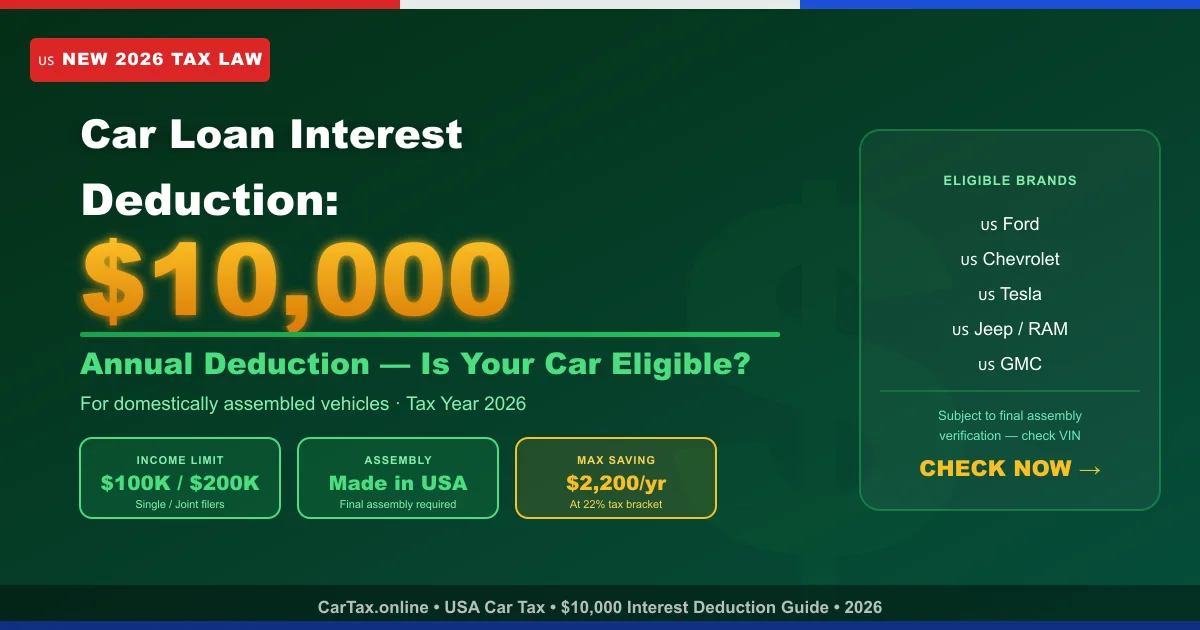
For decades, personal auto loan interest has been one of the most conspicuously non-deductible expenses in the U.S. tax code — a frustration for the tens of millions of Americans currently carrying car loans at interest rates between 7% and 12%. That changed with the signing of the One Big Beautiful Bill Act (OBBBA) in 2025, which included a new provision allowing a deduction of up to $10,000 per year in auto loan interest — but only on qualifying domestically assembled vehicles.
If you have an auto loan on a car assembled in the United States, or are planning to buy one in 2026, this deduction could save you $1,100 to $3,700 per year in federal income taxes depending on your tax bracket. Here is everything you need to know to claim it.
What Is the $10,000 Car Loan Interest Deduction?
The new deduction, codified under the OBBBA amendments to the Internal Revenue Code, allows individual taxpayers to deduct interest paid on a qualified motor vehicle loan from their federal taxable income, up to a maximum of $10,000 per year. Key parameters:
| Parameter | Details |
|---|---|
| Maximum annual deduction | $10,000 per tax year |
| Type of interest | Interest paid on a personal auto loan secured by the vehicle |
| Vehicle requirement | Final assembly must occur in the United States |
| Vehicle type | Passenger automobiles, light trucks, and SUVs (new purchases) |
| Income phase-out (single filers) | Begins at $100,000 MAGI, fully phased out at $150,000 |
| Income phase-out (married filing jointly) | Begins at $200,000 MAGI, fully phased out at $250,000 |
| Effective for | Vehicles purchased after the OBBBA enactment date (2025) — claimed starting Tax Year 2026 |
| Deduction type | Above-the-line deduction — you do NOT need to itemize to claim it |
| Can it be combined with EV credit? | Yes, if the vehicle also qualifies for the clean vehicle credit |
The above-the-line nature of this deduction is a major benefit. Unlike mortgage interest (which requires itemizing deductions on Schedule A), the auto loan interest deduction reduces your Adjusted Gross Income (AGI) directly — meaning you get the benefit even if you take the standard deduction.
How Much Could You Actually Save?
The real-world savings depend on your loan balance, interest rate, and tax bracket. Here are practical scenarios for 2026:
Scenario 1: $35,000 Loan at 8.5% APR, 60-Month Term (Year 1)
| Tax Bracket | Year 1 Interest Paid | Deductible Amount | Tax Savings |
|---|---|---|---|
| 22% | ~$2,890 | $2,890 | $636 |
| 24% | ~$2,890 | $2,890 | $694 |
| 32% | ~$2,890 | $2,890 | $925 |
Scenario 2: $55,000 Loan at 9.0% APR, 72-Month Term (Year 1)
| Tax Bracket | Year 1 Interest Paid | Deductible Amount | Tax Savings |
|---|---|---|---|
| 22% | ~$4,820 | $4,820 | $1,060 |
| 24% | ~$4,820 | $4,820 | $1,157 |
| 32% | ~$4,820 | $4,820 | $1,542 |
Scenario 3: Hitting the $10,000 Cap (Large Truck/SUV Loan at High Rate)
| Tax Bracket | Interest Paid | Deductible (capped) | Tax Savings |
|---|---|---|---|
| 22% | >$10,000 | $10,000 | $2,200 |
| 24% | >$10,000 | $10,000 | $2,400 |
| 32% | >$10,000 | $10,000 | $3,200 |
| 35% | >$10,000 | $10,000 | $3,500 |
Which Cars Qualify? The Domestic Assembly Requirement
This is the most important eligibility criterion — and the most misunderstood. The law requires that the vehicle's final assembly occur in North America (United States, Canada, or Mexico for the purposes of OBBBA, with a preference scoring that gives full deduction only for U.S.-assembled vehicles).
You can verify your specific vehicle's assembly location using the VIN decoder at the National Highway Traffic Safety Administration (NHTSA) website or the Department of Energy's Fuel Economy website (fueleconomy.gov), which lists the domestic content percentage and final assembly location for every model.
| Brand / Model | Assembly Location | Qualifies? |
|---|---|---|
| Ford F-150 (gasoline) | Dearborn, MI / Kansas City, MO | ✅ Yes |
| Chevy Silverado 1500 | Fort Wayne, IN / Silao, Mexico | ✅ U.S.-built VINs qualify |
| Tesla Model Y (U.S.-built) | Fremont, CA / Austin, TX | ✅ Yes |
| GMC Sierra 1500 | Fort Wayne, IN | ✅ Yes |
| Toyota Camry | Georgetown, KY | ✅ Yes |
| Honda CR-V (certain VINs) | East Liberty, OH | ✅ Verify by VIN |
| BMW X5 (certain VINs) | Spartanburg, SC | ✅ Yes |
| Toyota RAV4 (standard) | Woodstock, Ontario, Canada | ⚠ Partial — verify |
| Honda Accord | Marysville, OH | ✅ Yes |
| Hyundai Tucson | Montgomery, AL (some VINs) | ✅ Verify by VIN |
| Toyota Corolla | Blue Springs, MS | ✅ Yes |
| Kia Telluride | West Point, GA | ✅ Yes |
| Jeep Grand Cherokee | Detroit, MI | ✅ Yes |
| Honda Pilot | Lincoln, AL | ✅ Yes |
| Nissan Rogue | Smyrna, TN | ✅ Yes |
| Subaru Outback / Legacy | Lafayette, IN | ✅ Yes |
| Toyota Sienna | Princeton, IN | ✅ Yes |
| Rivian R1T / R1S | Normal, IL | ✅ Yes |
Important: Assembly location can vary even within the same model depending on the model year and production run. Always verify using your specific vehicle's VIN — not just the brand or model name.
How to Claim the Deduction on Your 2026 Tax Return
Claiming the deduction requires a few straightforward steps:
- Confirm your vehicle qualifies. Look up your VIN on the NHTSA website or fueleconomy.gov. Save the assembly location documentation.
- Get your annual interest statement. Your lender is required to send you a statement (similar to a mortgage Form 1098) showing total interest paid during the year. If your lender does not automatically provide one, request it in writing.
- Calculate your deductible amount. Total interest paid, up to $10,000 maximum. If you paid $7,200 in interest, you deduct $7,200. If you paid $13,000, you deduct $10,000.
- Check your MAGI. If your Modified Adjusted Gross Income exceeds the phase-out threshold ($100K single / $200K joint), calculate your reduced deduction using the phase-out worksheet in the IRS instructions.
- Report on Schedule 1, Part II. The deduction is entered on the appropriate line of Schedule 1 (Additional Income and Adjustments) as an above-the-line deduction reducing your AGI.
Income Phase-Out: How Much Do You Lose at Higher Incomes?
| MAGI (Single) | MAGI (Married Joint) | Deduction Available |
|---|---|---|
| Under $100,000 | Under $200,000 | Full $10,000 (or actual interest, whichever is less) |
| $100,000 – $125,000 | $200,000 – $225,000 | 75% of maximum |
| $125,000 – $150,000 | $225,000 – $250,000 | 50% of maximum |
| $150,000+ | $250,000+ | $0 — fully phased out |
Can You Combine This with the EV Clean Vehicle Credit?
Yes — and this is where the savings can be spectacular for qualifying EV buyers. If you purchase an EV that (a) qualifies for the $7,500 clean vehicle credit under Section 30D AND (b) is assembled in the United States, you can claim both benefits in the same tax year:
- Clean Vehicle Credit: Up to $7,500 (dollar-for-dollar tax credit)
- Auto Loan Interest Deduction: Up to $10,000 reduction in taxable income
On a qualifying $45,000 EV with a $40,000 loan at 8% APR, a married couple in the 24% bracket in Year 1 would receive approximately $7,500 + $768 (24% of ~$3,200 interest) = $8,268 in combined federal tax benefits.
Frequently Asked Questions
Can I deduct car loan interest on a used car?
No. The deduction under the OBBBA applies to new vehicle purchases only. A "new" vehicle means one purchased new from a dealer or directly from the manufacturer — it does not apply to used or certified pre-owned vehicles, even if the loan was taken out after the law's enactment date.
Does the car have to be used for business to deduct the interest?
No — this is what makes the new provision significant. Prior to the OBBBA, personal auto loan interest was not deductible (only business-use vehicle loan interest was deductible as a business expense). The new deduction explicitly applies to personal-use vehicles, requiring no business purpose.
What if I lease instead of finance? Can I still claim the deduction?
No. The deduction applies specifically to interest paid on a purchase loan secured by the vehicle. Lease payments are structured differently (they include a money factor/implicit interest component, but this is not separately deductible under the new provision). If tax savings are your priority, financing a qualifying vehicle is more advantageous than leasing in 2026.
Is there a limit on the vehicle's purchase price?
The deduction itself has no MSRP cap — the $10,000 is a cap on the interest deducted, not on the vehicle's price. However, higher-priced vehicles result in higher loan amounts and higher interest payments, which are more likely to reach the $10,000 cap quickly — so the deduction is proportionally more valuable for buyers of more expensive vehicles (trucks, SUVs, luxury sedans).
Do I need to itemize deductions to claim this?
No. This is an above-the-line deduction (also called an "adjustment to income"). It reduces your AGI whether you take the standard deduction or itemize. This is one of the most taxpayer-friendly aspects of the provision — the vast majority of Americans who take the standard deduction can still fully benefit.
Bottom Line: Who Benefits Most from This Deduction?
The $10,000 auto loan interest deduction delivers the greatest value to:
- Buyers of higher-priced vehicles with large loan balances (the faster you reach $10K in annual interest, the sooner you max out the deduction)
- Buyers in the 24%–32% federal tax bracket (middle-to-upper income range below the phase-out)
- Buyers of U.S.-assembled vehicles — specifically qualifying for both this deduction and any available EV credit stacking
- Buyers who financed in late 2025 or 2026 at elevated interest rates — the higher your rate, the more interest you pay, the larger your deduction
Use our Car Tax Calculator to see the full tax picture — including this deduction, your state's sales tax, and any applicable EV credits — before you sign the paperwork.