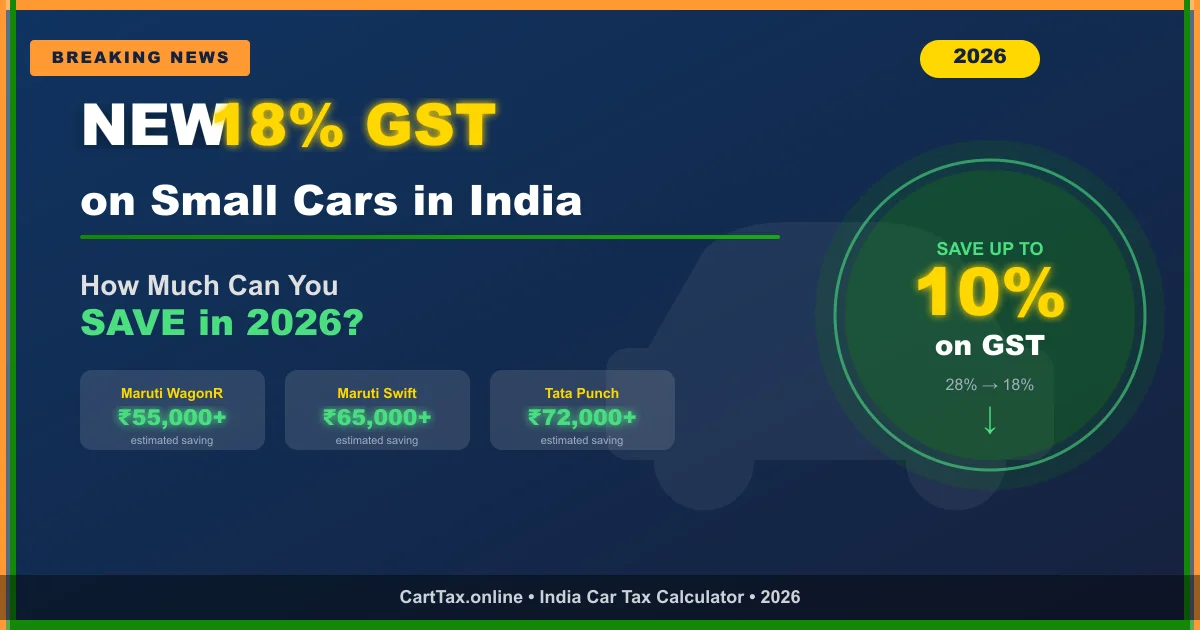
If you have been waiting to buy a small car in India, 2026 is the best time in a decade. The government has reduced the Goods and Services Tax (GST) on small petrol and diesel cars from 28% to 18% — a move that directly puts ₹50,000 to ₹80,000 back in your pocket on popular models like the Maruti WagonR, Swift, and Tata Punch.
In this article, we break down exactly what changed, which cars qualify, how much you save model-by-model, and whether now is the right time to buy.
What Changed: GST on Small Cars Reduced from 28% to 18%
Under India's GST framework, passenger cars fall into different tax slabs based on their engine size and length. Small cars — defined as vehicles under 4 metres in length with a petrol engine below 1,200cc or a diesel engine below 1,500cc — previously attracted:
- 28% GST (base slab for motor vehicles)
- 1% cess for petrol cars under 1,200cc
- 3% cess for diesel cars under 1,500cc
Effective from the revised schedule, the base GST slab for qualifying small cars has been reduced to 18%, while the cess remains unchanged. This brings the effective total tax rate on a small petrol car from ~29% down to ~19% — a full 10 percentage point reduction.
| Car Type | Old Rate (GST + Cess) | New Rate (GST + Cess) | Reduction |
|---|---|---|---|
| Small Petrol (<4m, <1200cc) | 28% + 1% = 29% | 18% + 1% = 19% | 10% |
| Small Diesel (<4m, <1500cc) | 28% + 3% = 31% | 18% + 3% = 21% | 10% |
| Mid-size / Large Cars | 28% + 15–22% cess | No change | 0% |
| Electric Vehicles | 5% (no change) | 5% (no change) | 0% |
Which Cars Qualify for the 18% GST Rate?
The following popular models meet the qualifying criteria (under 4m length, engine within limits):
| Model | Engine | Length | Qualifies? |
|---|---|---|---|
| Maruti Suzuki WagonR | 1.0L / 1.2L Petrol | 3,655 mm | ✅ Yes |
| Maruti Suzuki Swift | 1.2L Petrol | 3,860 mm | ✅ Yes |
| Tata Punch | 1.2L Petrol | 3,827 mm | ✅ Yes |
| Hyundai Grand i10 Nios | 1.2L Petrol / 1.2L Diesel | 3,805 mm | ✅ Yes |
| Maruti Suzuki Celerio | 1.0L Petrol | 3,695 mm | ✅ Yes |
| Tata Tiago | 1.2L Petrol | 3,771 mm | ✅ Yes |
| Renault Kwid | 0.8L / 1.0L Petrol | 3,731 mm | ✅ Yes |
| Maruti Suzuki Dzire | 1.2L Petrol | 3,995 mm | ✅ Yes |
| Hyundai i20 | 1.2L Petrol | 4,040 mm | ❌ No (over 4m) |
| Kia Sonet | 1.0L Turbo | 3,995 mm | ✅ Yes (check cess) |
How Much Can You Save? Model-by-Model Breakdown
Here is the real-world savings calculation based on approximate ex-showroom prices. Remember, GST is applied to the ex-showroom price before registration and insurance.
Maruti Suzuki WagonR — Save ₹50,000 to ₹58,000
The WagonR is India's best-selling small car. The 1.0L LXi base variant is priced at approximately ₹5.54 lakh ex-showroom (Delhi). At the old 29% total rate, the GST component was ~₹1.24 lakh. At the new 19% rate, it falls to ~₹81,600 — a saving of approximately ₹42,400 on the base variant, and up to ₹58,000 on the top-spec VXi+ AGS.
Maruti Suzuki Swift — Save ₹60,000 to ₹72,000
The all-new Swift (2024–26) with the 1.2L Z-series engine is priced between ₹6.49 lakh and ₹9.64 lakh ex-showroom. The 10-point GST reduction translates to savings of ₹60,000 on the LXi and up to ₹72,000 on the ZXi+ AMT top variant.
Tata Punch — Save ₹65,000 to ₹80,000
The Tata Punch, positioned as a micro-SUV, qualifies under the small car definition with its 1.2L Revotron engine and sub-4m body. Priced from ₹6.13 lakh to ₹9.99 lakh ex-showroom, buyers of the higher variants save close to ₹80,000 in GST alone.
Hyundai Grand i10 Nios — Save ₹48,000 to ₹62,000
The Grand i10 Nios petrol variants (₹5.92 lakh – ₹8.40 lakh) see savings in the range of ₹48,000 to ₹62,000. The diesel variants save slightly less due to the unchanged 3% cess.
| Model | Base Price (ex-showroom) | Old Tax (29%) | New Tax (19%) | You Save |
|---|---|---|---|---|
| WagonR 1.0L LXi | ₹5,54,000 | ₹1,24,000 | ₹81,600 | ₹42,400 |
| Swift LXi | ₹6,49,000 | ₹1,45,300 | ₹95,300 | ₹50,000 |
| Swift ZXi+ AMT | ₹9,64,000 | ₹2,15,800 | ₹1,41,400 | ₹74,400 |
| Tata Punch Pure | ₹6,13,000 | ₹1,37,200 | ₹89,900 | ₹47,300 |
| Tata Punch Accomplished+ | ₹9,99,000 | ₹2,23,800 | ₹1,46,600 | ₹77,200 |
| Grand i10 Nios Era | ₹5,92,000 | ₹1,32,500 | ₹86,800 | ₹45,700 |
| Tata Tiago XE | ₹5,60,000 | ₹1,25,400 | ₹82,100 | ₹43,300 |
Note: Prices are approximate ex-showroom (Delhi). Actual on-road price includes registration charges, insurance, TCS, and dealer handling. Use our India Car Tax Calculator for exact figures.
Will Dealers Pass On the Savings?
This is the most important question, and the honest answer is: it depends.
Manufacturers like Maruti Suzuki, Tata Motors, and Hyundai are expected to pass on the GST benefit in full, as they did during previous GST revisions. However, some dealers may reduce visible discounts while keeping sticker prices the same. Here's how to protect yourself:
- Ask for the ex-showroom price breakdown — the GST amount must now reflect 18%, not 28%.
- Check the official price list on the manufacturer's website — Maruti, Tata, and Hyundai all publish recommended retail prices that include GST at the current rate.
- Compare the invoice carefully — the GST invoice must show 18% CGST + SGST split (9% + 9%), not the old 14% + 14% split.
- Use our calculator to verify the on-road price you are being quoted.
Should You Buy Now or Wait?
With the GST cut already in effect, there is no strategic reason to wait further on that front. Here is a simple decision framework:
- Buy now if: You need a car within 6 months, your chosen model qualifies, and the dealer has confirmed the revised pricing. The savings are real and immediate.
- Wait if: A new model update or facelift is expected in the next 3–6 months for your preferred car. The Swift just got a major update, so you are buying the latest version. The WagonR facelift is due — check launch timelines before committing.
- Consider electric if: Your daily commute is under 150 km and you have home charging. EV incentives (FAME III, state subsidies) can make a Tata Tiago EV or Citroen eC3 competitive even against the GST-reduced petrol options.
Beyond GST: The Full On-Road Cost
Remember, GST is only one part of the on-road cost. Here is the full picture for a ₹7 lakh ex-showroom small car in Delhi after the GST cut:
| Cost Component | Amount | Notes |
|---|---|---|
| Ex-showroom price | ₹7,00,000 | Includes 18% GST + 1% cess |
| Registration (Road Tax) | ₹49,000 – ₹70,000 | 4–5% in Delhi; varies by state |
| Insurance (1st year) | ₹18,000 – ₹25,000 | Mandatory comprehensive cover |
| TCS (Tax Collected at Source) | ₹7,000 | 1% on vehicles above ₹10 lakh — N/A here |
| Dealer handling / logistics | ₹5,000 – ₹10,000 | Varies; negotiable |
| Estimated On-Road Price | ₹7,72,000 – ₹8,05,000 |
Use our India Car Tax Calculator to get a precise on-road estimate for your exact city, model, and variant.
Frequently Asked Questions
Does the 18% GST apply to all cars in India?
No. The 18% rate applies specifically to small cars: petrol cars under 4 metres with engine capacity below 1,200cc, and diesel cars under 4 metres with engine capacity below 1,500cc. Mid-size and large cars, SUVs, and luxury vehicles continue to attract 28% GST plus a higher cess of 15–22%.
How much is the total GST on a small petrol car now?
For a small petrol car (under 4m, under 1200cc) the total GST incidence is 18% base GST + 1% cess = 19% effective rate. Previously it was 28% + 1% = 29%. This is a 10 percentage point reduction on the ex-factory price before dealer margin.
Is the WagonR 1.2L eligible for the lower GST rate?
Yes. The Maruti WagonR 1.2L (Z-series engine, 1,197cc) is under 1,200cc and the car body is well under 4 metres (3,655 mm). Both variants — 1.0L and 1.2L — qualify for the 18% GST slab.
Will the Swift diesel also get the GST cut?
Maruti discontinued the Swift diesel in India. The current Swift range is petrol-only (1.2L Z12E engine) and fully qualifies for the 18% GST rate with a 1% cess, giving a 19% effective rate.
Does GST apply to the on-road price or the ex-showroom price?
GST is included in the ex-showroom price — it is collected by the manufacturer and dealer, not separately added on top. When you see a quoted ex-showroom price, the GST is already embedded in it. Road tax (registration), insurance, and other charges are calculated separately on top of the ex-showroom price.
Can I claim GST input tax credit (ITC) on a car purchase?
In most cases, no. Under Section 17(5) of the CGST Act, input tax credit on motor vehicles used for personal transportation is blocked. Exceptions exist for businesses that use vehicles for taxable purposes such as transportation of goods, passenger transportation services, or driver training — but the average individual buyer cannot claim ITC.
Conclusion: The Right Time to Buy a Small Car in India
The 10-percentage-point GST reduction on small cars is the most significant tax relief for entry-level car buyers in India since the GST rollout in 2017. On a ₹7–9 lakh car, the saving ranges from ₹50,000 to ₹80,000 — enough to cover your first year of fuel or insurance.
If you are in the market for a WagonR, Swift, Punch, Grand i10 Nios, or Tata Tiago, the math is firmly in your favour right now. Verify the revised ex-showroom prices with your dealer, get the revised GST invoice, and use our India Car Tax Calculator to check the full on-road cost before you sign the papers.