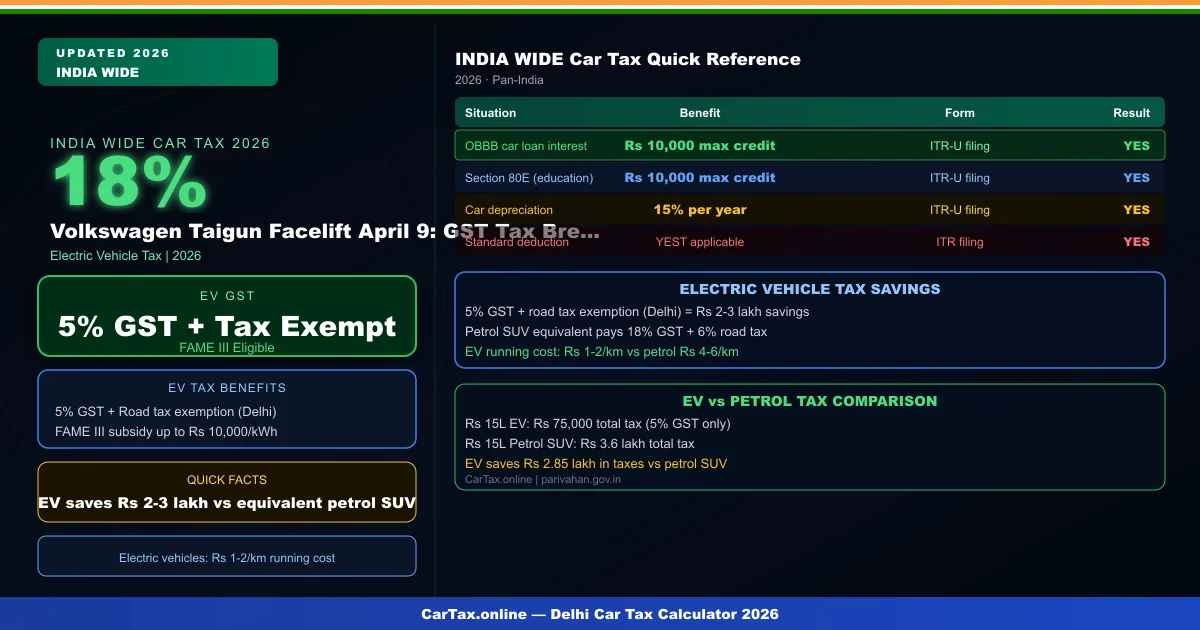
On April 7, 2026, just two days before the official Volkswagen Taigun Facelift launch on April 9, 2026, the complete price and GST breakdown has emerged — and the tax structure tells a compelling story. India's GST framework treats the Taigun's two engine options very differently: the 1.0L TSI engine variants attract 18% GST (sub-4m, sub-1200cc rules), while the 1.5L TSI variants jump to 28% GST plus a 22% compensation cess — effectively a 50% tax burden on the bigger engine. Here is the full GST breakdown, on-road cost analysis, and whether the 1.0L Taigun Facelift's savings make it the smarter buy.
Volkswagen Taigun Facelift GST Rate: The Engine-Tax Equation
India's GST structure for passenger vehicles is engine-size dependent — not just body-size dependent. For the Taigun Facelift 2026, this creates a significant pricing gap between the two powertrain options:
- 1.0L TSI (999cc) — Comfortline, Topline: GST at 18% — qualifies as a small car (engine under 1200cc, length under 4m). No compensation cess. This is the lowest GST slab for any petrol car in India.
- 1.5L TSI (1498cc) — GT Line, GT Plus: GST at 28% + 22% compensation cess = effective tax rate of 50% on ex-factory price. This is the standard SUV/luxury vehicle GST rate.
For the Taigun Facelift's expected ex-showroom pricing (₹12.5 lakh to ₹20.5 lakh), this tax differential translates to real savings of ₹1.2 lakh to ₹1.5 lakh on the 1.0L variants compared to what you would pay for comparable features if they were on the 1.5L platform.
Expected Taigun Facelift 2026 Variant Prices with GST Breakdown
Based on pre-launch dealer communications and the Volkswagen India price matrix for 2026, here is the expected structure launching April 9:
- Taigun Comfortline 1.0 TSI (MT): Ex-showroom ~₹12.5 lakh | GST component: ~₹1.89 lakh (18%) | On-road Delhi ~₹14.8 lakh
- Taigun Topline 1.0 TSI (AT): Ex-showroom ~₹15.5 lakh | GST component: ~₹2.34 lakh (18%) | On-road Delhi ~₹18.2 lakh
- Taigun GT Line 1.5 TSI (DSG): Ex-showroom ~₹18.2 lakh | GST component: ~₹5.46 lakh (28%+cess) | On-road Delhi ~₹22.1 lakh
- Taigun GT Plus 1.5 TSI (DSG): Ex-showroom ~₹20.5 lakh | GST component: ~₹6.15 lakh (28%+cess) | On-road Delhi ~₹24.8 lakh
The on-road cost includes Karnataka or Delhi road tax (varies by state — use our on-road price calculator for your state), RTO registration fee, insurance (first-year comprehensive), and the mandatory accessories.
New Safety Features and Their Cess Impact
The Taigun Facelift 2026 introduces several safety and technology upgrades that were not on the outgoing model. Notably, these features are fitted as standard across all variants following India's new vehicle safety mandate update effective Q1 2026:
- 6 airbags (up from 2 standard on base variants)
- Electronic Stability Control (ESC) and Hill Hold Assist
- 360-degree camera system (Topline and above)
- Level 2 ADAS — Lane Keeping Assist, Adaptive Cruise Control (GT Line and GT Plus only)
The safety mandate additions add an estimated ₹35,000–₹65,000 to manufacturing cost, which is reflected in the ex-showroom price increase over the outgoing Taigun. Importantly, since the safety features are now standard rather than optional accessories, they are included in the vehicle's taxable value — meaning the 18% or 28%+cess GST applies to the full price including mandatory safety equipment.
1.0L vs 1.5L Taigun Facelift: Which One to Buy?
The decision between the two engines is not purely about performance — the GST gap makes it a financial decision as much as a preference one. Here is a structured comparison:
- For city driving (under 60 km/day): The 1.0L TSI at 115 PS is more than adequate for urban use. The 18% GST saves ₹1.2–1.5 lakh on ex-showroom price. Lower insurance premium due to lower IDV. Strongly recommended for city buyers.
- For highway/performance buyers: The 1.5L TSI at 150 PS with DSG offers genuinely better highway performance. However, factor in the additional GST cost, higher insurance, and DSG service costs when calculating total cost of ownership over 5 years.
- For corporate/company car buyers: The 1.0L variants benefit from lower perquisite tax computation under India's company car fringe benefit rules — another tax advantage for salaried employees who get company-provided vehicles.
🧮 Calculate Taigun's On-Road Price in Your State
Road tax varies from 4% (Delhi EV) to 14.5% (Karnataka). Get the exact on-road price for the Taigun Facelift variant you want — including RTO charges and insurance estimate.
Old GST vs New GST: What Changed for Compact SUVs in 2026
Many buyers are confused by the "new GST 18% rule" for small cars. To clarify: the 18% GST rate for sub-4m, sub-1200cc petrol cars is not new — it has been in effect since the GST rollout in 2017. What changed in India's 2026 budget is a clarification on the SUV classification that tightened when the 28%+cess rate kicks in. Previously, some gray-area vehicles (like Maruti Brezza 2024 series) had classification disputes. The new rules clarify:
- Sub-4m length AND under 1200cc petrol OR under 1500cc diesel = 18% GST
- Any vehicle above 4m OR above these engine limits = 28% + 22% cess
- SUVs (high ground clearance vehicles) above 4m = 28% + 22% cess regardless of engine
The Taigun measures exactly 4.22m in length — which puts it firmly in the 28%+cess bracket for 1.5L variants regardless of cess rule clarifications. Only the 1.0L variants escape to 18% due to the engine displacement being under 1200cc.
Waiting Period and Availability
Volkswagen India has indicated that initial allocations for the Taigun Facelift will be limited in the first 6–8 weeks. Based on dealer communications as of April 7:
- 1.0L Comfortline MT: Shortest wait — 4–6 weeks from booking
- 1.0L Topline AT: 8–10 weeks — automatic variant demand higher
- 1.5L GT Line / GT Plus DSG: 10–14 weeks — limited initial DSG stock
Frequently Asked Questions
Can I get ITC (Input Tax Credit) on the Taigun Facelift as a business purchase?
ITC on passenger vehicles is blocked under GST rules except for vehicles used for specific business purposes (taxi operators, driving schools, transport businesses). If you are buying the Taigun Facelift for personal or general business employee use, ITC is not available. The full GST (18% or 28%+cess) is your cost.
Does the Taigun Facelift get any GST concession for EV variants?
The Taigun Facelift is not available in an electric variant as of April 2026. Volkswagen India's EV strategy for the Taigun segment is the ID.2 platform expected in 2027–28. EVs in India attract 5% GST versus 18–50% for ICE vehicles, so when a Taigun EV does arrive, the GST difference will be dramatic. For the April 9 launch, only petrol variants are available.
Booking for the Taigun Facelift 2026 opens April 9 at all Volkswagen India dealerships and through the Volkswagen India website at volkswagen.co.in. Use our on-road calculator to get the exact figure for your specific state before you walk into the showroom.
Frequently Asked Questions
Q: What is the current road tax rate for cars in India 2026?
Road tax rates in India vary by state and vehicle category. For new cars, GST is charged at 5% for EVs, 18% for hybrids under 1,200cc, and up to 28% for petrol/diesel SUVs. State road tax is charged separately and varies from Rs3,000-15,000 annually depending on the state's slab system. Check your specific state's RTO website for current rates.
Q: How do I calculate my car road tax online in India?
You can calculate your car road tax using online calculators available on state RTO portals and CarTax.online. The calculation considers your vehicle's ex-showroom price, fuel type, engine capacity, and state of registration. Road tax is payable annually or for the vehicle's lifetime depending on your state's rules.
Q: Is GST included in the road tax for new cars in India?
No — GST and road tax are separate charges. GST is a central tax charged by the vehicle manufacturer at the time of purchase. State road tax is a separate annual or one-time charge levied by your state's transport department. Both apply at the time of first registration, and annual road tax continues for subsequent years.
Q: Do electric vehicles get tax benefits in India 2026?
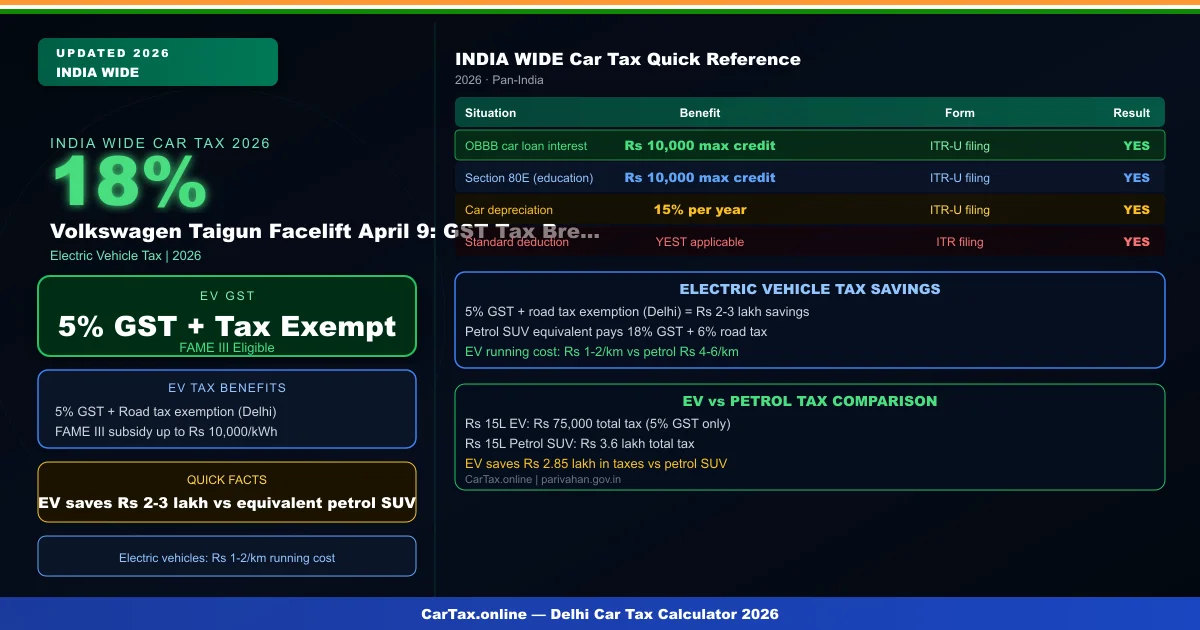
Yes — electric vehicles in India qualify for a reduced GST rate of 5% (down from 28% for petrol cars). Under FAME-III subsidies, EVs may also qualify for additional state-level incentives, reduced road tax, and free registration in many states. The exact benefits vary by state.
Q: What happens if I don't pay my car road tax on time?
If you don't pay road tax, your vehicle's registration can be flagged in the Vahan database, preventing renewal of fitness certificates and creating legal liability during police checks. Penalties range from Rs200-500 per day of default in most states. Road tax is a legal requirement under the Motor Vehicles Act.