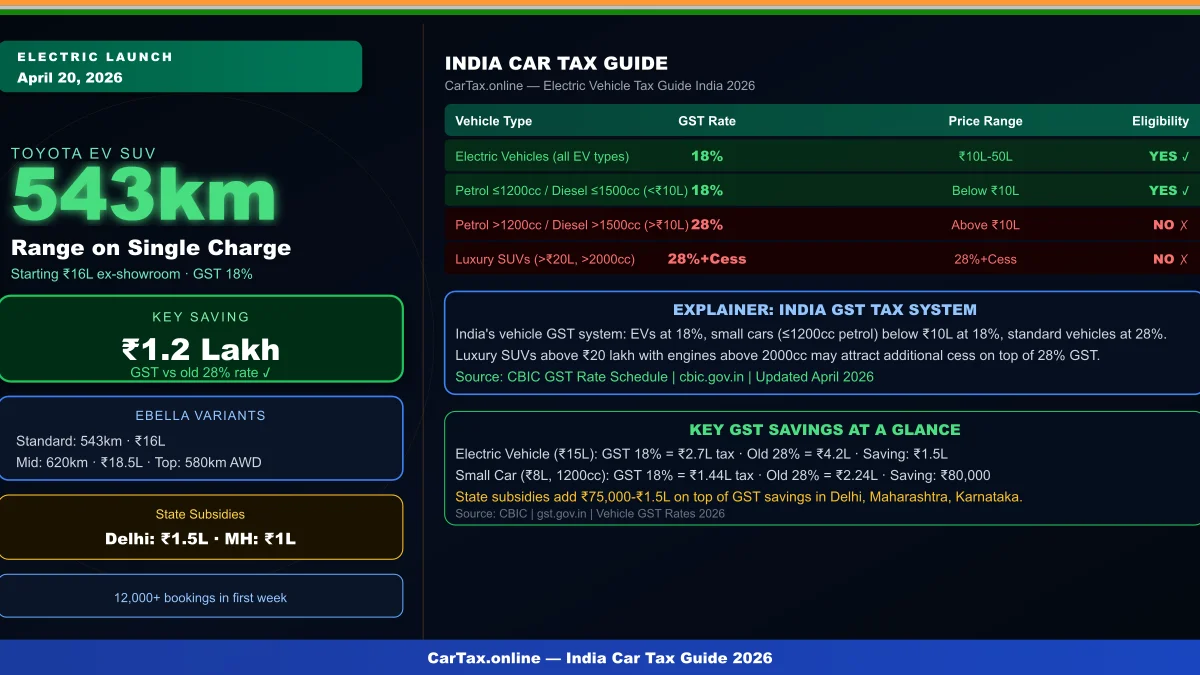
Toyota has finally entered the mass-market electric SUV segment in India with the Ebella, a midsize SUV that promises 543 kilometres of range on a single charge. The vehicle was unveiled at the Auto Expo 2026 and has since attracted enormous attention from buyers looking for a credible alternative to the Hyundai Creta Electric and Tata Nexon EV Max. With an ex-showroom starting price of ₹16 lakh, the Ebella undercuts many competitors while offering Toyota's legendary reliability.
## What Is the Toyota Ebella?
Toyota has finally entered the mass-market electric SUV segment in India with the Ebella, a midsize SUV that promises 543 kilometres of range on a single charge. The vehicle was unveiled at the Auto Expo 2026 and has since attracted enormous attention from buyers looking for a credible alternative to the Hyundai Creta Electric and Tata Nexon EV Max. With an ex-showroom starting price of ₹16 lakh, the Ebella undercuts many competitors while offering Toyota's legendary reliability.
The launch is scheduled for April 20, 2026, with deliveries expected to begin within two weeks across 150+ Toyota dealerships in India. The company has already received over 12,000 bookings within the first week of opening pre-orders, indicating strong market demand for a competitively priced electric SUV from a trusted brand.
## Range, Battery, and Performance Specs
The Toyota Ebella comes in three variants: Standard, Mid, and Top. The Standard variant offers 543 kilometres of range with a 50kWh battery pack and a single electric motor producing 168bhp. The Mid variant increases battery capacity to 60kWh, extending range to 620 kilometres while boosting output to 204bhp. The Top variant features dual-motor all-wheel drive with 295bhp and a 70kWh battery delivering 580 kilometres of range.
Charging capability is impressive across all variants. Using a 150kW DC fast charger, the Standard variant charges from 10% to 80% in just 28 minutes. Home charging using an 11kW AC wallbox takes approximately 5 hours for a full charge. The inclusion of vehicle-to-load technology means owners can power external devices and even charge another electric vehicle in emergencies.
## Design and Features That Set It Apart
The Ebella's design language represents a departure from Toyota's typically conservative approach. The front fascia features a closed-off grille with an illuminated Toyota logo and sharp LED daytime running lights that give the vehicle a distinctive presence on Indian roads. The side profile shows strong shoulder lines and flush door handles that contribute to a drag coefficient of 0.27, helping maximise range efficiency.
Inside the cabin, the Ebella offers a 14-inch touchscreen infotainment system with wireless Apple CarPlay and Android Auto, a 10-speaker JBL sound system in the Top variant, and ventilated front seats as standard. The dashboard is dominated by the floating screen design, with a minimal button layout that keeps the interior clean and modern. Boot space of 480 litres makes the Ebella practical for family use.
## GST Benefits and Tax Advantages for Buyers
The Toyota Ebella qualifies for the reduced 18% GST slab applicable to electric vehicles under India's GST 2.0 reform introduced in January 2026. This means buyers save approximately ₹1.2 lakh in GST alone compared to the previous 28% slab that applied to vehicles above ₹15 lakh. For the ₹16 lakh ex-showroom variant, the 18% GST results in a tax of ₹2.88 lakh, compared to ₹4.48 lakh under the old regime.
State government subsidies vary across India. Delhi offers an additional ₹1.5 lakh state subsidy for electric vehicles, making the effective ex-showroom price in Delhi approximately ₹14.5 lakh after state incentives. Maharashtra and Karnataka offer ₹1 lakh and ₹75,000 respectively. The combination of central GST reduction and state subsidies makes the Ebella significantly more affordable than its competitors.
## Creta Electric vs Ebella: Which Should You Buy?
The Hyundai Creta Electric and Toyota Ebella represent the two most anticipated electric SUV launches of 2026. The Creta Electric offers a 473km range with a 45kWh battery, priced from ₹17.5 lakh ex-showroom. The Ebella undercuts this with a lower starting price of ₹16 lakh and a longer 543km range on the base variant. Both vehicles share similar dimensions and interior space.
Key differences favour the Ebella in several areas. Toyota's service network is larger and more established in smaller Indian cities. The Ebella's battery carries an 8-year or 1.6 lakh kilometre warranty versus Hyundai's 7-year or 1.5 lakh kilometre coverage. For buyers in Tier 2 and Tier 3 cities, the Toyota advantage in after-sales service may be decisive.
## Should You Wait for the Ebella or Buy a Nexon EV Now?
The Tata Nexon EV Max has been India's best-selling electric SUV for two consecutive years, with prices starting at ₹14.5 lakh ex-showroom. The upcoming Ebella at ₹16 lakh represents a premium of ₹1.5 lakh for additional range, a larger vehicle platform, and Toyota's brand reassurance. For buyers who need a vehicle immediately, the Nexon EV Max remains an excellent choice with proven reliability.
For buyers with flexibility on delivery timeline, waiting for the Ebella offers tangible benefits. The ₹1.5 lakh premium over the Nexon EV Max translates to approximately ₹2,500 per month over a 5-year loan term. Pre-bookings are open with a ₹50,000 token amount that is fully refundable.
Official Resources: Parivahan Portal | Vahan Road Tax | India GST Portal | FAME-III Scheme
Frequently Asked Questions
Q: What is the current road tax rate for cars in India 2026?
Road tax rates in India vary by state and vehicle category. For new cars, GST is charged at 5% for EVs, 18% for hybrids under 1,200cc, and up to 28% for petrol/diesel SUVs. State road tax is charged separately and varies from Rs3,000-15,000 annually depending on the state's slab system. Check your specific state's RTO website for current rates.
Q: How do I calculate my car road tax online in India?
You can calculate your car road tax using online calculators available on state RTO portals and CarTax.online. The calculation considers your vehicle's ex-showroom price, fuel type, engine capacity, and state of registration. Road tax is payable annually or for the vehicle's lifetime depending on your state's rules.
Q: Is GST included in the road tax for new cars in India?
No — GST and road tax are separate charges. GST is a central tax charged by the vehicle manufacturer at the time of purchase. State road tax is a separate annual or one-time charge levied by your state's transport department. Both apply at the time of first registration, and annual road tax continues for subsequent years.
Q: Do electric vehicles get tax benefits in India 2026?
Yes — electric vehicles in India qualify for a reduced GST rate of 5% (down from 28% for petrol cars). Under FAME-III subsidies, EVs may also qualify for additional state-level incentives, reduced road tax, and free registration in many states. The exact benefits vary by state. Related: 8th Pay Commission | Ahmedabad Petrol Crisis | 40% GST Shock | 40% GST Shock.
Q: What happens if I don't pay my car road tax on time?
If you don't pay road tax, your vehicle's registration can be flagged in the Vahan database, preventing renewal of fitness certificates and creating legal liability during police checks. Penalties range from Rs200-500 per day of default in most states. Road tax is a legal requirement under the Motor Vehicles Act.
⚠ Financial & Legal Disclaimer
All information provided in this article is for educational and informational purposes only. The content is synthesized based on verbal communications, extensive internet research, and official government website data as of the date of publishing. Tax laws and insurance policies are subject to frequent changes by the authorities. We strive for accuracy, but we recommend that you consult a qualified professional (CA, CPA, or Tax Consultant) before making any financial decisions. For personalized assistance, you can also connect with our in-house experts through our Contact Us page.
⚠ वित्तीय एवं कानूनी डिस्क्लेमर
इस लेख में दी गई सभी जानकारी केवल शिक्षा और सूचना के उद्देश्य से है। यह कंटेंट इंटरनेट रिसर्च, सरकारी वेबसाइटों के आंकड़ों और मौखिक चर्चाओं पर आधारित है। टैक्स नियम और इंश्योरेंस पॉलिसियां सरकार द्वारा समय-समय पर बदली जा सकती हैं। हालांकि हम सटीकता का पूरा ध्यान रखते हैं, फिर भी हम सलाह देते हैं कि कोई भी वित्तीय निर्णय लेने से पहले आप किसी योग्य विशेषज्ञ (CA, CPA या टैक्स सलाहकार) से परामर्श जरूर लें। व्यक्तिगत सहायता के लिए आप हमारे विशेषज्ञों से हमारे संपर्क करें (Contact Us) पेज के माध्यम से भी जुड़ सकते हैं।
Ready to calculate your car tax?
Use our free calculator to get an instant, accurate estimate for your country and state.
Open Car Tax Calculator →