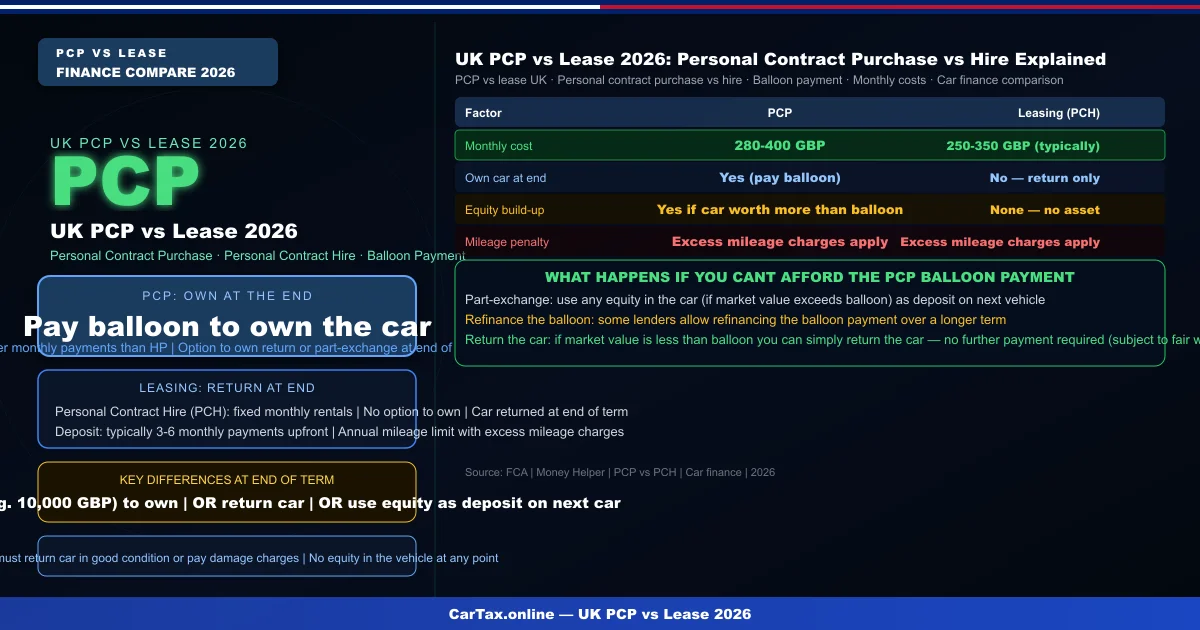
The UK car finance market offers three main pathways to vehicle access: Personal Contract Purchase (PCP), Personal Contract Hire (PCH, also known as leasing) and Hire Purchase (HP). Each has distinct financial characteristics, ownership implications and suitability criteria. Understanding the differences is essential for making the right decision in 2026.
Personal Contract Purchase (PCP) Explained
PCP involves paying a deposit (typically 10 percent of the car's value), lower monthly payments over two to four years covering only the vehicle's depreciation, and a Guaranteed Minimum Future Value (GMFV or balloon payment) at the end if you choose to own the car. At the end of the term, you have three options: pay the GMFV to own, return the car with nothing further to pay, or use any equity (positive difference between GMFV and market value) as a deposit on a new PCP.
PCP is most suitable for drivers who want flexibility and the option to change cars every two to four years without owning the depreciation risk. It is also suitable for those who want the lowest monthly payments and can accept mileage limits and wear-and-tear conditions.
Personal Contract Hire (PCH) vs PCP
PCH is a pure rental agreement with no ownership option at the end of the term. You pay an initial rental advance (typically three months), then monthly rentals over two to four years and return the car. PCH includes road tax and often a maintenance package as optional extras. PCH monthly rentals are typically lower than PCP payments because there is no GMFV to account for: you are simply renting the vehicle for its full depreciation period. Related: Canada Car Lease Tax Deduction 2026 | HST on Leased Vehicles Canada 2026 | Car Lease Deals Uk | Andhra Pradesh Road Tax Calculator 2026 — AP Vehicle Rates.
PCP gives you an ownership pathway; PCH does not. If you want to own the car at the end, PCP is the only option of the two. If you simply want to drive a new car every two to three years and never own, PCH is typically cheaper and simpler.
Hire Purchase (HP) Explained
HP is a straightforward loan to purchase the vehicle. You pay a deposit (typically 10 percent), and monthly payments covering the full vehicle value plus interest over one to five years. Upon final payment, you own the car outright. HP has no mileage limits, no wear-and-tear conditions and no balloon payment. Monthly payments are higher than PCP because they cover the entire vehicle value, not just depreciation.
HP is most suitable for those who want outright ownership at the end and can afford the higher monthly payments. It provides certainty of outcome: at the end of the term, the car belongs to you. HP is simpler than PCP and has fewer terms and conditions to manage.
Total Cost Comparison
On a 25,000 GBP car over 48 months with a 10 percent deposit: PCP total payments (deposit plus monthly payments) typically total 16,000 to 20,000 GBP, plus the optional GMFV of approximately 8,000 to 10,000 GBP if you choose to own. HP total payments over 60 months total approximately 22,500 to 25,000 GBP including interest, resulting in outright ownership. PCH total payments over 36 months total approximately 12,000 to 16,000 GBP, with no asset at the end.
Frequently Asked Questions
Which is cheaper, PCP or PCH? PCH is typically cheaper per month because it has no GMFV balloon element. However, PCP gives you an ownership pathway while PCH is a pure rental with no asset at the end.
What happens if my PCP car's market value is less than the GMFV at the end? You simply return the car without paying the GMFV. This is the key advantage of PCP: you are not obligated to pay the balloon if the market value does not support it.
Can I settle PCP early? Yes, you have the right to settle HP and PCP early under the Consumer Credit Act. The settlement figure reduces over time as you pay down the balance.
Official Resources: GOV.UK Check Vehicle Tax | GOV.UK Vehicle Tax | DVLA Online | MOT Check
Frequently Asked Questions
Q: How much is car tax (VED) in the UK 2026?
Car tax rates in the UK depend on your vehicle's CO2 emissions and list price. Standard rates start from £190 per year for petrol and diesel cars, with zero-rated VED for EVs. First-year rates vary from £0 to £2,605 depending on emissions. Additional premiums apply for vehicles over £40,000.
Q: How do I check if my car is taxed online?
You can check your vehicle's tax status for free on the Gov.uk website at gov.uk/check-vehicle-tax. You'll need your vehicle's registration number (number plate). You can also check via the Motor Insurance Database to verify road tax and insurance status simultaneously.
Q: Can I get a refund on car tax if I sell my vehicle?
Yes — if you sell or scrap your vehicle, you can claim a refund on any full months of remaining road tax. Contact DVLA with the V11 reminder letter or apply online at gov.uk. Refunds are usually processed within 4-6 weeks.
Q: Is road tax refund available when transferring ownership?
No — road tax does not transfer with the vehicle. When you sell your car, the tax is automatically cancelled and any remaining months are refunded to you by DVLA. The new owner must tax the vehicle immediately. As a buyer, always verify the vehicle's tax status before purchasing.
Q: What is the luxury car tax threshold in the UK 2026?
The additional rate for vehicles over £40,000 (list price) adds £410 per year to standard VED rates for years 2-6 of registration. This surcharge brings the annual cost for high-emission vehicles over £40,000 to around £600-690 per year. Pure EVs under £40,000 pay zero VED.