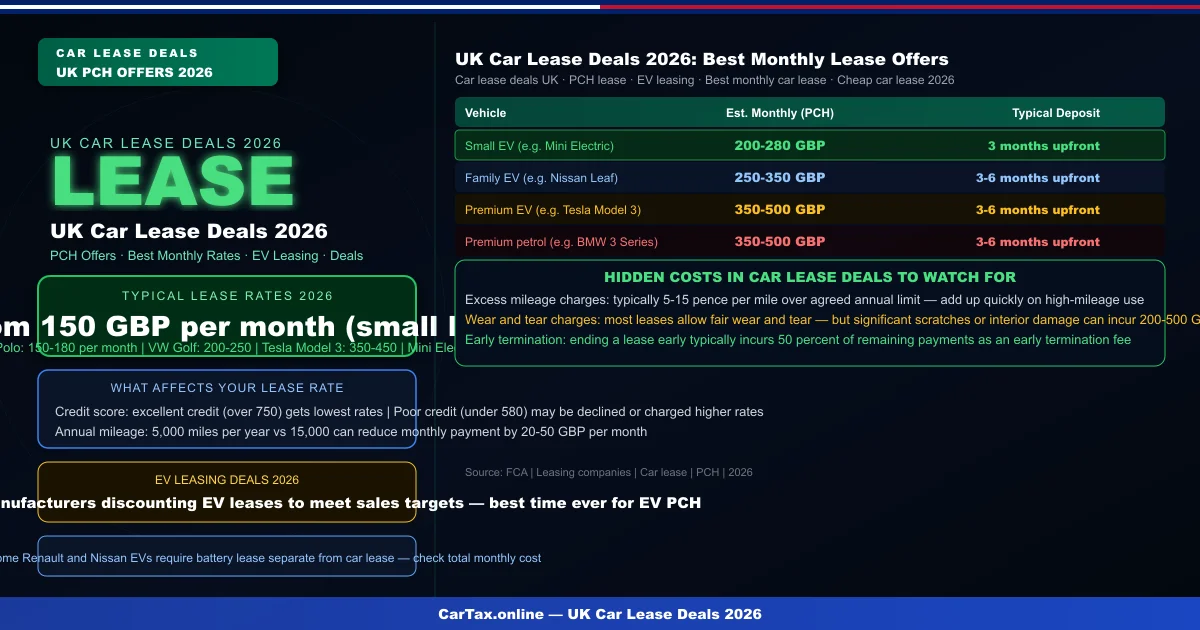
Personal car leasing (PCH) has grown substantially in the UK as consumers increasingly prioritise access to new cars over ownership. Finding the best lease deals in 2026 requires understanding how leasing brokers work, where to find competitive pricing and how to evaluate lease offers against alternatives.
How Car Leasing Works in 2026
Personal Contract Hire (PCH) is a long-term rental agreement where you pay an initial rental advance (typically three months), followed by fixed monthly rentals over two to four years. At the end of the term, you simply return the car with no option to buy. Road tax is included in most lease agreements. Maintenance packages are typically available as optional extras at 20 to 50 GBP per month.
Lease prices are set based on the vehicle's list price, the agreed annual mileage, the lease term and the anticipated residual value at the end of the term. Vehicles with strong residual values (such as Toyota and Skoda models) are cheaper to lease than those with poor residual values (such as premium brands with high depreciation).
Where to Find the Best Car Lease Deals
Lease comparison websites including LeaseLoco, Leasing.com, Carparison and Select Car Leasing aggregate offers from multiple lease brokers and funders, allowing side-by-side comparison of identical vehicles across different providers. These brokers negotiate bulk pricing with lease funders and pass savings to consumers. Related: Canada Car Lease Tax Deduction 2026 | HST on Leased Vehicles Canada 2026 | Pcp Vs Lease Uk | Andhra Pradesh Road Tax Calculator 2026 — AP Vehicle Rates.
Direct manufacturer leasing through brands including Jaguar Land Rover Financial Services, BMW Financial Services and Mercedes-Benz Financial Services can offer competitive deals, particularly on pre-registered or in-stock vehicles. Pre-registered cars (registered to the dealer but never used) can offer 10 to 20 percent discounts on list price lease calculations.
Cheapest Cars to Lease in 2026
The most affordable personal lease deals in 2026 are typically small hatchbacks with strong residual values. The Skoda Citigo-e iV and Citigo IV (electric) can be leased from approximately 150 to 200 GBP per month. The Toyota Yaris Hybrid and VW Polo typically lease from 200 to 280 GBP per month. Family hatchbacks such as the Toyota Corolla Hybrid and Skoda Octavia start from approximately 250 to 350 GBP per month.
Electric Vehicle Lease Deals
EV lease deals have become increasingly competitive as new EV prices have fallen and leasing companies adjust their residual value expectations. The MG4 Electric can be leased from approximately 200 to 280 GBP per month. The Tesla Model 3 typically leases from 350 to 450 GBP per month. The VW ID.3 starts from approximately 300 to 380 GBP per month. These prices include road tax and typically exclude maintenance packages.
Factors That Affect Lease Pricing
Annual mileage is the most significant variable in lease pricing. A vehicle leased at 8,000 miles per year will cost less per month than the same vehicle at 12,000 miles. Initial rental advance affects monthly payments: increasing from three months to six months advance reduces monthly payments by approximately 30 to 40 percent but increases upfront cost. Lease term affects pricing: three-year leases are typically more cost-effective than two-year leases on a per-month basis.
Frequently Asked Questions
What is the cheapest way to lease a car in the UK? Use a lease comparison broker (LeaseLoco, Leasing.com, Carparison) to compare multiple funders simultaneously. Also check manufacturer pre-registered deals which can be 10-20 percent cheaper than standard pricing.
What credit score do I need to lease a car? Most lease providers require a good credit score, typically 650+ on the Experian scale. Lease applications involve hard credit checks and providers assess affordability alongside credit history.
Official Resources: Parivahan Portal | Vahan Road Tax | India GST Portal | FAME-III Scheme
Frequently Asked Questions
Q: What is the current road tax rate for cars in India 2026?
Road tax rates in India vary by state and vehicle category. For new cars, GST is charged at 5% for EVs, 18% for hybrids under 1,200cc, and up to 28% for petrol/diesel SUVs. State road tax is charged separately and varies from Rs3,000-15,000 annually depending on the state's slab system. Check your specific state's RTO website for current rates.
Q: How do I calculate my car road tax online in India?
You can calculate your car road tax using online calculators available on state RTO portals and CarTax.online. The calculation considers your vehicle's ex-showroom price, fuel type, engine capacity, and state of registration. Road tax is payable annually or for the vehicle's lifetime depending on your state's rules.
Q: Is GST included in the road tax for new cars in India?
No — GST and road tax are separate charges. GST is a central tax charged by the vehicle manufacturer at the time of purchase. State road tax is a separate annual or one-time charge levied by your state's transport department. Both apply at the time of first registration, and annual road tax continues for subsequent years.
Q: Do electric vehicles get tax benefits in India 2026?
Yes — electric vehicles in India qualify for a reduced GST rate of 5% (down from 28% for petrol cars). Under FAME-III subsidies, EVs may also qualify for additional state-level incentives, reduced road tax, and free registration in many states. The exact benefits vary by state.
Q: What happens if I don't pay my car road tax on time?
If you don't pay road tax, your vehicle's registration can be flagged in the Vahan database, preventing renewal of fitness certificates and creating legal liability during police checks. Penalties range from Rs200-500 per day of default in most states. Road tax is a legal requirement under the Motor Vehicles Act.