What Is a Car Write-Off?
A car write-off occurs when an insurer declares a vehicle a total loss because the cost of repairing it would exceed its market value or because it cannot be made roadworthy safely. In the UK, write-offs are classified into four categories — A, B, S, and N — which determine what can legally happen to the vehicle. The classification is determined by a qualified engineer or by the AutoData total loss evaluation standard used by most insurers.
The concept of a write-off is sometimes misunderstood. A write-off does not necessarily mean the car is destroyed — it means the insurer has determined that financially or structurally, it is not viable to repair. Many written-off vehicles are repaired and returned to the road through the salvage route, while others are parted out or scrapped.
UK Vehicle Write-Off Categories Explained
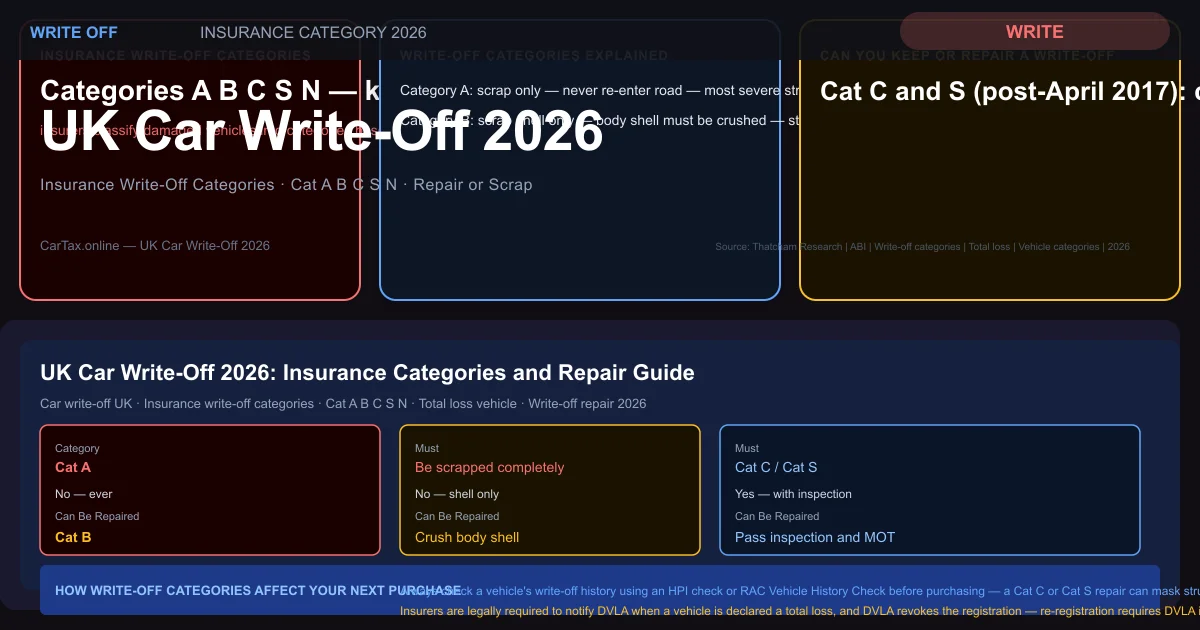
Category A is the most severe classification. The vehicle is so badly damaged that it must be crushed completely. Nothing from the vehicle can be reused, not even component parts. Category A write-offs are rare and typically involve severe structural damage, fire damage, or flood immersion that compromises the vehicle beyond any reasonable repair.
Category B vehicles have sustained severe damage but some parts may be salvageable. The shell must be crushed, but individual components such as engines, gearboxes, doors, and panels can be removed and sold. Category B vehicles cannot be returned to the road as complete vehicles under any circumstances. Related: Big Car Tax Changes Coming to UK 2026 | Car Tax Changes UK 2026 | Car Tax Rates UK 2026 | Check If Car Is Taxed UK.
Category S (formerly Category C) is a significant change from older classifications. Category S means the vehicle has sustained structural damage — meaning damage to the loadbearing structure of the car, such as the chassis, body tub, or monocoque frame. Category S vehicles can be repaired and returned to the road, but the repair must meet specific standards and be certified by a qualified engineer.
Category N (formerly Category D) applies to vehicles with non-structural damage where the cost of repair exceeds the vehicle's value or where the vehicle is uneconomical to repair but has no structural damage. Category N vehicles include those with failed engines, gearboxes, electrical faults, or cosmetic damage that is beyond economic repair. Category N vehicles can be repaired and re-registered, but may require an identity check and engineering inspection.
How Insurers Determine a Write-Off
Insurers calculate whether a vehicle is a total loss using a combination of the vehicle's market value and the estimated repair cost. The market value is typically determined using insurance valuation databases that account for the vehicle's age, mileage, condition, and specification. The repair estimate is based on quotes from approved repairers or engineers.
The general threshold is that if the repair cost exceeds the market value, the vehicle is declared a write-off. However, insurers also consider the vehicle's pre-accident condition, any existing damage, and the expected repair quality. They may use a formula where a vehicle is written off if repair costs exceed 60 to 70 percent of the vehicle's value, though different insurers have different thresholds.
Your Rights When Your Car Is Written Off
As a policyholder, you have specific rights when your car is declared a write-off. The insurer must offer you the market value of the vehicle plus any remaining policy excess. You can negotiate if you believe the valuation is too low — providing evidence of comparable vehicles for sale, recent service history, and any modifications can support a higher valuation.
You also have the right to retain the salvage of your vehicle. If you want to keep the wreck and repair it yourself, you can inform the insurer. They will deduct the salvage value from your settlement. This can be worthwhile for Category S and N vehicles where you have the skills and resources to repair them. However, you will need to notify the DVLA of the write-off status and obtain a vehicle identity check before re-registering.
Buying a Written-Off Vehicle
Written-off vehicles are commonly sold through salvage auctions, dealer disposal programmes, and online marketplaces. Category S and N vehicles are particularly common in the used car market. Before purchasing a written-off vehicle, you should obtain a full vehicle history check that includes write-off records, and arrange an independent inspection to assess the quality of any existing repairs.
Insurance write-off records are shared across the motor industry through the Motor Insurance Anti-Fraud and Theft Register (MIAFTR) and the Driver and Vehicle Licensing Agency (DVLA). Finance companies and insurers will usually flag a vehicle as written off when conducting checks, and a written-off vehicle can be difficult and expensive to insure if it has a Category S or N marker.
Challenging a Write-Off Decision
If you disagree with the insurer's decision to write off your vehicle, you have the right to challenge it. Your first step is to request a detailed breakdown of the insurer's valuation, including the repair cost estimate. You can then obtain independent quotes from alternative repairers to challenge the repair cost assessment.
If you believe the market value has been underestimated, you can provide evidence of similar vehicles sold at higher prices. The Financial Ombudsman Service provides a free dispute resolution service for disagreements between policyholders and insurers about total loss settlements. Most disputes are resolved without needing to escalate to the Ombudsman.
Official Resources: GOV.UK Check Vehicle Tax | GOV.UK Vehicle Tax | DVLA Online | MOT Check
Frequently Asked Questions
Q: How much is car tax (VED) in the UK 2026?
Car tax rates in the UK depend on your vehicle's CO2 emissions and list price. Standard rates start from £190 per year for petrol and diesel cars, with zero-rated VED for EVs. First-year rates vary from £0 to £2,605 depending on emissions. Additional premiums apply for vehicles over £40,000.
Q: How do I check if my car is taxed online?
You can check your vehicle's tax status for free on the Gov.uk website at gov.uk/check-vehicle-tax. You'll need your vehicle's registration number (number plate). You can also check via the Motor Insurance Database to verify road tax and insurance status simultaneously.
Q: Can I get a refund on car tax if I sell my vehicle?
Yes — if you sell or scrap your vehicle, you can claim a refund on any full months of remaining road tax. Contact DVLA with the V11 reminder letter or apply online at gov.uk. Refunds are usually processed within 4-6 weeks.
Q: Is road tax refund available when transferring ownership?
No — road tax does not transfer with the vehicle. When you sell your car, the tax is automatically cancelled and any remaining months are refunded to you by DVLA. The new owner must tax the vehicle immediately. As a buyer, always verify the vehicle's tax status before purchasing.
Q: What is the luxury car tax threshold in the UK 2026?
The additional rate for vehicles over £40,000 (list price) adds £410 per year to standard VED rates for years 2-6 of registration. This surcharge brings the annual cost for high-emission vehicles over £40,000 to around £600-690 per year. Pure EVs under £40,000 pay zero VED.