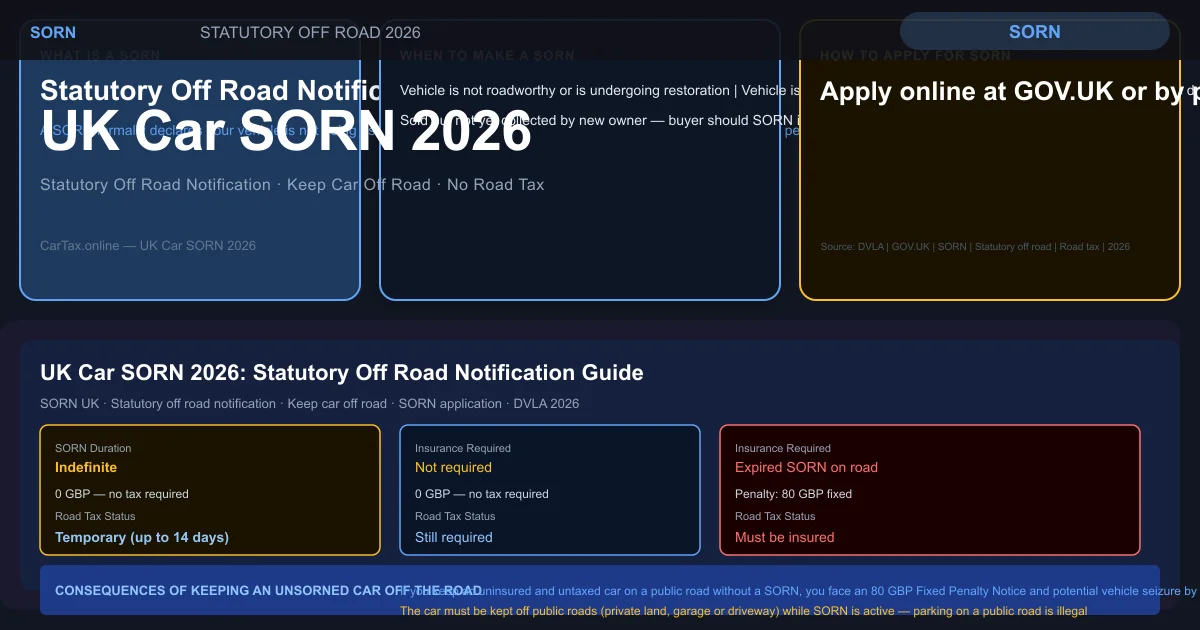
What Is a SORN?
A Statutory Off Road Notification (SORN) is a legal declaration that tells the DVLA you are not using a vehicle on any public road. When you declare a SORN, the vehicle is effectively taken off the road for the declared period, and you do not need to pay road tax for that duration. The SORN remains in force until the declared end date or until the vehicle is used, sold, or scrapped.
The SORN system was introduced in 1997 to ensure that vehicles not in use do not need to be taxed. It applies to any vehicle registered in the UK, including cars, motorbikes, vans and trailers, as long as it is kept off the public road network. If a vehicle has a SORN and is kept entirely on private land, it can remain untaxed indefinitely.
When to Declare a SORN
You must declare a SORN if your vehicle is not taxed and you do not plan to drive it on a public road. The most common situations include keeping a restoration project off the road, storing a second car, or inheriting a vehicle you are not ready to use. If your vehicle is untaxed and not declared as SORN, the DVLA may assume it is on the road and impose a penalty.
SORN is also necessary when your vehicle's tax expires and you are not renewing it. Even if you plan to sell the vehicle, if it is not going to be driven before the sale, declaring a SORN protects you from road tax liability. A SORN is free to declare and can be done online or by phone with the DVLA. Related: Car SORN Renewal UK 2026 | Big Car Tax Changes Coming to UK 2026 | Car Tax Changes UK 2026 | Car Tax Rates UK 2026.
How to Declare a SORN
The quickest way to declare a SORN is through the DVLA's online service at gov.uk. You need your vehicle registration number, the 11-digit reference number from your V5C log book, and your driving licence number. The SORN takes effect immediately and can be backdated to the start of the current calendar month if applicable.
Alternatively, you can declare by telephone by calling the DVLA on 0300 123 4326. Have your V5C reference number ready. The operator will process the SORN over the phone and confirm the start date. You will receive a confirmation letter within a few days. Postal declarations are also possible using the V11 form, though this is slower.
Rules for Vehicles with a SORN
A vehicle under SORN must be kept on private land — not on any public road, lay-by, or car park. Even parking on a public road for a few hours requires the vehicle to be taxed. The land must be in your lawful possession, meaning you own it, rent it, or have the owner's permission to store the vehicle there.
The vehicle must also be in a roadworthy condition if it is kept on a public road for any reason, such as being transported to a MOT centre. You can drive a SORN vehicle directly to a pre-booked MOT appointment or to a garage for repair, but this is permitted only for the journey to the test and must be via the most direct route.
Cancelling a SORN and Returning to the Road
To return a SORN vehicle to the road, you must tax the vehicle first. You can tax online at gov.uk, by phone, or at a post office. When you tax the vehicle, the SORN is automatically cancelled. You do not need to separately notify the DVLA that you are ending the SORN. The vehicle cannot be driven until the tax is in place.
If the vehicle has been off the road for more than 12 months, it will require a fresh MOT test before it can be taxed. This is because the MOT expiry date on the DVLA record will have lapsed. Booking an MOT before taxing the vehicle is essential, as you cannot legally drive to the test without valid tax and MOT.
SORN and Vehicle Tax Refunds
When you declare a SORN, any remaining months of road tax on the vehicle are refunded automatically by the DVLA. The refund is calculated from the start of the month following the SORN declaration. For example, if you declare a SORN on 15 April, you receive a refund for May, June, and any remaining full months on the tax disc.
The refund is paid into the bank account linked to the original tax payment if it was made by Direct Debit. If you paid by card, the refund comes via a cheque. The DVLA typically processes refunds within two to three weeks. Note that if the tax was paid for a full year, only the unused months are refunded — the first 12 months of tax is non-refundable if the vehicle was registered after October 2014.
SORN vs Continuous Registration
Some vehicle owners choose not to declare a SORN and instead keep the vehicle permanently taxed, even when it is not in use. This approach avoids the need to remember to re-declare SORN and re-tax when returning the vehicle to use. However, it costs more in road tax and is only practical for short-term storage periods.
The continuous registration route means the vehicle is always considered on the road for tax purposes, so the MOT continues in force and the registered keeper details remain current. This can be useful if the vehicle is used intermittently throughout the year. However, for vehicles stored for six months or more, declaring a SORN is the more cost-effective approach.
Official Resources: GOV.UK Check Vehicle Tax | GOV.UK Vehicle Tax | DVLA Online | MOT Check
Frequently Asked Questions
Q: How much is car tax (VED) in the UK 2026?
Car tax rates in the UK depend on your vehicle's CO2 emissions and list price. Standard rates start from £190 per year for petrol and diesel cars, with zero-rated VED for EVs. First-year rates vary from £0 to £2,605 depending on emissions. Additional premiums apply for vehicles over £40,000.
Q: How do I check if my car is taxed online?
You can check your vehicle's tax status for free on the Gov.uk website at gov.uk/check-vehicle-tax. You'll need your vehicle's registration number (number plate). You can also check via the Motor Insurance Database to verify road tax and insurance status simultaneously.
Q: Can I get a refund on car tax if I sell my vehicle?
Yes — if you sell or scrap your vehicle, you can claim a refund on any full months of remaining road tax. Contact DVLA with the V11 reminder letter or apply online at gov.uk. Refunds are usually processed within 4-6 weeks.
Q: Is road tax refund available when transferring ownership?
No — road tax does not transfer with the vehicle. When you sell your car, the tax is automatically cancelled and any remaining months are refunded to you by DVLA. The new owner must tax the vehicle immediately. As a buyer, always verify the vehicle's tax status before purchasing.
Q: What is the luxury car tax threshold in the UK 2026?
The additional rate for vehicles over £40,000 (list price) adds £410 per year to standard VED rates for years 2-6 of registration. This surcharge brings the annual cost for high-emission vehicles over £40,000 to around £600-690 per year. Pure EVs under £40,000 pay zero VED.