What Is the Car Scrappage Scheme?
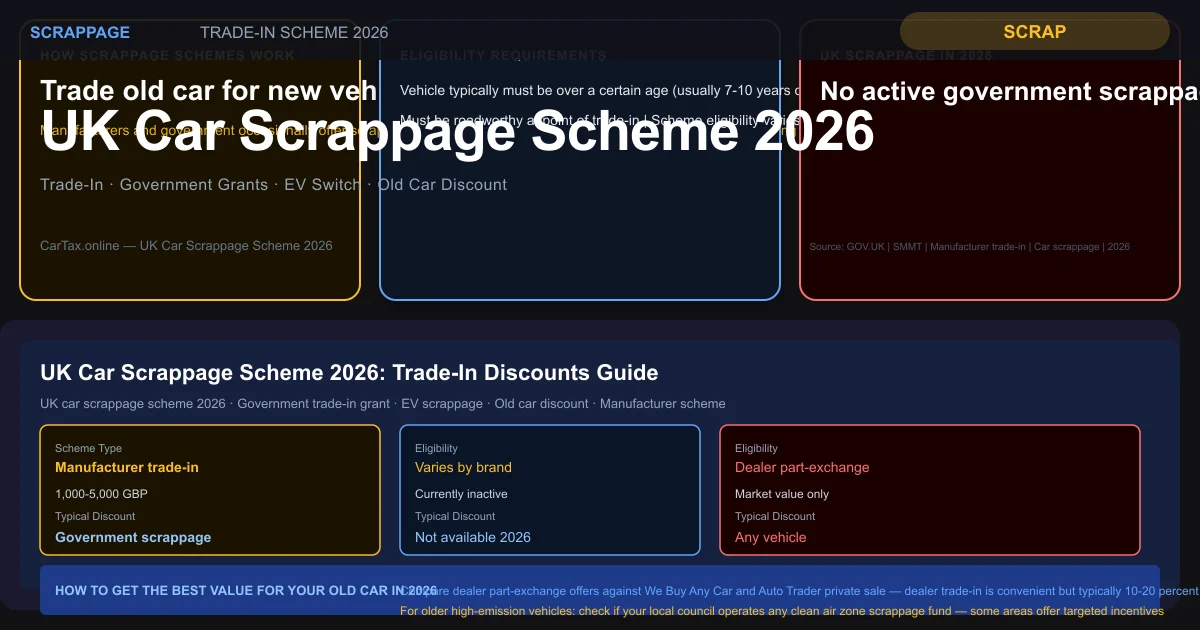
The UK car scrappage scheme is a government-backed programme designed to take high-emission older vehicles off the road. It offers eligible vehicle owners financial incentives to scrap their old car and, in many cases, switch to a newer, cleaner model. The scheme has operated intermittently since 2009, with the most recent manufacturer-run programmes continuing through 2026.
In essence, you trade in your old, polluting vehicle — typically one that fails to meet Euro 6 emission standards for diesel or Euro 4 for petrol — and receive a contribution toward either a new car purchase or a subscription to a mobility service. The incentive usually ranges from 1,000 to 2,000 GBP depending on the manufacturer and vehicle type.
Current Scheme Eligibility Criteria
To qualify for most scrappage programme options, vehicle owners must typically meet several conditions. The car being scrapped must usually be at least 12 months old and registered in the owner's name for at least 12 months prior to the application. The vehicle must also fail to meet current emissions standards — most often pre-Euro 6 diesel engines.
Age requirements vary by scheme. Manufacturer-backed schemes typically require the trade-in vehicle to be at least seven years old. Some local authority programmes accept vehicles from four years of age. All schemes require the vehicle to have a valid MOT at the time of disposal, though some programmes offer a free MOT test as part of the package. Related: Big Car Tax Changes Coming to UK 2026 | Car Tax Changes UK 2026 | Car Tax Rates UK 2026 | Check If Car Is Taxed UK.
How Much Does the Government Pay?
Government funding for scrappage schemes has varied across different programme iterations. In 2026, direct government grants for private car scrappage are not currently active as a standalone national programme. However, the Department for Transport has supported local authority initiatives, and major manufacturers continue to operate their own scrappage incentives as part of broader sales promotion strategies.
Manufacturer scrappage contributions typically range from 1,000 to 2,000 GBP off the purchase price of a new car. Some EV manufacturers offer higher incentives of up to 3,500 GBP when scrapping a qualifying vehicle and switching to a battery electric model. The exact figure depends on the manufacturer's programme, the age of the vehicle, and the type of new vehicle purchased.
Which Vehicles Qualify?
Eligibility largely depends on the vehicle's emissions classification. Pre-September 2015 diesel vehicles that do not meet Euro 6 standards are the primary targets. Pre-Euro 4 petrol vehicles also qualify under most programmes. The vehicle must be roadworthy or have a valid MOT at the point of scrappage.
Some schemes also target specific vehicle categories. Large panel vans and pick-up trucks that fail to meet Euro 6 diesel standards are frequently included. Motorcycles over a certain age may also be eligible under two-wheeled schemes. The qualifying emissions standard is listed in the vehicle's V5C registration certificate under the Euro emissions class field.
How to Claim Your Scrappage Payment
The process begins by identifying an active scheme. Check the Government website or contact a registered Authorised Treatment Facility (ATF) that participates in the scheme. Major car manufacturers also advertise their own programmes directly, with brands like Audi, BMW, Ford and Volkswagen regularly offering scrappage contributions as part of new car promotions.
Once you identify a suitable programme, you need to provide your V5C registration certificate, proof of identity, proof of address, and MOT certificate. The ATF will inspect the vehicle, and upon acceptance, they will issue a Certificate of Destruction and pay the scrappage contribution. The contribution is usually deducted from the purchase price of your new vehicle rather than paid as a cash sum.
Environmental Impact of Car Scrappage
The primary purpose of scrappage schemes is to remove the most polluting vehicles from UK roads. Older cars produce significantly higher levels of nitrogen oxides (NOx) and particulate matter (PM) than modern equivalents. A pre-Euro 6 diesel vehicle can produce up to four times more NOx than a Euro 6d-compliant model.
The environmental benefit extends beyond tailpipe emissions. Newer vehicles are also more fuel-efficient, so the switch typically reduces lifetime CO2 emissions even when accounting for manufacturing overhead. However, the Environmental Audit Committee has noted that scrappage schemes should be designed to encourage the switch to electric or hybrid vehicles rather than simply newer petrol or diesel models.
Alternatives to the Scrappage Scheme
If your vehicle does not qualify for a scrappage programme, or if no active scheme is available, several alternatives exist. Private sale may yield a higher price than scrappage value, particularly for vehicles in running condition. Part-exchange at a dealership also provides value, even for older vehicles.
Charitable donation is another route for vehicles that are still roadworthy. Charities such as Cars for Good accept vehicle donations and provide a tax deduction certificate based on the vehicle's market value. For non-roadworthy vehicles, direct disposal to an ATF typically pays between 150 and 400 GBP depending on the vehicle's weight and condition.
Scrappage Scheme vs Your Money Back
The financial return from a scrappage scheme is typically lower than the private market value of a running vehicle. However, it provides certainty — you know exactly what you will receive, and the process is streamlined. For vehicles that are mechanically failed or would be expensive to repair, the scrappage scheme often represents the best financial outcome.
When evaluating whether to use a scrappage scheme, compare the offered incentive against the private sale value or part-exchange offer. For vehicles worth under 500 GBP in private sale, a 1,000 GBP scrappage contribution is likely superior. For vehicles in good condition worth 2,000 GBP or more, a private sale is almost always more profitable.
Official Resources: GOV.UK Check Vehicle Tax | GOV.UK Vehicle Tax | DVLA Online | MOT Check
Frequently Asked Questions
Q: How much is car tax (VED) in the UK 2026?
Car tax rates in the UK depend on your vehicle's CO2 emissions and list price. Standard rates start from £190 per year for petrol and diesel cars, with zero-rated VED for EVs. First-year rates vary from £0 to £2,605 depending on emissions. Additional premiums apply for vehicles over £40,000.
Q: How do I check if my car is taxed online?
You can check your vehicle's tax status for free on the Gov.uk website at gov.uk/check-vehicle-tax. You'll need your vehicle's registration number (number plate). You can also check via the Motor Insurance Database to verify road tax and insurance status simultaneously.
Q: Can I get a refund on car tax if I sell my vehicle?
Yes — if you sell or scrap your vehicle, you can claim a refund on any full months of remaining road tax. Contact DVLA with the V11 reminder letter or apply online at gov.uk. Refunds are usually processed within 4-6 weeks.
Q: Is road tax refund available when transferring ownership?
No — road tax does not transfer with the vehicle. When you sell your car, the tax is automatically cancelled and any remaining months are refunded to you by DVLA. The new owner must tax the vehicle immediately. As a buyer, always verify the vehicle's tax status before purchasing.
Q: What is the luxury car tax threshold in the UK 2026?
The additional rate for vehicles over £40,000 (list price) adds £410 per year to standard VED rates for years 2-6 of registration. This surcharge brings the annual cost for high-emission vehicles over £40,000 to around £600-690 per year. Pure EVs under £40,000 pay zero VED.