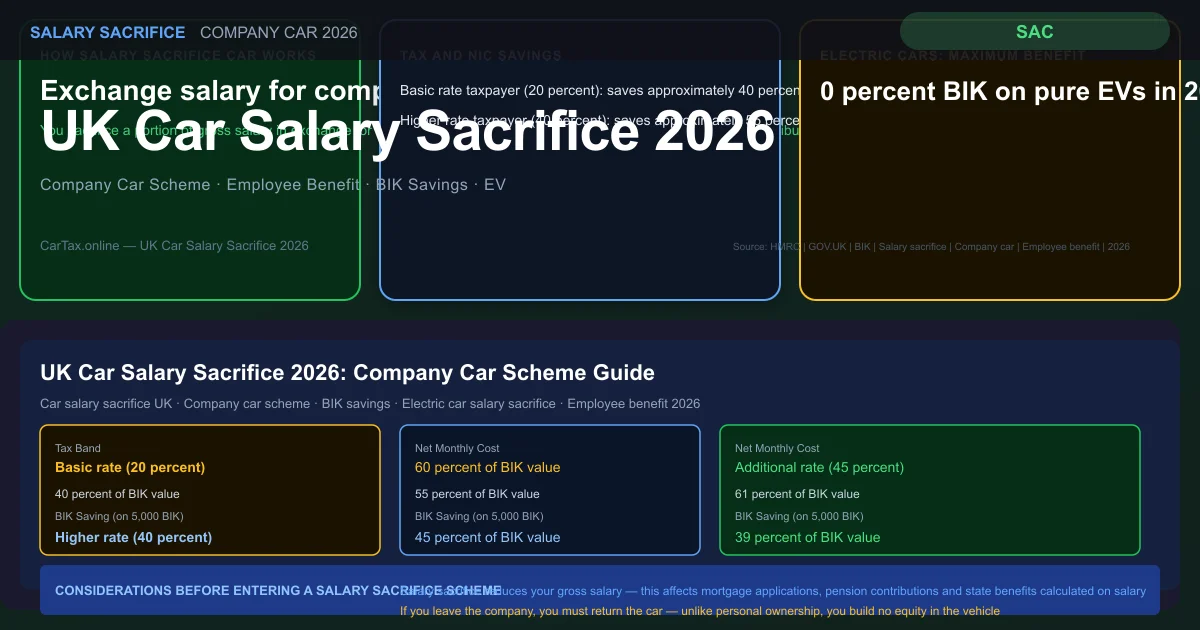
What Is a Car Salary Sacrifice Scheme?
A car salary sacrifice scheme allows an employee to exchange part of their gross salary for the use of a company car. Rather than receiving the cash and paying for a car themselves, the employee sacrifices salary before income tax and National Insurance contributions are calculated. This reduces their taxable income and, in most cases, results in a lower overall cost compared to purchasing or financing the same car privately.
The scheme is set up and administered by the employer, typically through a third-party fleet management company. The employer usually retains ownership of the vehicle and includes it in their company car fleet. The employee pays a monthly contribution deducted directly from their gross salary. Because the payment comes from gross salary, both the employee and employer save on National Insurance contributions.
Tax Benefits of Salary Sacrifice Cars
The primary tax advantage of a salary sacrifice car is the reduction in Income Tax. Because the payment is deducted from gross salary before tax is applied, the employee pays tax on a lower income. For a higher-rate taxpayer in the 40 percent band, a 400 GBP monthly sacrifice saves 160 GBP in income tax per month, compared to using post-tax income to pay for a privately funded car.
The benefit-in-kind (BIK) tax rate applied to salary sacrifice cars depends on the vehicle's CO2 emissions and fuel type. Ultra-low emission vehicles (under 75g/km) currently benefit from a 2 percent BIK rate, which is significantly lower than the 20 to 37 percent rates applied to higher-emission vehicles. This makes salary sacrifice particularly attractive for electric and hybrid vehicles. Related: Big Car Tax Changes Coming to UK 2026 | Car Tax Changes UK 2026 | Car Tax Rates UK 2026 | Check If Car Is Taxed UK.
National Insurance Savings
Salary sacrifice reduces the employee's National Insurance contributions because the sacrificed amount is excluded from the calculation of Class 1 NICs. For an employee paying the main 12 percent rate, a 400 GBP monthly sacrifice saves around 48 GBP in NIC per month. Higher-rate employees save 48 GBP per month at the 12 percent rate, with additional savings at the 2 percent rate on income above the upper earnings limit.
Employers also save on their National Insurance contributions because the sacrificed salary is not subject to employer's Class 1 NIC. This saving typically amounts to 13.8 percent of the sacrificed amount. Some employers pass a portion of these savings to employees through lower monthly contributions or better-inclusive maintenance packages.
Who Can Use a Salary Sacrifice Car Scheme?
Salary sacrifice car schemes are available through employers who have set up the facility with a fleet provider. Not all employers offer the scheme, so employees should check with their HR or benefits department. There is no specific legal restriction on who can participate, but the sacrificed salary must not reduce the employee's earnings below the National Minimum Wage or National Living Wage.
The scheme is most beneficial for higher-rate taxpayers who pay 40 percent income tax and 12 percent NIC on additional earnings. For basic-rate taxpayers, the savings are smaller but still meaningful, particularly when combined with the employer NIC saving that is often reflected in a more competitive scheme contribution rate.
Electric and Ultra-Low Emission Salary Sacrifice
Electric vehicles are particularly well-suited to salary sacrifice arrangements due to their low BIK rates. Under current HMRC rules, fully electric vehicles with CO2 emissions of 0g/km are taxed at a 2 percent BIK rate, compared to 20 to 37 percent for conventional petrol and diesel cars. For a 40,000 GBP electric car, the annual BIK tax liability at 2 percent is 800 GBP, compared to 11,100 GBP for an equivalent 37 percent vehicle.
This makes an electric salary sacrifice car significantly more affordable than a conventionally fuelled equivalent. Many employers use salary sacrifice schemes specifically to promote electric vehicle adoption as part of their net-zero commitments. The benefit to the employee is substantial — a Tesla Model 3 on salary sacrifice could cost 300 to 400 GBP per month less in tax and NIC than a privately funded purchase at equivalent monthly cost.
Considerations and Potential Drawbacks
Salary sacrifice arrangements have implications for pension contributions. Because the sacrifice reduces the employee's gross salary, it also reduces the amount on which pension contributions are calculated. This means the employee builds up a smaller pension entitlement during the sacrifice period. The salary sacrifice pension impact should be calculated before entering the scheme.
There is also a maximum list price cap of 80,000 GBP for vehicles eligible for salary sacrifice tax advantages. Vehicles above this price threshold attract a 37 percent BIK rate regardless of emissions, which largely negates the salary sacrifice benefit. Additionally, if the employee leaves the employment, the vehicle must be returned, and there may be termination charges depending on the remaining contract terms.
Official Resources: GOV.UK Check Vehicle Tax | GOV.UK Vehicle Tax | DVLA Online | MOT Check
Frequently Asked Questions
Q: How much is car tax (VED) in the UK 2026?
Car tax rates in the UK depend on your vehicle's CO2 emissions and list price. Standard rates start from £190 per year for petrol and diesel cars, with zero-rated VED for EVs. First-year rates vary from £0 to £2,605 depending on emissions. Additional premiums apply for vehicles over £40,000.
Q: How do I check if my car is taxed online?
You can check your vehicle's tax status for free on the Gov.uk website at gov.uk/check-vehicle-tax. You'll need your vehicle's registration number (number plate). You can also check via the Motor Insurance Database to verify road tax and insurance status simultaneously.
Q: Can I get a refund on car tax if I sell my vehicle?
Yes — if you sell or scrap your vehicle, you can claim a refund on any full months of remaining road tax. Contact DVLA with the V11 reminder letter or apply online at gov.uk. Refunds are usually processed within 4-6 weeks.
Q: Is road tax refund available when transferring ownership?
No — road tax does not transfer with the vehicle. When you sell your car, the tax is automatically cancelled and any remaining months are refunded to you by DVLA. The new owner must tax the vehicle immediately. As a buyer, always verify the vehicle's tax status before purchasing.
Q: What is the luxury car tax threshold in the UK 2026?
The additional rate for vehicles over £40,000 (list price) adds £410 per year to standard VED rates for years 2-6 of registration. This surcharge brings the annual cost for high-emission vehicles over £40,000 to around £600-690 per year. Pure EVs under £40,000 pay zero VED.