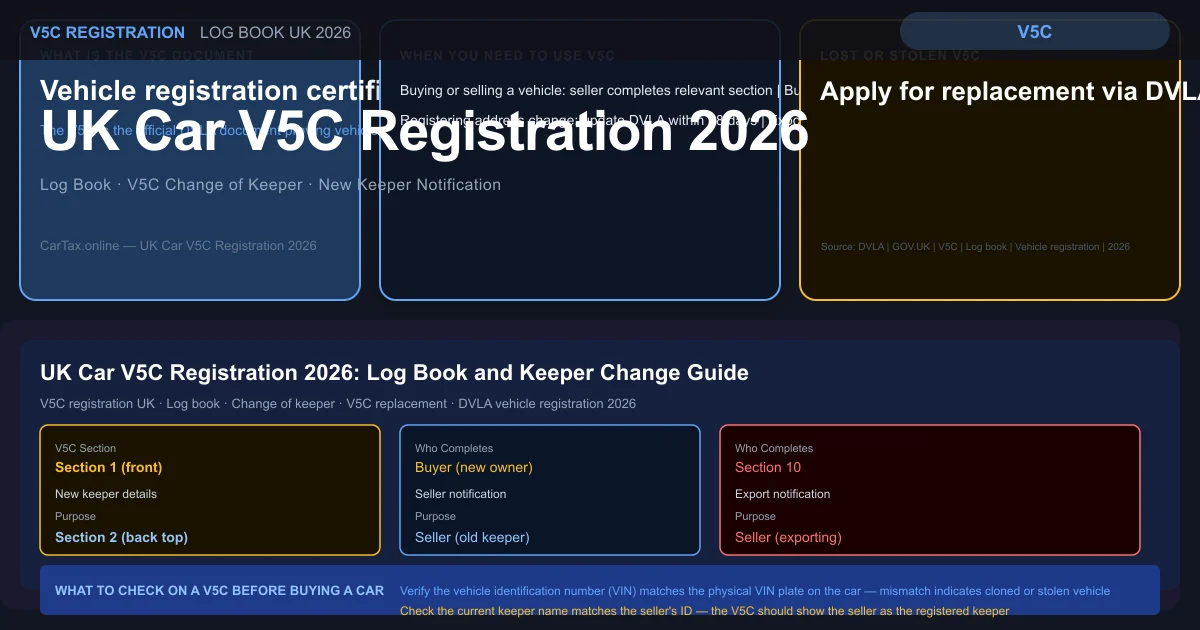
What Is the V5C Registration Certificate?
The V5C, commonly known as the vehicle log book, is the primary registration document for any vehicle registered in the United Kingdom. It provides official proof of who is the registered keeper of a vehicle and contains key details including the vehicle's identity, registration number, engine capacity, and emissions classification. The DVLA issues the V5C, and it is a legal requirement for any vehicle on a public road.
The V5C is split into two parts: the main log book document and the green slip at the bottom, which is the notification of sale section. When you buy or sell a vehicle, the seller fills in the green slip and sends it to the DVLA, while the buyer keeps the rest of the document. This process is critical for ensuring the recorded keeper is updated correctly.
How to Obtain a V5C for a New Vehicle
When you purchase a brand-new vehicle from a dealership, the franchised dealer typically handles the registration process on your behalf. They submit the application to the DVLA electronically, and the V5C is sent to your address within seven to 10 working days. The registration number is assigned either as a personal choice or from the available stock.
For new imported vehicles, the registration process is more involved. You must apply to the DVLA using the V55/1 form for a new vehicle, providing evidence of compliance with UK standards, foreign registration documents, and proof of identity. The DVLA may require an individual vehicle approval inspection if the vehicle has not been certified to UK specification. Related: Car Registration Hold UK 2026 | Big Car Tax Changes Coming to UK 2026 | Car Tax Changes UK 2026 | Car Tax Rates UK 2026.
Updating Keeper Details on the V5C
Whenever the registered keeper changes, the V5C must be updated. This applies to private sales, dealership purchases, gifts, and inheritances. The outgoing keeper completes Section 2 of the V5C, which is the Notification of Sale or Transfer, and sends it to the DVLA. Failure to notify the DVLA within 28 days of a transfer can result in a fine of up to 1,000 GBP.
The incoming keeper should complete Section 6 of the V5C and return it to the DVLA along with the notification of sale slip. The DVLA will then issue a new V5C in the new keeper's name within four to six weeks. If the new keeper does not receive the updated V5C within this timeframe, they can check the status online using the DVLA's vehicle enquiry service.
What Information Does the V5C Contain?
The V5C log book contains several important data points. The front page shows the vehicle's make, model, VIN (chassis number), engine number, colour, fuel type, and year of manufacture. It also shows the current registration number, the MOT due date, and the vehicle's revenue weight for tax purposes.
The middle pages record the vehicle's registration history, including previous keepers and any changes of registration number. The V5C also includes theVED class, which determines the vehicle's tax band. This information is essential for calculating road tax and understanding the vehicle's tax status.
Lost or Damaged V5C: How to Get a Replacement
If your V5C is lost, stolen, or damaged, you can apply for a replacement using the DVLA's online service or by post. The online replacement costs 15 GBP and is processed within five working days. By post, you use form V62 and send it to the DVLA with a 25 GBP fee. The replacement V5C will show the same details as the original.
When applying for a replacement, you need to provide your driving licence number, the vehicle's registration number, and your National Insurance number. The DVLA will verify the information against their records before issuing the replacement. If you have recently bought the vehicle and the V5C has not yet been transferred into your name, the process differs — you will need to contact the DVLA with additional supporting documentation.
V5C and Vehicle Taxation
The V5C document is directly connected to road tax through the VED system. The vehicle's tax class andVED band are recorded on the V5C, and these figures determine the annual or six-month road tax rate. Electric vehicles and some other categories receive zero-ratedVED, which is also recorded on the V5C.
When a vehicle changes keeper, the road tax does not transfer. The seller should cancel the tax and claim any remaining refund, while the new keeper must apply for tax before the vehicle can be driven. Driving an untaxed vehicle on a public road is an offence, regardless of whether the seller has already paid the tax.
Common V5C Errors and How to Fix Them
Errors on the V5C are more common than many people realise. Incorrect colour listings, wrong fuel types, and incorrect engine capacities all appear frequently. These errors can affect insurance validity and taxation calculations. If you notice an error, you should report it to the DVLA immediately with supporting evidence such as the MOT certificate or the manufacturer's certificate of conformity.
Address changes on the V5C should also be updated promptly. The registered keeper address must match your current address for DVLA correspondence to reach you. You can update the address online using the DVLA's change of address service at no cost. This change updates all vehicles registered in your name simultaneously.
Official Resources: GOV.UK Check Vehicle Tax | GOV.UK Vehicle Tax | DVLA Online | MOT Check
Frequently Asked Questions
Q: How much is car tax (VED) in the UK 2026?
Car tax rates in the UK depend on your vehicle's CO2 emissions and list price. Standard rates start from £190 per year for petrol and diesel cars, with zero-rated VED for EVs. First-year rates vary from £0 to £2,605 depending on emissions. Additional premiums apply for vehicles over £40,000.
Q: How do I check if my car is taxed online?
You can check your vehicle's tax status for free on the Gov.uk website at gov.uk/check-vehicle-tax. You'll need your vehicle's registration number (number plate). You can also check via the Motor Insurance Database to verify road tax and insurance status simultaneously.
Q: Can I get a refund on car tax if I sell my vehicle?
Yes — if you sell or scrap your vehicle, you can claim a refund on any full months of remaining road tax. Contact DVLA with the V11 reminder letter or apply online at gov.uk. Refunds are usually processed within 4-6 weeks.
Q: Is road tax refund available when transferring ownership?
No — road tax does not transfer with the vehicle. When you sell your car, the tax is automatically cancelled and any remaining months are refunded to you by DVLA. The new owner must tax the vehicle immediately. As a buyer, always verify the vehicle's tax status before purchasing.
Q: What is the luxury car tax threshold in the UK 2026?
The additional rate for vehicles over £40,000 (list price) adds £410 per year to standard VED rates for years 2-6 of registration. This surcharge brings the annual cost for high-emission vehicles over £40,000 to around £600-690 per year. Pure EVs under £40,000 pay zero VED.