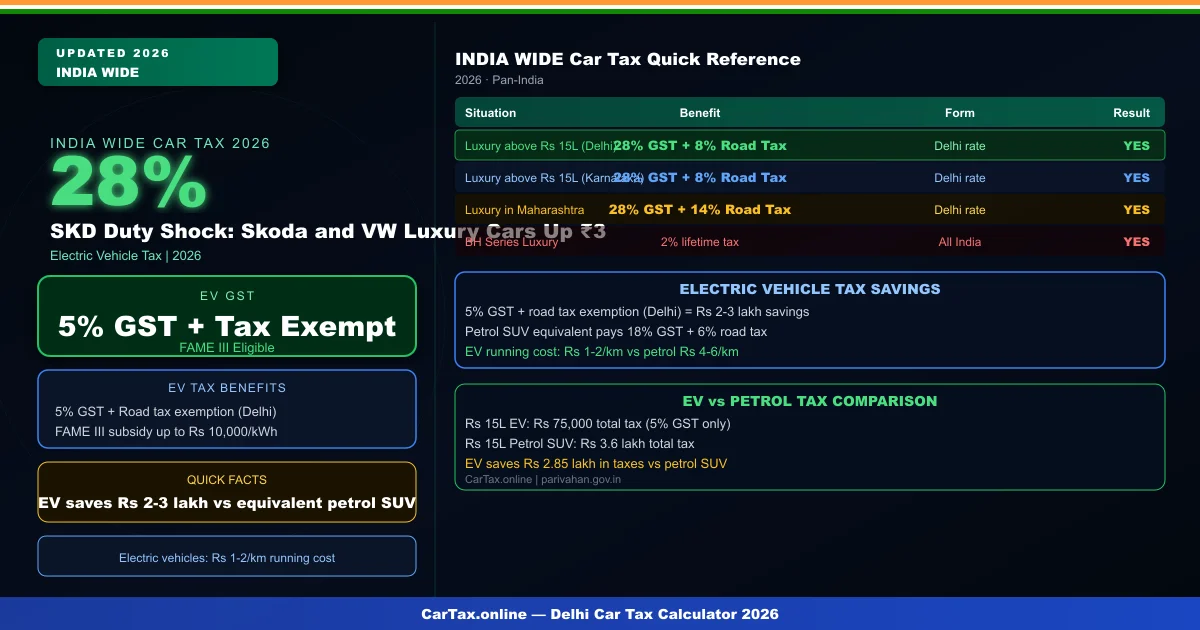
As of April 7, 2026, premium car buyers in India are waking up to significant price increases on some of the most popular European luxury vehicles. The Ministry of Finance's notification dated April 3, 2026 — effective immediately — has doubled the customs duty on Semi-Knocked Down (SKD) vehicle kits from 15% to 30%, triggering immediate price revisions from Skoda India and Volkswagen India on models that are assembled from SKD kits at their Chakan, Pune facility. The Skoda Superb, VW Tiguan, and Skoda Octavia are the primary casualties, with on-road prices jumping ₹3–5 lakh overnight. Here is what changed, which models are affected, and what buyers should do now.
What Is SKD and Why Does the Duty Hike Matter?
India's automotive import framework distinguishes between three levels of vehicle assembly:
- CBU (Completely Built Unit): Fully assembled vehicles imported from abroad — highest duty at 100%+ for vehicles above 3,000cc
- SKD (Semi-Knocked Down): Vehicles imported as major pre-assembled sub-assemblies (body-in-white, engine, transmission as separate units) and assembled in India — previously 15% duty, now 30%
- CKD (Completely Knocked Down): Vehicles imported as individual components and parts — lowest duty at 7–10% for most components, promotes maximum local assembly work
The SKD route has been the preferred path for European luxury brands that want to sell in India without building a full local manufacturing line. Skoda and Volkswagen import body shells, engines, and transmissions as pre-assembled sub-units from their Czech Republic and Germany plants, then assemble the final vehicle at Chakan. This allowed them to position cars like the Superb and Tiguan at relatively competitive prices by avoiding the 100%+ CBU duty while keeping quality consistent with European specifications.
With the duty now at 30%, the cost advantage of the SKD route over CBU has narrowed significantly — and Skoda India and VW India have passed the full additional cost to buyers.
Which Models Are Affected and By How Much?
The following models use the SKD assembly route at Chakan and face immediate price revisions as of April 7, 2026:
- Skoda Superb (L&K, Sportline): Old ex-showroom: ₹53.99 lakh | New ex-showroom: ₹57.50–58.50 lakh | Increase: ₹3.5–4.5 lakh
- Volkswagen Tiguan (Elegance, R-Line): Old ex-showroom: ₹35.17–39.99 lakh | New ex-showroom: ₹38.50–43.50 lakh | Increase: ₹3–4 lakh
- Skoda Octavia (Style, RS): Old ex-showroom: ₹35.99–39.99 lakh | New ex-showroom: ₹39.50–44.50 lakh | Increase: ₹3.5–5 lakh
- Volkswagen Passat (if available): Was already limited supply — CBU route — unaffected by SKD duty change
The on-road price impact is even larger. Adding road tax (9–14% depending on state) and registration on top of the higher ex-showroom price, a Skoda Superb buyer in Karnataka is now looking at an additional ₹5–6 lakh on-road compared to a booking made before April 3, 2026. Use our on-road price calculator to get the exact figure for your state.
Why the Government Hiked the SKD Duty
The Ministry of Finance's rationale for doubling the SKD duty is to push automakers toward deeper local manufacturing. The SKD route has been criticized as a form of duty arbitrage — importing nearly-complete vehicles as "kits" to access the lower duty rate without making meaningful investment in Indian manufacturing. The government's stated goal is to shift SKD assemblers to either:
- Full CKD local manufacturing with genuine component sourcing from Indian suppliers, or
- Accept CBU pricing for volumes too small to justify full CKD investment
The hike is specifically targeted at European brands. Japanese and Korean automakers (Toyota, Honda, Hyundai, Kia) predominantly use CKD manufacturing in India and are largely unaffected. The duty change is essentially a policy signal: invest more in India or pay more to sell here.
What Buyers Should Do: Alternatives and Timing
If you were planning to buy a Skoda Superb or VW Tiguan, the immediate price increase changes the calculus significantly. Here is how to think about your options:
- Honor existing bookings at old price: If you had a confirmed booking before April 3, 2026 with a booking amount paid, Skoda India has confirmed it will honor the pre-hike price for confirmed orders that were in the system before the duty notification date. Check with your dealer immediately and get written confirmation.
- Consider CKD-assembled alternatives: At ₹38–44 lakh, the VW Tiguan now overlaps with the Jeep Meridian (CKD, ₹30–37 lakh) and the Skoda Kodiaq — which uses the CKD MQB-India platform and is unaffected by the SKD duty change.
- Wait for Skoda/VW response: Both brands are reportedly evaluating a shift to deeper CKD production for high-volume models like the Tiguan. If this transition happens (12–18 month timeline at minimum), prices could moderate. The Superb, being a low-volume model, is unlikely to get CKD investment.
🧮 Calculate New On-Road Price in Your State
The SKD duty hike affects ex-showroom price — your road tax, registration, and on-road total depend on your state. Calculate the exact new on-road cost for the Tiguan or Superb in your state.
SKD vs CKD: The Key Difference for Car Prices
Many buyers are confused about why two similar-sounding import routes — SKD and CKD — carry such different duty rates. The logic is straightforward: the more work done in India, the lower the duty. CKD imports bring individual components — sheet metal pressings, plastic parts, wiring harnesses — that require Indian workers to assemble, weld, and paint. SKD imports skip most of that — the body arrives pre-painted and pre-welded, the engine arrives pre-built, requiring only final assembly work in India.
The government considers CKD as genuinely manufacturing in India; SKD as essentially importing a finished car in pieces. The duty differential is meant to price this distinction into the market.
Frequently Asked Questions
Are other European brands affected — BMW, Mercedes, Audi?
BMW, Mercedes-Benz, and Audi use CBU imports for most of their India-sold models, not the SKD route. Some BMW models (3 Series, 5 Series) are assembled at their Chennai plant under a genuine CKD process — these are unaffected by the SKD duty hike. The brands most impacted are those using the Chakan assembly facility under the Skoda-VW India partnership: Skoda and VW-branded models specifically.
Does this affect the upcoming Skoda Kylaq or Kushaq?
No — the Kylaq (sub-4m compact SUV) and Kushaq are built on the MQB-India CKD platform with significant local component content. These models are unaffected by the SKD duty hike. Only models assembled from imported pre-built sub-assemblies (Superb, Tiguan, Octavia) face the price increase. For official CBIC duty notifications, check cbic.gov.in.
Frequently Asked Questions
Q: What is the current road tax rate for cars in India 2026?
Road tax rates in India vary by state and vehicle category. For new cars, GST is charged at 5% for EVs, 18% for hybrids under 1,200cc, and up to 28% for petrol/diesel SUVs. State road tax is charged separately and varies from Rs3,000-15,000 annually depending on the state's slab system. Check your specific state's RTO website for current rates.
Q: How do I calculate my car road tax online in India?
You can calculate your car road tax using online calculators available on state RTO portals and CarTax.online. The calculation considers your vehicle's ex-showroom price, fuel type, engine capacity, and state of registration. Road tax is payable annually or for the vehicle's lifetime depending on your state's rules.
Q: Is GST included in the road tax for new cars in India?
No — GST and road tax are separate charges. GST is a central tax charged by the vehicle manufacturer at the time of purchase. State road tax is a separate annual or one-time charge levied by your state's transport department. Both apply at the time of first registration, and annual road tax continues for subsequent years.
Q: Do electric vehicles get tax benefits in India 2026?
Yes — electric vehicles in India qualify for a reduced GST rate of 5% (down from 28% for petrol cars). Under FAME-III subsidies, EVs may also qualify for additional state-level incentives, reduced road tax, and free registration in many states. The exact benefits vary by state.
Q: What happens if I don't pay my car road tax on time?
If you don't pay road tax, your vehicle's registration can be flagged in the Vahan database, preventing renewal of fitness certificates and creating legal liability during police checks. Penalties range from Rs200-500 per day of default in most states. Road tax is a legal requirement under the Motor Vehicles Act.