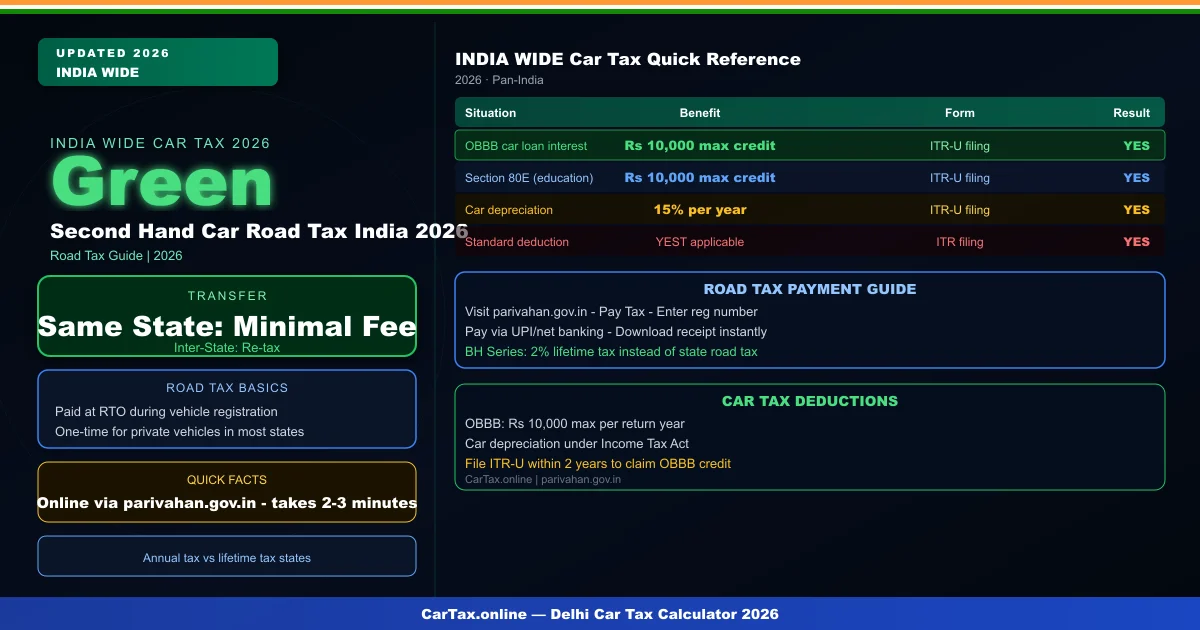
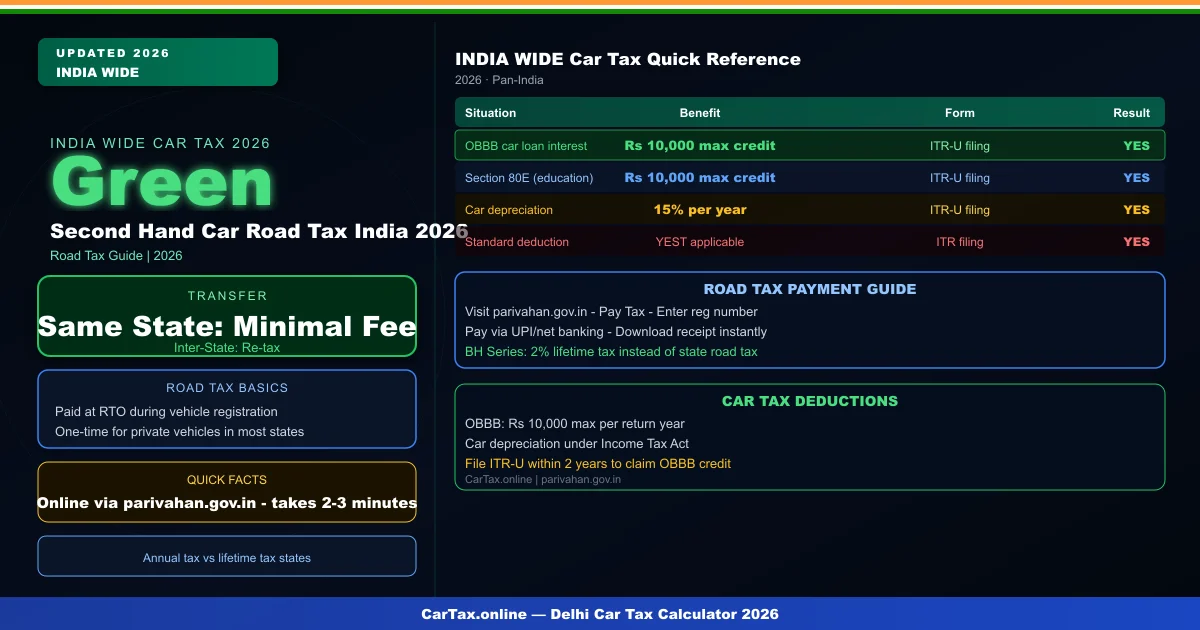
Second hand car road tax in India involves a complex set of charges that buyers and sellers must understand to avoid unexpected costs. Whether you are buying a pre-owned vehicle in the same state, purchasing across state lines, or transferring a car when moving to a new state, the road tax implications can add significant amounts to the transaction cost. This guide covers everything you need to know about second hand car road tax in India for 2026.
Road Tax on Second Hand Cars — Same State Transfer
When buying a second hand car within the same state, the main road tax consideration is whether the original road tax has been fully paid. For vehicles in lifetime tax states like Maharashtra and Karnataka, if the previous owner paid the one-time lifetime road tax, no additional road tax is required from the new buyer — the tax is attached to the vehicle, not the owner.
For annual tax states, you need to verify that all road tax installments are paid up to date before completing the purchase. Unpaid road tax becomes the responsibility of the new owner, and an RTO check during the transfer process may flag outstanding amounts that must be cleared before registration can proceed.
The ownership transfer fee at the RTO for same-state transfers ranges from Rs 500 to Rs 1,500 depending on the state and vehicle category. Additional charges include smart card update fees of Rs 200 and hypothecation endorsement fees of Rs 100-150 if the vehicle has an existing loan that needs to be transferred or removed.
Inter-State Second Hand Car Purchases and Re-tax
Purchasing a second hand car registered in a different state triggers the re-tax requirement. Re-tax is mandatory if you bring the vehicle to your home state for permanent use. The re-tax amount is calculated based on the remaining useful life of the vehicle and the road tax rate applicable in your destination state.
For example, a 5-year-old INR 12 lakh car originally registered in Delhi with road tax paid at 6% (Rs 72,000) being transferred to Karnataka faces re-tax calculated as follows: Karnataka road tax rate of 13% applied to the depreciated value of the vehicle over its remaining 10-year useful life. This can amount to Rs 60,000-80,000 in re-tax — a significant cost that is often overlooked by buyers focused only on the purchase price of the vehicle.
The original state road tax is generally not refunded when re-tax is paid in the new state. This creates a situation where the vehicle effectively pays road tax twice. Buyers purchasing inter-state used cars should factor this re-tax cost into their total acquisition budget.
NOC and Transfer Process for Second Hand Cars
The transfer process for second hand cars involves obtaining a No Objection Certificate (NOC) from the original state RTO if the vehicle is being sold to a buyer in a different state. The NOC application costs approximately Rs 100-200 and can be applied for online through the Parivahan portal.
For inter-state transfers, the process involves obtaining NOC from the original RTO, paying re-tax at the destination RTO, and completing the fresh registration in the new state. This entire process typically takes 2-4 weeks and costs Rs 30,000 to over Rs 1,00,000 in re-tax alone for mid-range vehicles.
Tips for Second Hand Car Buyers Regarding Road Tax
Before purchasing any second hand car, run a Parivahan check using the vehicle registration number to verify its road tax payment status, fitness certificate validity, and any outstanding challans or blacklisting. For inter-state purchases, always get a re-tax estimate from the destination state RTO before finalizing the deal.
Frequently Asked Questions
Do I need to pay road tax again when buying a second hand car?
In lifetime tax states, no additional road tax is required if the original owner paid the one-time tax. In annual tax states, verify that all annual tax payments are current. For inter-state transfers, re-tax is mandatory in the destination state.
How is re-tax calculated for second hand cars in India?
Re-tax is calculated based on the destination state's road tax rate multiplied by the vehicle's current market value (after depreciation) multiplied by the remaining useful life percentage.
Can I avoid re-tax by keeping the original state registration?
Technically, you can keep the vehicle registered in the original state, but if you establish permanent residence in a new state, the Motor Vehicles Act requires you to register the vehicle in the new state within 30 days.
What documents do I need for second hand car road tax transfer?
For same-state transfer: original RC, sale deed, valid insurance, pollution certificate, buyer and seller ID proofs. For inter-state: add NOC from original RTO, re-tax payment receipt, and Form 28.
Is the original road tax refunded when transferring a car to another state?
Generally, the original state road tax is not refunded when you pay re-tax in the new state. Some states may offer partial refunds of unexpired tax periods, but this is state-specific.
Conclusion
Second hand car road tax is a critical cost that many buyers overlook. Same-state transfers require only transfer fees of Rs 500-1,500 at the RTO. Inter-state transfers can cost Rs 30,000 to over Rs 1,00,000 in re-tax alone for mid-range vehicles. Always run a Parivahan check on the vehicle before purchase, verify road tax payment status, and get a re-tax estimate from your destination state RTO before finalizing any inter-state used car deal.
Disclaimer: This article is for informational purposes only. Tax rules and processes may change. Verify current procedures at parivahan.gov.in or your nearest RTO.