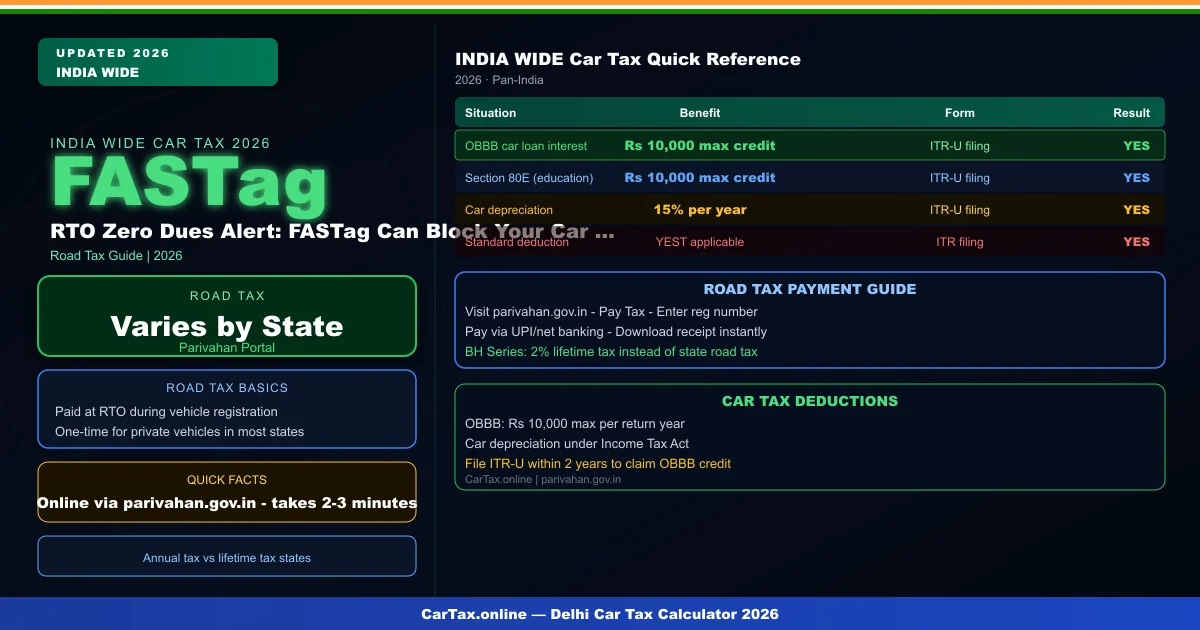
As of April 10, 2026 in India, a new Ministry of Road Transport and Highways (MoRTH) circular has made zero pending FASTag dues and traffic challans mandatory for any car sale, NOC application, or RC ownership transfer. If you are planning to sell your car — or buy a used one — and there is even ₹1 of outstanding toll dues or a single unpaid challan linked to the vehicle's FASTag, the Parivahan portal will block the entire transaction. Here is everything you need to know and the exact steps to fix it.
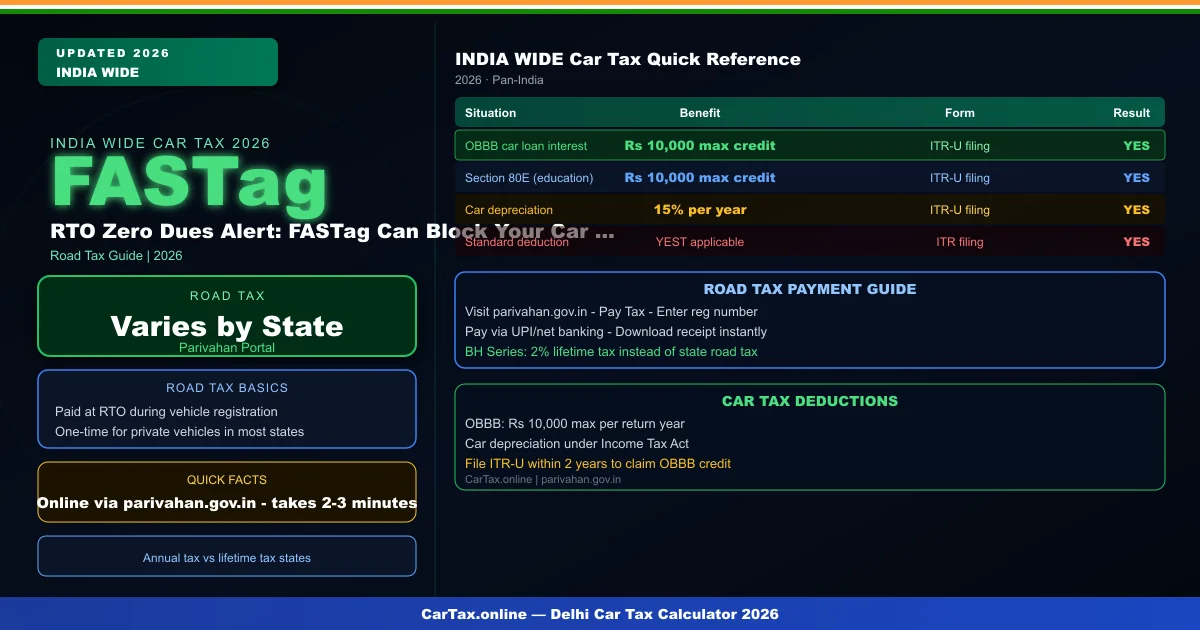
What Is the RTO Zero Dues Rule and When Did It Come Into Effect?
The Ministry of Road Transport and Highways issued a circular in March 2026 mandating that the Parivahan Sewa portal must verify zero outstanding dues before processing any of the following transactions:
- NOC (No Objection Certificate) for inter-state vehicle transfer
- Ownership transfer (Form 29/30 RC transfer) within the same state
- Vehicle deregistration (before scrapping or permanent export)
- Hypothecation removal (after loan repayment)
The system works by automatically querying the IHMCL (Indian Highways Management Company Limited) FASTag database and the national e-challan system for any pending dues linked to the vehicle's registration number before approving the transaction.
What Exactly Blocks Your Car Sale?
There are two primary types of dues that can block your car sale or transfer:
1. FASTag Pending Toll Dues
If your FASTag has a negative balance or an outstanding toll transaction that failed (due to insufficient balance), the IHMCL database flags the vehicle. Even ₹12 of unpaid toll can block an RC transfer worth ₹5 lakh. This commonly happens when:
- The FASTag auto-recharge failed (bank account debit failed)
- The FASTag was blacklisted for non-payment and then reactivated without clearing dues
- Disputed toll deductions that were not resolved with the bank
2. Pending Traffic Challans
Any traffic challan — whether issued by the physical traffic police, red light camera, speed camera, or ANPR system — that remains unpaid against the vehicle's registration number will block the transfer. Even challans from states other than where the vehicle is currently registered are included in the national e-challan database.
🛠 Step-by-Step: How to Clear Dues and Sell Your Car
| Step | Action | Portal/App | Time |
|---|---|---|---|
| 1 | Check FASTag balance and outstanding dues | ihmcl.com or your bank FASTag app | 5 min |
| 2 | Check pending challans by registration number | echallan.parivahan.gov.in | 5 min |
| 3 | Pay all challan dues online | echallan.parivahan.gov.in | Instant |
| 4 | Recharge FASTag and clear negative balance | Bank FASTag app / ihmcl.com | 1–3 days sync |
| 5 | Apply for NOC (inter-state) or initiate RC transfer | parivahan.gov.in | 15–30 days |
How to Check FASTag Dues Before Selling Your Car
There are three ways to check if your FASTag has any outstanding dues:
- Your bank's FASTag app or netbanking: HDFC, ICICI, SBI, Paytm, PhonePe — all show real-time FASTag balance, recent transactions, and any pending/failed deductions
- IHMCL portal (ihmcl.com): Log in with your vehicle registration number and mobile number. Shows FASTag status (active/blacklisted/expired) and outstanding balance
- NETC FASTag portal (netc.in): The National Electronic Toll Collection portal allows vehicle registration-based lookup of linked FASTag status
If your FASTag shows a negative balance or blacklisted status, pay the outstanding amount through the bank portal. After payment, the IHMCL database typically updates within 24–72 hours. Do not attempt the RC transfer before the status shows as active with zero dues.
Road Tax Refund When Selling Across States
If your vehicle was originally registered in a high-road-tax state (Maharashtra 11%, Karnataka 13.5%, Telangana 14%) and the buyer is re-registering in another state, you as the seller may be eligible for a prorated road tax refund from the original RTO. The formula is:
Refund = (Road tax paid × Remaining registration years) ÷ Total registration period (15 years)
For example, if you paid ₹1.1 lakh in road tax in Maharashtra and are selling after 5 years, you may be eligible for a refund of approximately ₹62,000. Apply at the original RTO within 12 months of de-registration using Form 33.
BH Series Owners Are Exempt from NOC
If your vehicle is registered under the Bharat Series (BH) scheme, you do not need an NOC when transferring the vehicle to a buyer in a different state. The BH Series number plate was introduced specifically to eliminate the NOC barrier for central government employees and multi-state company employees. This makes selling a BH-registered car significantly faster and simpler than a standard state registration.
For the official Parivahan portal and e-challan payment, visit parivahan.gov.in. For FASTag status check, visit ihmcl.com. Use our India Car Tax Calculator to estimate road tax costs when buying your next car.
Frequently Asked Questions
Can I sell my car if I have a pending court challan?
No — court challans (issued by a traffic magistrate, not just traffic police) are treated as pending legal dues and will block the RC transfer. You must pay the court challan penalty, obtain a receipt, and have the record updated in the e-challan system before the Parivahan portal will allow the transfer.
How long does it take for paid challan dues to clear in the system?
For online payments made through echallan.parivahan.gov.in, the status typically updates in 2–5 business days. For payments made at RTO counters or through bank challans, it may take 5–10 business days. Wait for the status to show as cleared before initiating the RC transfer.
Does the buyer need to transfer FASTag when buying a used car?
Yes — after RC transfer is complete, the seller's FASTag must be closed or reassigned. The buyer should obtain a new FASTag linked to their vehicle registration number (now updated to their name). Operating with the seller's FASTag after ownership transfer is a violation and can lead to the buyer's transactions being rejected at toll plazas.