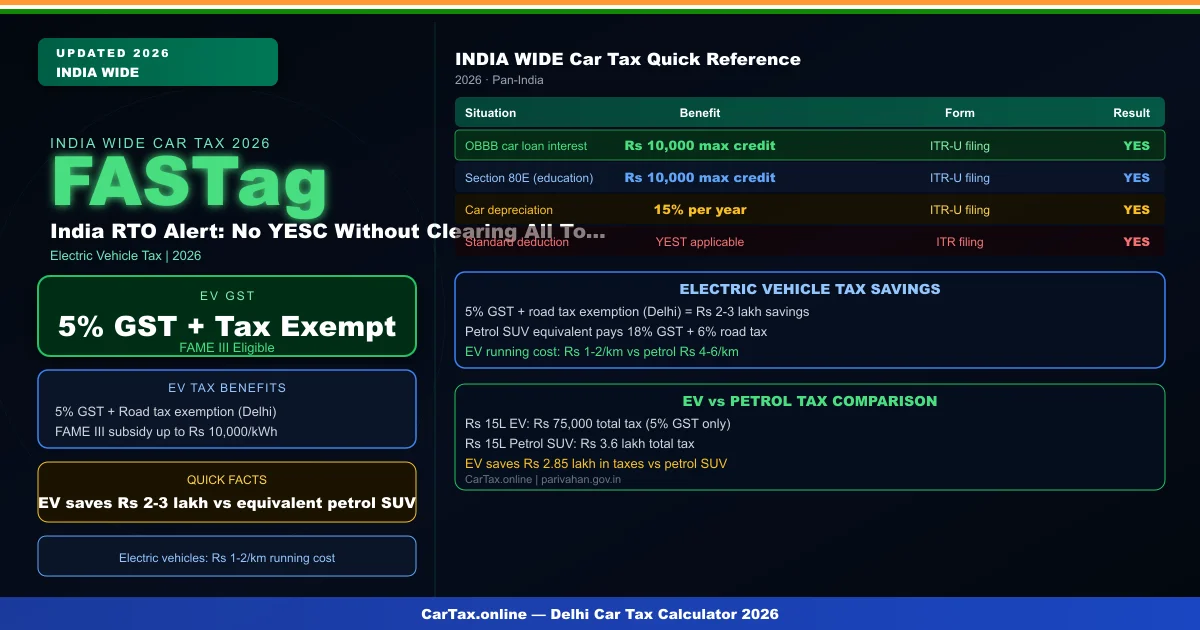
As of April 6, 2026, vehicle owners across India who have pending FASTag toll dues are encountering a major new obstacle. Under the India RTO toll dues NOC mandate introduced through the Central Motor Vehicles (Second Amendment) Rules 2026 — effective April 1, 2026 — you cannot obtain a No Objection Certificate (NOC) for vehicle transfer or renew your fitness certificate without first clearing all outstanding toll arrears linked to your vehicle's FASTag account. The rule is already blocking hundreds of pending vehicle sales across major metros. Here is what changed, how to check your dues, and the exact steps to get your vehicle cleared before your next RTO visit.
What Changed: India RTO Toll Dues NOC Rule 2026
The Central Motor Vehicles (Second Amendment) Rules 2026 — notified by the Ministry of Road Transport and Highways in March 2026 — amended Form 28 (Application for NOC) to include a mandatory FASTag compliance declaration. The revised Form 28 requires the applicant to submit a "Zero Outstanding Toll Dues Certificate" from the issuing bank of the FASTag linked to the vehicle being transferred. Similarly, the fitness certificate renewal form (Form 38A for transport vehicles; applicable Form C for private vehicles in select states) now requires verification against the National Highway Authority of India's toll recovery database.
Why the Rule Was Introduced
The NHAI's shift to barrier-less toll collection — where ANPR cameras automatically debit FASTag accounts as vehicles pass through toll plazas at normal speed — created a growing problem of unrecovered dues. Vehicles with blacklisted or zero-balance FASTag accounts continued to use national highways without paying, accumulating dues that remained unrecovered at vehicle sale. The new rule closes this gap by making toll compliance a prerequisite for any ownership change or fitness renewal, ensuring that dues cannot be passed to a new owner.
Which Transactions Are Affected?
- NOC for interstate vehicle transfer: Cannot be issued with outstanding FASTag dues
- Fitness Certificate renewal (transport vehicles): Blocked if dues exceed ₹500 in aggregate
- Private vehicle sale transfer (Form 29/30): NOC from the original RTO is now required in all states — previously waived in some intrastate transfers
- Hypothecation removal (loan clearance): Not directly affected, but delays in NOC can delay hypothecation removal if NOC is a linked step in your state
How to Check Your FASTag Outstanding Toll Dues
- Log in to your FASTag issuing bank's portal or app (ICICI, HDFC, SBI, Paytm, Axis, etc.) and check the account statement for any "toll shortfall" or "blacklist" entries
- Use the NHAI FASTag portal at fastag.ihmcl.com — enter your vehicle registration number to see any NHAI-flagged outstanding amounts
- Check the VAHAN portal at parivahan.gov.in — the FASTag compliance section now shows a green/red indicator linked to NHAI's toll recovery database
- Request a Zero Dues Certificate from your FASTag issuing bank after clearing all outstanding amounts — this document is what the RTO requires with Form 28
How to Clear Outstanding FASTag Dues
Outstanding FASTag dues can arise from three scenarios: (a) insufficient balance at the time of crossing, (b) FASTag account blacklisted due to non-payment, or (c) disputed deductions from incorrect toll readings. For each:
- Insufficient balance dues: Recharge your FASTag account and pay the shortfall through your issuing bank's portal — most banks process this within 24 hours
- Blacklisted FASTag: Pay the full outstanding amount through the bank portal and request de-blacklisting — this typically takes 48–72 hours
- Disputed deductions: File a dispute through NHAI's toll grievance portal (nhai.gov.in/en/grievances) with your vehicle's photo evidence from the toll plaza — resolution time is 5–10 working days
According to the Ministry of Road Transport and Highways, all FASTag compliance queries can be addressed through the FASTag helpline and the Vahan portal at parivahan.gov.in. The ministry notes that approximately 94% of FASTag accounts maintain zero outstanding dues, meaning most vehicle owners are unaffected by the new rule.
🧮 Calculate Your Car's Full On-Road and Registration Cost
RTO fees, road tax, and registration charges vary by state. Get the complete on-road price breakdown for any vehicle before you buy or sell.
What Buyers of Used Vehicles Should Do Before Purchase
If you are buying a used vehicle, the FASTag compliance check is now your responsibility as part of pre-purchase due diligence. Before completing the transaction:
- Ask the seller to show you the current FASTag account balance and the last 6 months of transaction history
- Verify on the VAHAN portal that the vehicle shows a green FASTag compliance indicator
- Request the Zero Dues Certificate from the seller — the document they must submit with Form 28
- If buying from a dealer, ask for the FASTag compliance check to be included in the dealer's pre-delivery inspection report
Frequently Asked Questions
What if I have disputed FASTag deductions — will my NOC be blocked?
Yes — even disputed amounts block the NOC until the dispute is resolved. File your dispute through the NHAI grievance portal immediately. If the dispute resolution timeline exceeds your NOC deadline, the NHAI has a provision for a conditional Zero Dues Certificate when an active dispute is on record. Contact your RTO and the NHAI helpline to request this provision.
Does this rule apply to two-wheelers with FASTag?
Two-wheeler FASTag adoption has been voluntary in most states through 2025. The NOC compliance requirement currently applies to four-wheelers and above — the categories for which FASTag is mandatory under NHAI rules. If your two-wheeler carries an optional FASTag, any outstanding dues on that account are not included in the NOC compliance check as of April 2026.
My FASTag is linked to an account that is closed — what should I do?
If your FASTag-linked bank account has been closed but the FASTag VRN remains active in the NHAI database, you may have accumulated unpaid toll attempts. Contact your original FASTag issuing bank to transfer the balance to a new account, or visit the bank branch to resolve the account closure and settle any outstanding amounts before requesting your Zero Dues Certificate.
Frequently Asked Questions
Q: What is the current road tax rate for cars in India 2026?
Road tax rates in India vary by state and vehicle category. For new cars, GST is charged at 5% for EVs, 18% for hybrids under 1,200cc, and up to 28% for petrol/diesel SUVs. State road tax is charged separately and varies from Rs3,000-15,000 annually depending on the state's slab system. Check your specific state's RTO website for current rates.
Q: How do I calculate my car road tax online in India?
You can calculate your car road tax using online calculators available on state RTO portals and CarTax.online. The calculation considers your vehicle's ex-showroom price, fuel type, engine capacity, and state of registration. Road tax is payable annually or for the vehicle's lifetime depending on your state's rules.
Q: Is GST included in the road tax for new cars in India?
No — GST and road tax are separate charges. GST is a central tax charged by the vehicle manufacturer at the time of purchase. State road tax is a separate annual or one-time charge levied by your state's transport department. Both apply at the time of first registration, and annual road tax continues for subsequent years.
Q: Do electric vehicles get tax benefits in India 2026?
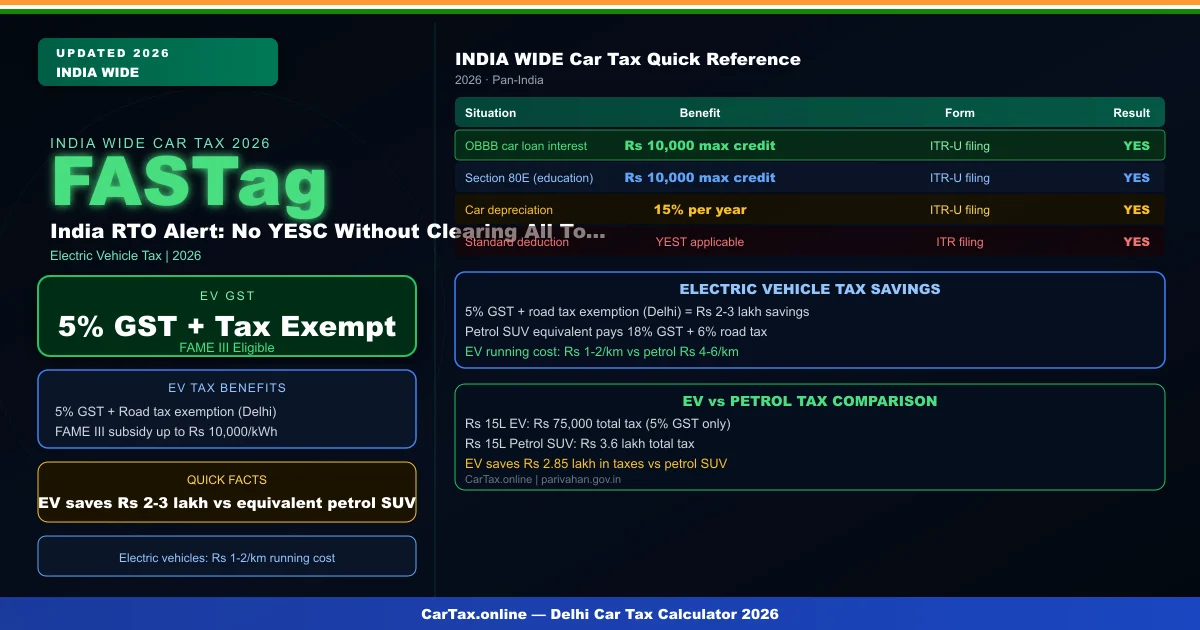
Yes — electric vehicles in India qualify for a reduced GST rate of 5% (down from 28% for petrol cars). Under FAME-III subsidies, EVs may also qualify for additional state-level incentives, reduced road tax, and free registration in many states. The exact benefits vary by state.
Q: What happens if I don't pay my car road tax on time?
If you don't pay road tax, your vehicle's registration can be flagged in the Vahan database, preventing renewal of fitness certificates and creating legal liability during police checks. Penalties range from Rs200-500 per day of default in most states. Road tax is a legal requirement under the Motor Vehicles Act.