How Road Tax Works for Electric Vehicles in India
India's shift toward electric vehicles is accelerating in 2026, and road tax policy plays a crucial role in making EVs financially attractive compared to petrol and diesel alternatives. Each state sets its own road tax for electric vehicles, creating a landscape where the same EV can cost significantly more or less to register depending on the state you live in.
The Motor Vehicles Act allows states to set road tax rates for EVs at their discretion. This has resulted in a wide range of approaches — from full exemptions in some states to reduced rates in others. Since EVs do not consume petrol or diesel, they contribute less to road maintenance funds through fuel duties, making road tax exemptions a form of partial cost recovery that states have adopted at varying levels.
FAME-II Subsidies and Their Role
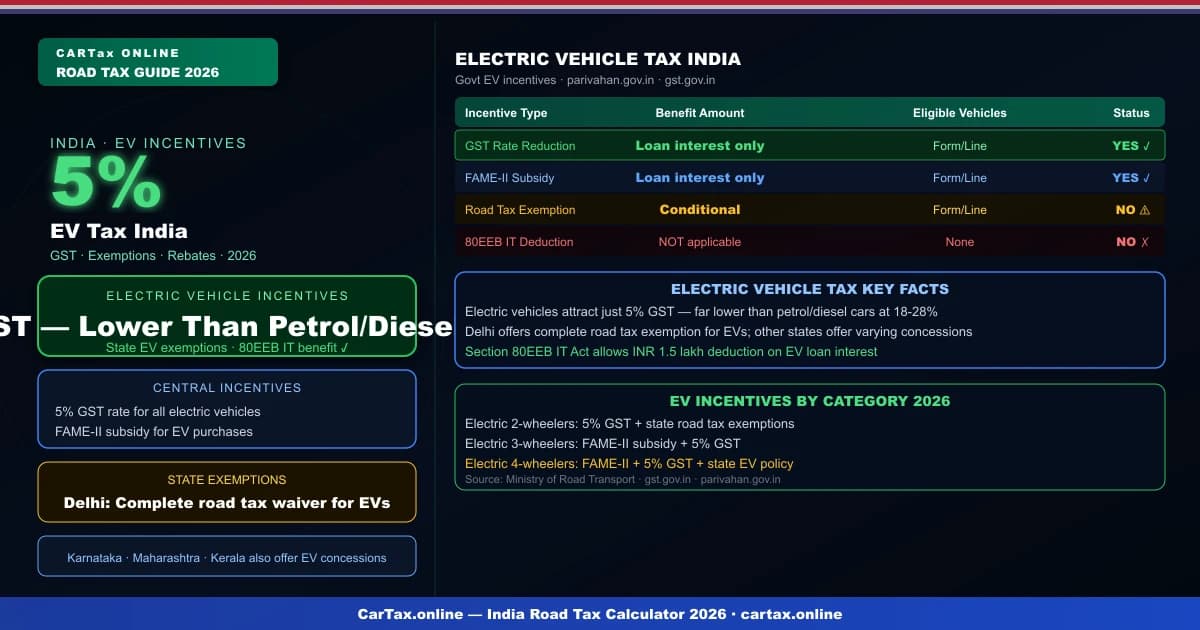
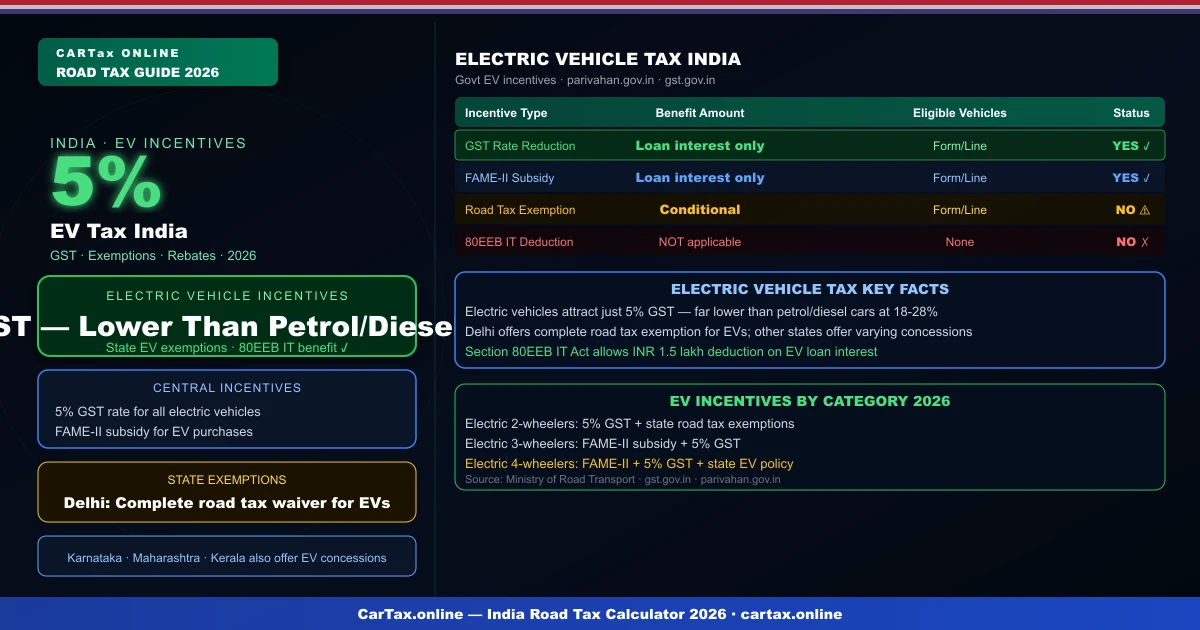
The Faster Adoption and Manufacturing of Electric Vehicles (FAME-II) scheme run by the central government provides purchase subsidies for eligible EVs. FAME-II subsidies are separate from road tax — they reduce the vehicle's purchase price at the dealership level, while road tax concessions reduce the registration cost at the RTO.
As of April 2026, FAME-II covers two-wheelers, three-wheelers, buses, and light commercial vehicles. The subsidy amount varies by vehicle category and battery capacity. Always confirm current subsidy amounts with the dealer, as FAME-II fund allocation changes periodically based on government budget allocations.
State-Wise Electric Vehicle Road Tax in 2026
Delhi — EVs enjoy significant road tax exemptions under the Delhi EV Policy. Electric two-wheelers and cars typically receive near-full or complete road tax waivers, making Delhi one of the most EV-friendly states for registration costs.
Maharashtra — The state's EV policy provides road tax concessions for electric vehicles. Electric two-wheelers and cars qualify for reduced road tax compared to equivalent petrol vehicles. The exact reduction varies by vehicle category and price bracket.
Karnataka — Karnataka's EV policy promotes electric mobility with road tax concessions available for qualifying electric two-wheelers and cars. The state has been particularly active in building charging infrastructure in Bangalore and other urban centres.
Tamil Nadu — Tamil Nadu's EV policy provides road tax exemptions for qualifying electric vehicles. As India's automotive manufacturing hub, the state has been proactive in supporting EV production and adoption.
Gujarat — Gujarat's EV promotion framework offers road tax concessions for electric vehicles. Electric two-wheelers and cars may qualify for reduced or waived road tax under current incentives.
Kerala — Kerala promotes electric mobility through its EV policy with road tax concessions available for qualifying EVs. The state's environmental focus has accelerated EV adoption in urban areas.
Rajasthan — Rajasthan's EV policy is expanding incentives for electric vehicles. Road tax concessions for EVs are available under current eligibility criteria, though the programme is more recent than in southern states.
Section 80EEB — Income Tax Deduction for EV Loans
Under Section 80EEB of the Income Tax Act, buyers of electric vehicles can claim a deduction of up to INR 1,50,000 on the interest paid on loans used to purchase an EV. This deduction is available for loans taken from financial institutions or banks for electric vehicles purchased before March 31, 2027 (subject to extensions). The vehicle must be a new electric vehicle — used EVs do not qualify.
This deduction is in addition to any road tax savings and FAME-II subsidies, making EVs increasingly competitive on total cost of ownership compared to petrol vehicles over a 5-7 year ownership period.
Charging Infrastructure Considerations
Before buying an EV, consider the charging infrastructure available in your area. Delhi, Mumbai, Bangalore, Chennai, and other major cities have expanding public charging networks, while smaller cities may require home charging solutions. The cost of installing a home charging point (approximately INR 15,000-30,000) is worth factoring into your EV purchase budget alongside road tax savings.
Frequently Asked Questions
Are electric vehicles exempt from road tax in India?
For the most accurate answer related to Electric vehicle tax India 2026, visit the official Parivahan portal at parivahan.gov.in or contact your nearest Regional Transport Office. Tax rules and rates are updated periodically by state governments, so always verify current information before making financial decisions.
What is FAME-II and how does it affect EV pricing?
For the most accurate answer related to Electric vehicle tax India 2026, visit the official Parivahan portal at parivahan.gov.in or contact your nearest Regional Transport Office. Tax rules and rates are updated periodically by state governments, so always verify current information before making financial decisions.
Can I claim both road tax exemption and FAME-II subsidy on the same EV?
For the most accurate answer related to Electric vehicle tax India 2026, visit the official Parivahan portal at parivahan.gov.in or contact your nearest Regional Transport Office. Tax rules and rates are updated periodically by state governments, so always verify current information before making financial decisions.
Is there an income tax benefit for buying an electric vehicle in India?
For the most accurate answer related to Electric vehicle tax India 2026, visit the official Parivahan portal at parivahan.gov.in or contact your nearest Regional Transport Office. Tax rules and rates are updated periodically by state governments, so always verify current information before making financial decisions.
How much can I save on road tax by buying an EV instead of a petrol car?
For the most accurate answer related to Electric vehicle tax India 2026, visit the official Parivahan portal at parivahan.gov.in or contact your nearest Regional Transport Office. Tax rules and rates are updated periodically by state governments, so always verify current information before making financial decisions.
Conclusion
Electric vehicle tax India 2026 varies significantly by state, and understanding your specific state's policy can save you INR 10,000 to over INR 1,00,000 in road tax depending on the vehicle price. Combine road tax savings with FAME-II purchase subsidies and Section 80EEB IT deductions, and EVs are increasingly competitive on total cost of ownership. Use our EV tax guide to calculate your total EV savings across all available incentives.
Frequently Asked Questions
Q: What is the current road tax rate for cars in India 2026?
Road tax rates in India vary by state and vehicle category. For new cars, GST is charged at 5% for EVs, 18% for hybrids under 1,200cc, and up to 28% for petrol/diesel SUVs. State road tax is charged separately and varies from Rs3,000-15,000 annually depending on the state's slab system. Check your specific state's RTO website for current rates.
Q: How do I calculate my car road tax online in India?
You can calculate your car road tax using online calculators available on state RTO portals and CarTax.online. The calculation considers your vehicle's ex-showroom price, fuel type, engine capacity, and state of registration. Road tax is payable annually or for the vehicle's lifetime depending on your state's rules.
Q: Is GST included in the road tax for new cars in India?
No — GST and road tax are separate charges. GST is a central tax charged by the vehicle manufacturer at the time of purchase. State road tax is a separate annual or one-time charge levied by your state's transport department. Both apply at the time of first registration, and annual road tax continues for subsequent years.
Q: Do electric vehicles get tax benefits in India 2026?
Yes — electric vehicles in India qualify for a reduced GST rate of 5% (down from 28% for petrol cars). Under FAME-III subsidies, EVs may also qualify for additional state-level incentives, reduced road tax, and free registration in many states. The exact benefits vary by state.
Q: What happens if I don't pay my car road tax on time?
If you don't pay road tax, your vehicle's registration can be flagged in the Vahan database, preventing renewal of fitness certificates and creating legal liability during police checks. Penalties range from Rs200-500 per day of default in most states. Road tax is a legal requirement under the Motor Vehicles Act.