All Types of Car Tax in India — What You Actually Pay
When you buy a car in India, the on-road price is made up of multiple taxes layered on top of each other. Most buyers focus only on the ex-showroom price, only to be surprised by the total bill at the dealership. In April 2026, understanding car tax in India means knowing five distinct types of taxes that apply to vehicle purchases.
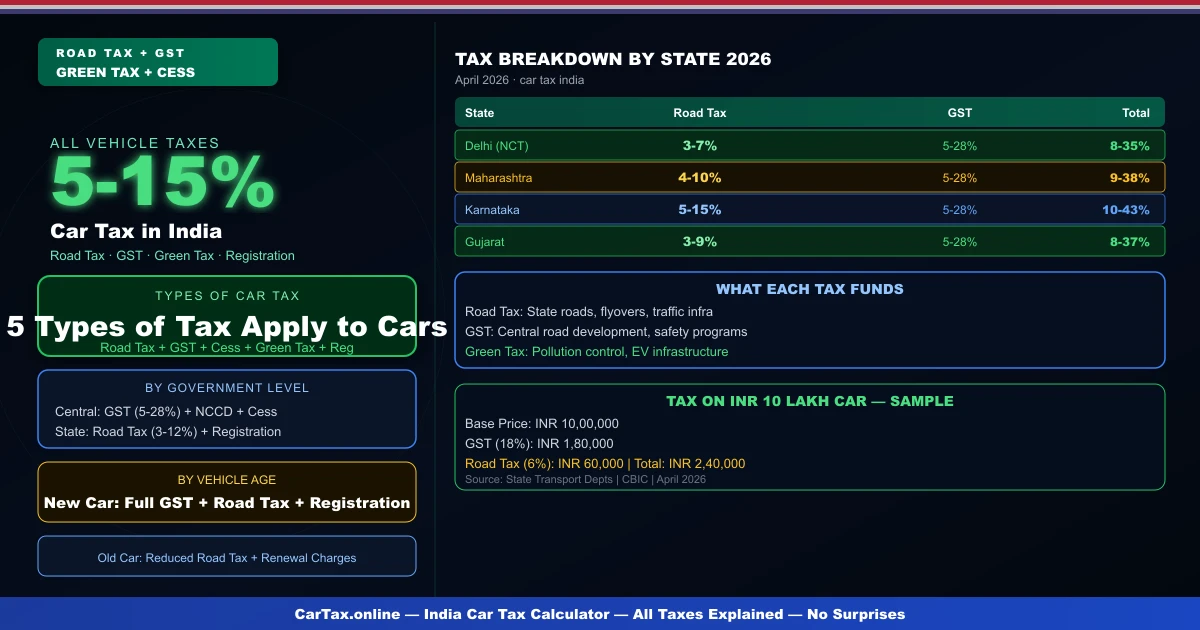
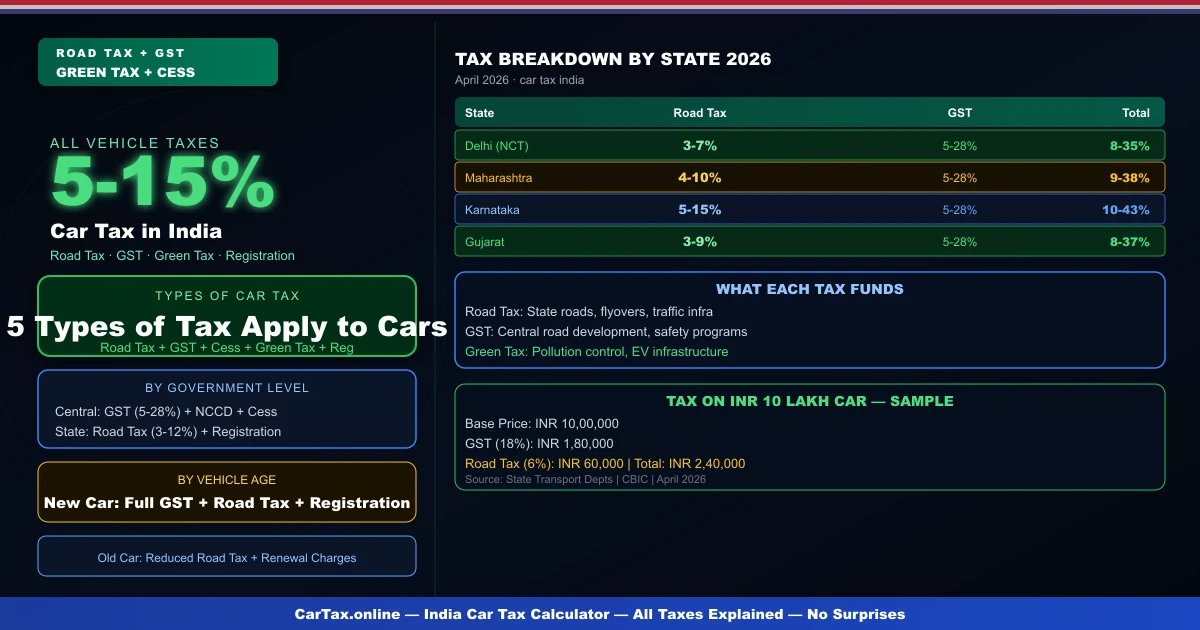
These taxes come from two levels of government. The central government levies GST, the National Calamity Contingent Duty (NCCD), and compensation cess. State governments levy road tax and registration fees. Together, these can add 15% to 45% to the ex-showroom price of a vehicle.
GST — The Central Goods and Services Tax
GST replaced multiple indirect taxes in 2017 and is now the primary central tax on cars. The GST rate on cars varies by vehicle category: small petrol cars under 4 metres with engine capacity under 1,200cc attract 5% GST. Most mid-size cars attract 18% GST. Large SUVs, luxury sedans, and diesel vehicles above 1,500cc attract 22-28% GST plus additional compensation cess.
Electric cars attract the lowest GST rate at 5% with no compensation cess, making EVs significantly cheaper at the point of purchase compared to equivalent petrol or diesel vehicles.
Road Tax — State-Level Vehicle Taxation
Road tax is levied by state governments under the Motor Vehicles Act and funds road construction, maintenance, and traffic management in each state. Road tax rates vary dramatically between states and are calculated on the vehicle's ex-showroom price.
States like Delhi charge 3-7% lifetime road tax, while Karnataka charges 5-15% for premium vehicles. Maharashtra ranges from 4-10%, Gujarat from 3-9%, and Rajasthan from 3-9%. The road tax on a INR 10 lakh car can therefore range from INR 30,000 in Delhi to INR 1,50,000 in Karnataka — a difference of INR 1.2 lakh depending on where you register the vehicle.
Green Tax — Environmental Levy on Older Vehicles
Green tax is a relatively recent addition to India's car tax landscape, introduced to address vehicle pollution in cities. As of April 2026, most states charge green tax on vehicles that are 10 years old or older. The tax is typically INR 2,000-8,000 per year for petrol cars and INR 5,000-15,000 per year for diesel cars, paid during annual registration renewal.
Electric vehicles are exempt from green tax across all states. Hybrid vehicles receive a 50% concession on green tax in most states. The green tax for cars is collected by state transport departments and funds pollution control boards and clean air initiatives.
Compensation Cess — Luxury and SUV Surcharge
Compensation cess is levied on top of GST for certain vehicle categories to compensate states for any loss of revenue from the GST transition. Large SUVs, luxury sedans, and diesel vehicles with engine capacity above 1,500cc attract cess of up to 22% in addition to the 22-28% GST rate. This effectively means some luxury SUVs carry a total central tax of 35-50% on the vehicle's assessable value.
Registration Fees and Fastag Charges
Beyond the major taxes, registration fees (INR 200-1,500 depending on the state), Fastag charges (INR 100-500), and optional extended warranty or accessory packages add to the on-road price. These are smaller items but can add INR 3,000-10,000 to the final bill.
State-Wise Car Tax Comparison in 2026
For a mid-size car priced at INR 10 lakh ex-showroom, here is how total car tax compares across major states: Delhi (NCT) totals approximately INR 2.4 lakh (18% GST + 6% road tax), Maharashtra totals approximately INR 2.4 lakh (18% GST + 6% road tax), Karnataka totals approximately INR 2.8 lakh (18% GST + 10% road tax), and Gujarat totals approximately INR 2.1 lakh (18% GST + 3% road tax).
Frequently Asked Questions
What are the different types of tax on cars in India?
For the most accurate information about car tax in india, visit the official Parivahan portal or your nearest Regional Transport Office. Tax rules, rates, and exemptions are updated periodically by government authorities, so always verify current information before making financial decisions.
Which state has the lowest road tax for cars in India?
For the most accurate information about car tax in india, visit the official Parivahan portal or your nearest Regional Transport Office. Tax rules, rates, and exemptions are updated periodically by government authorities, so always verify current information before making financial decisions.
How is GST calculated on cars in India?
For the most accurate information about car tax in india, visit the official Parivahan portal or your nearest Regional Transport Office. Tax rules, rates, and exemptions are updated periodically by government authorities, so always verify current information before making financial decisions.
What is green tax and which cars need to pay it?
For the most accurate information about car tax in india, visit the official Parivahan portal or your nearest Regional Transport Office. Tax rules, rates, and exemptions are updated periodically by government authorities, so always verify current information before making financial decisions.
Is there a cess or surcharge on luxury cars in India?
For the most accurate information about car tax in india, visit the official Parivahan portal or your nearest Regional Transport Office. Tax rules, rates, and exemptions are updated periodically by government authorities, so always verify current information before making financial decisions.
Conclusion
Car tax in India is a multi-layered system with taxes from both central and state governments. Use our car tax calculator to get an exact breakdown for your vehicle, state, and purchase price before visiting the dealership. Knowing the total tax burden upfront prevents the common surprise of discovering the on-road price is significantly higher than the ex-showroom quote.
Frequently Asked Questions
Q: What is the current road tax rate for cars in India 2026?
Road tax rates in India vary by state and vehicle category. For new cars, GST is charged at 5% for EVs, 18% for hybrids under 1,200cc, and up to 28% for petrol/diesel SUVs. State road tax is charged separately and varies from Rs3,000-15,000 annually depending on the state's slab system. Check your specific state's RTO website for current rates.
Q: How do I calculate my car road tax online in India?
You can calculate your car road tax using online calculators available on state RTO portals and CarTax.online. The calculation considers your vehicle's ex-showroom price, fuel type, engine capacity, and state of registration. Road tax is payable annually or for the vehicle's lifetime depending on your state's rules.
Q: Is GST included in the road tax for new cars in India?
No — GST and road tax are separate charges. GST is a central tax charged by the vehicle manufacturer at the time of purchase. State road tax is a separate annual or one-time charge levied by your state's transport department. Both apply at the time of first registration, and annual road tax continues for subsequent years.
Q: Do electric vehicles get tax benefits in India 2026?
Yes — electric vehicles in India qualify for a reduced GST rate of 5% (down from 28% for petrol cars). Under FAME-III subsidies, EVs may also qualify for additional state-level incentives, reduced road tax, and free registration in many states. The exact benefits vary by state.
Q: What happens if I don't pay my car road tax on time?
If you don't pay road tax, your vehicle's registration can be flagged in the Vahan database, preventing renewal of fitness certificates and creating legal liability during police checks. Penalties range from Rs200-500 per day of default in most states. Road tax is a legal requirement under the Motor Vehicles Act.