What Is Green Tax for Cars in India — April 2026
Green tax is an environmental levy imposed on older, more polluting vehicles in India. Introduced under the Motor Vehicles Act, it is collected by state transport departments during annual registration renewal. In April 2026, most states have implemented green tax for cars that are 10 years old or older, with the revenue directed toward pollution control boards and clean air programmes.
The rationale behind green tax is straightforward: older vehicles emit significantly more pollution per kilometre than newer models that comply with BS6 emission standards. By charging owners for the environmental cost of operating older vehicles, the tax creates an economic incentive to retire or upgrade to cleaner vehicles.
Green Tax Rates for Cars in 2026
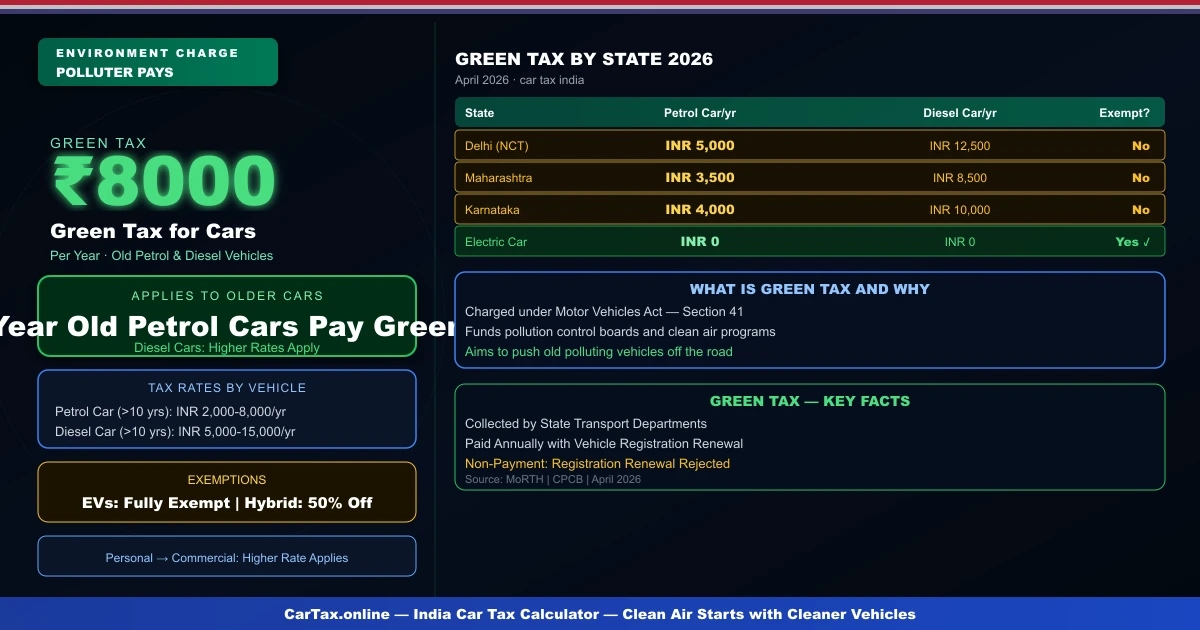
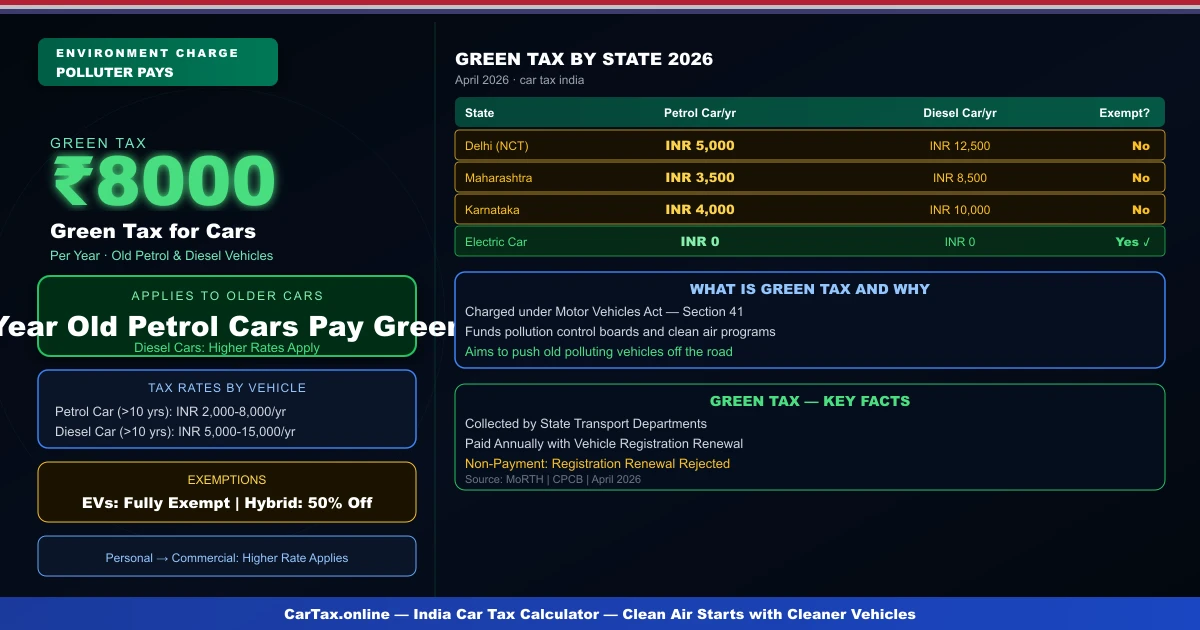
Green tax rates for cars vary by state and fuel type. In most states, petrol cars older than 10 years pay green tax of approximately INR 2,000-5,000 per year during registration renewal. Diesel cars older than 10 years pay significantly more — approximately INR 5,000-12,500 per year — reflecting their higher pollution footprint.
States like Delhi, which face severe air quality challenges, charge higher green tax rates than states with better air quality metrics. The exact rates in your state should be confirmed with the local RTO or on the Parivahan portal.
Exemptions and Concessions
Electric vehicles are fully exempt from green tax across all states — this exemption applies to both pure EVs and does not extend to hybrid vehicles in most states, though some states offer a 50% concession on green tax for hybrids. Personal vehicles converted from petrol to electric are also exempt from green tax for the remaining life of the vehicle in several states.
Vehicles used for specific purposes — ambulances, fire brigades, and government vehicles — may qualify for exemptions in certain states. Agricultural vehicles and tractors are typically exempt as they operate under different regulatory frameworks.
How Green Tax Differs from Road Tax and Cess
Green tax is often confused with road tax or compensation cess, but it is a distinct levy with a different purpose. Road tax funds road infrastructure — construction, maintenance, and traffic management. Green tax funds pollution control and clean air initiatives. Compensation cess on luxury vehicles is a revenue-raising measure related to GST transition, not an environmental levy.
All three taxes are separate line items in your vehicle's total tax bill. Road tax is typically paid once (lifetime) or annually depending on the state. Green tax is paid annually at the time of registration renewal for vehicles over 10 years old.
How to Pay Green Tax Online
Green tax can be paid online through the Parivahan portal alongside your annual registration renewal. Select your state, navigate to vehicle-related services, and choose the renewal option. The system will automatically calculate any applicable green tax based on the vehicle's age and fuel type.
Payment is accepted via net banking, UPI, debit card, and credit card. Download the receipt immediately — it serves as your proof of green tax payment and is required for successful registration renewal.
The Future of Green Tax in India
Several state governments are considering increasing green tax rates and lowering the vehicle age threshold from 10 years to 7 years as air quality standards tighten. Delhi has already discussed bringing forward the implementation of stricter norms. If you own an older vehicle, planning for higher green tax costs — or considering an upgrade to a BS6-compliant or electric vehicle — is increasingly prudent.
Frequently Asked Questions
What is green tax for cars in India and who needs to pay it?
For the most accurate information about green tax for cars, visit the official Parivahan portal or your nearest Regional Transport Office. Tax rules, rates, and exemptions are updated periodically by government authorities, so always verify current information before making financial decisions.
How much is green tax for petrol and diesel cars in 2026?
For the most accurate information about green tax for cars, visit the official Parivahan portal or your nearest Regional Transport Office. Tax rules, rates, and exemptions are updated periodically by government authorities, so always verify current information before making financial decisions.
Are electric vehicles exempt from green tax?
For the most accurate information about green tax for cars, visit the official Parivahan portal or your nearest Regional Transport Office. Tax rules, rates, and exemptions are updated periodically by government authorities, so always verify current information before making financial decisions.
How do I pay green tax online for my car?
For the most accurate information about green tax for cars, visit the official Parivahan portal or your nearest Regional Transport Office. Tax rules, rates, and exemptions are updated periodically by government authorities, so always verify current information before making financial decisions.
What is the difference between green tax, road tax, and cess?
For the most accurate information about green tax for cars, visit the official Parivahan portal or your nearest Regional Transport Office. Tax rules, rates, and exemptions are updated periodically by government authorities, so always verify current information before making financial decisions.
Conclusion
Green tax for cars is an annual reality for owners of vehicles over 10 years old. Understanding the rates in your state, planning for the cost at renewal time, and considering whether an upgrade to a BS6 or electric vehicle makes financial sense will help you manage this growing expense. Pay green tax online through the Parivahan portal during your annual registration renewal to avoid any lapse in your vehicle's registration status.
Frequently Asked Questions
Q: What is the current road tax rate for cars in India 2026?
Road tax rates in India vary by state and vehicle category. For new cars, GST is charged at 5% for EVs, 18% for hybrids under 1,200cc, and up to 28% for petrol/diesel SUVs. State road tax is charged separately and varies from Rs3,000-15,000 annually depending on the state's slab system. Check your specific state's RTO website for current rates.
Q: How do I calculate my car road tax online in India?
You can calculate your car road tax using online calculators available on state RTO portals and CarTax.online. The calculation considers your vehicle's ex-showroom price, fuel type, engine capacity, and state of registration. Road tax is payable annually or for the vehicle's lifetime depending on your state's rules.
Q: Is GST included in the road tax for new cars in India?
No — GST and road tax are separate charges. GST is a central tax charged by the vehicle manufacturer at the time of purchase. State road tax is a separate annual or one-time charge levied by your state's transport department. Both apply at the time of first registration, and annual road tax continues for subsequent years.
Q: Do electric vehicles get tax benefits in India 2026?
Yes — electric vehicles in India qualify for a reduced GST rate of 5% (down from 28% for petrol cars). Under FAME-III subsidies, EVs may also qualify for additional state-level incentives, reduced road tax, and free registration in many states. The exact benefits vary by state.
Q: What happens if I don't pay my car road tax on time?
If you don't pay road tax, your vehicle's registration can be flagged in the Vahan database, preventing renewal of fitness certificates and creating legal liability during police checks. Penalties range from Rs200-500 per day of default in most states. Road tax is a legal requirement under the Motor Vehicles Act.