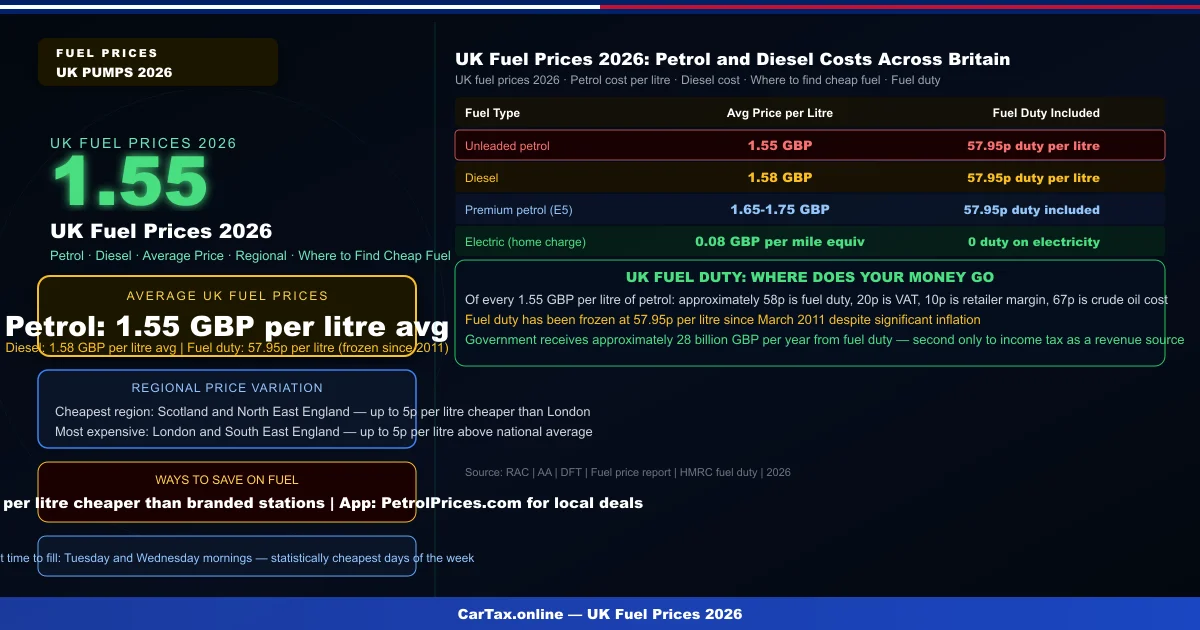
Fuel prices in the UK have been a major concern for drivers throughout 2024 and 2025, with pump prices remaining persistently high relative to global oil prices due to the structure of the UK fuel market and the fuel duty regime. Understanding where your money goes at the pumps and how to find the cheapest fuel can save the average driver hundreds of pounds per year.
Average UK Fuel Prices 2026
As of April 2026, average UK fuel prices stand at approximately 1.55 GBP per litre for unleaded petrol and 1.58 GBP per litre for diesel. Premium fuels (E5 super-unleaded at 97+ octane) typically cost 1.65 to 1.75 GBP per litre. These prices remain historically high, with fuel duty frozen at 57.95 pence per litre since March 2011.
At these prices, filling a typical 50-litre petrol tank costs approximately 77.50 GBP. For a driver covering 10,000 miles per year in a family car averaging 40 mpg, annual fuel expenditure is approximately 1,400 to 1,600 GBP.
Where Does Your Money Go: Fuel Duty Breakdown
Of every 1.55 GBP per litre of petrol, approximately 58 pence is fuel duty (hydrocarbon oil duty), making it by far the largest component. A further 20 pence is VAT at 20 percent applied to the combined pump price. The remainder is split between retailer margin (approximately 10 pence) and the crude oil cost (approximately 67 pence based on current oil prices). Related: UK Petrol Prices 2026 | UK Motoring Costs 2026 | UK Advisory Fuel Rates 2026 | UK Car Fuel Consumption Guide 2026.
The government receives approximately 28 billion GBP per year from fuel duty, making it the second largest source of tax revenue after income tax. Fuel duty has been frozen at 57.95 pence per litre since 2011 despite cumulative inflation of approximately 35 percent over that period.
Regional Price Variation Across the UK
Fuel prices vary significantly by region in the UK. Scotland and the North East of England consistently have the cheapest fuel, up to 5 pence per litre below the national average. London and the South East are typically the most expensive regions, up to 5 pence per litre above the national average. Wales and Northern Ireland also tend to have above-average prices.
Using price-comparison apps such as PetrolPrices.com or the AA Fuel Price Comparator can identify the cheapest local fuel stations, potentially saving 3 to 5 pence per litre on a full tank.
Motorway Fuel Premium
Motorway fuel stations consistently charge 5 to 10 pence per litre more than comparable off-motorway stations. Filling a 50-litre tank at a motorway service station versus a supermarket can cost 2.50 to 5.00 GBP more. Planning to fill up before joining the motorway is one of the most straightforward fuel savings available.
Supermarket Fuel: The Cheapest Option
Supermarket fuel stations (Asda, Morrisons, Tesco, Sainsbury's) consistently offer the cheapest fuel in the UK market, typically 3 to 5 pence per litre below the national average. This price advantage comes from high volumes, lower retail margins and location economics. The quality of fuel from supermarket stations is identical to that from branded stations.
Best Time to Buy Fuel
Fuel prices follow weekly and seasonal patterns. Tuesdays and Wednesdays are statistically the cheapest days of the week to fill up, while Sundays and Mondays tend to be the most expensive. Prices tend to be slightly lower in the morning than the afternoon. Avoiding Bank Holiday weekends, when demand peaks, is advisable.
Electric Vehicle Fuel Cost Comparison
For comparison, charging an electric vehicle at home on a standard tariff costs approximately 8 pence per mile equivalent. A BEV covering 10,000 miles per year would cost approximately 800 GBP in electricity at current rates, versus 1,400 to 1,600 GBP in petrol for an equivalent petrol car. Public rapid charging at 50 to 80 pence per kWh brings the cost closer to 15 to 25 pence per mile, making it more comparable to petrol but still typically cheaper.
Frequently Asked Questions
How much is fuel duty in the UK? Fuel duty is currently 57.95 pence per litre, frozen since March 2011. This means it has not increased in over 15 years in nominal terms, though inflation has eroded its real value significantly.
What is the cheapest day to buy fuel in the UK? Tuesday and Wednesday mornings are statistically the cheapest days to buy fuel. Sunday and Monday tend to be the most expensive.
Why is motorway fuel so expensive? Motorway fuel stations charge premium prices because they have captive customers who cannot easily drive to an alternative station. They also pay premium rents to motorway operators.
Is supermarket fuel the same quality as branded fuel? Yes. All UK fuel must meet the same EN 228 (petrol) and EN 590 (diesel) standards regardless of retailer. The only differences are detergent additives, where branded fuel sellers may offer premium formulations.
Official Resources: Parivahan Portal | Vahan Road Tax | India GST Portal | FAME-III Scheme
Frequently Asked Questions
Q: What is the current road tax rate for cars in India 2024?
Road tax rates in India vary by state and vehicle category. For new cars, GST is charged at 5% for EVs, 18% for hybrids under 1,200cc, and up to 28% for petrol/diesel SUVs. State road tax is charged separately and varies from Rs3,000-15,000 annually depending on the state's slab system. Check your specific state's RTO website for current rates.
Q: How do I calculate my car road tax online in India?
You can calculate your car road tax using online calculators available on state RTO portals and CarTax.online. The calculation considers your vehicle's ex-showroom price, fuel type, engine capacity, and state of registration. Road tax is payable annually or for the vehicle's lifetime depending on your state's rules.
Q: Is GST included in the road tax for new cars in India?
No — GST and road tax are separate charges. GST is a central tax charged by the vehicle manufacturer at the time of purchase. State road tax is a separate annual or one-time charge levied by your state's transport department. Both apply at the time of first registration, and annual road tax continues for subsequent years.
Q: Do electric vehicles get tax benefits in India 2024?
Yes — electric vehicles in India qualify for a reduced GST rate of 5% (down from 28% for petrol cars). Under FAME-III subsidies, EVs may also qualify for additional state-level incentives, reduced road tax, and free registration in many states. The exact benefits vary by state.
Q: What happens if I don't pay my car road tax on time?
If you don't pay road tax, your vehicle's registration can be flagged in the Vahan database, preventing renewal of fitness certificates and creating legal liability during police checks. Penalties range from Rs200-500 per day of default in most states. Road tax is a legal requirement under the Motor Vehicles Act.