In the United Kingdom in 2026, HMRC publishes Advisory Fuel Rates (AFR) quarterly to help employers reimburse employees for business miles driven in company cars In 2026, advisory fuel rates uk 2026 . These rates represent the recommended pence-per-mile amounts for fuel costs, ensuring tax-free reimbursement within HMRC guidelines. Understanding Advisory Fuel Rates is essential for company car drivers, employers, and contractors who use company-provided vehicles for business travel.
For more information, visit the Car Tax Calculator, Canada Car Tax Guide, Used Car Tax Guide.
advisory fuel rates uk 2026 — Current UK Advisory Fuel Rates 2026
HMRC updates Advisory Fuel Rates quarterly, typically in February, May, August, and November. The rates are derived from average fuel prices across the United Kingdom and rounded to the nearest whole penny per mile for simplicity. Separate rates apply for petrol, diesel, LPG, and electric vehicles.
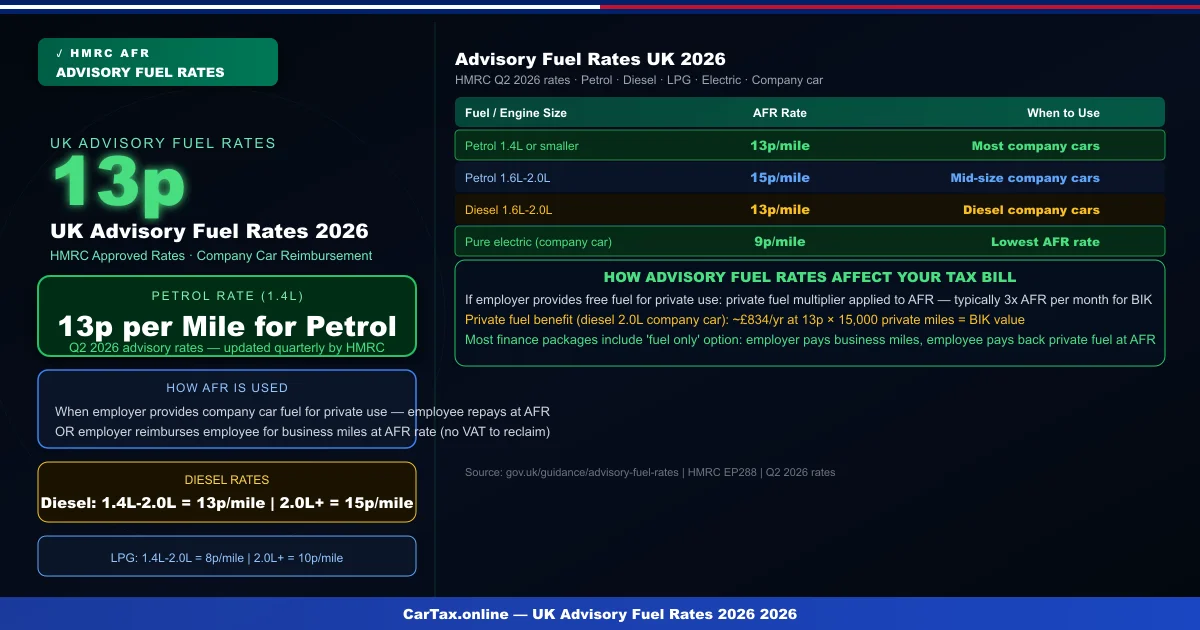
Current AFR rates for 2026:
- Petrol cars up to 1.4 litres: approximately 13 pence per mile
- Petrol cars 1.6 to 2.0 litres: approximately 15 pence per mile
- Diesel cars 1.6 to 2.0 litres: approximately 13 pence per mile
- Pure electric company cars: approximately 9 pence per mile
- LPG vehicles: corresponding rates available from HMRC
Always check HMRC's official Advisory Fuel Rates page for the current quarter's exact figures, as rates change with fuel price fluctuations.
advisory fuel rates uk 2026 — When Advisory Fuel Rates Apply
Advisory Fuel Rates apply in three principal scenarios in the United Kingdom:
Employer reimburses employee for business miles: When an employee uses a company car (with fuel provided by the employer) for business travel, the employer can reimburse at the AFR rate tax-free. The employee does not need to repay anything for business fuel use.
Employee repays employer for private fuel: If the employer provides fuel for both business and private use, the employee can repay the employer at the AFR rate for private miles. This reduces the company's tax deduction and the employee's benefit-in-kind liability.
Contractor fuel card accounting: When a contractor uses a company-provided fuel card for business mileage, the Advisory Fuel Rate provides the basis for accounting for the personal fuel portion attributable to private travel.
The AFR rates represent the maximum tax-free reimbursement level. Employers can pay more than the AFR rate without creating a tax liability for the employee, but any excess becomes taxable as employment income. If an employer pays less than the AFR rate, the employee can claim the shortfall as a deduction against their taxable income using form P87.
advisory fuel rates uk 2026 — Electric Vehicle AFR Rate
The current Advisory Fuel Rate for pure electric vehicles in 2026 is approximately 9 pence per mile — significantly lower than petrol and diesel rates. This reflects the substantially lower energy cost per mile for electric vehicles.
Employers reimbursing electric company car drivers at the 9p AFR rate are fully compliant with HMRC guidance, and the reimbursement is entirely free of Income Tax for the employee. For company car benefit-in-kind calculations, the private fuel benefit charge for electric vehicles is also much lower than for petrol or diesel equivalents, making electric company cars particularly tax-efficient for employees who receive fuel as part of their package.
advisory fuel rates uk 2026 — Advisory Fuel Rates vs AMAP Rates
It's important not to confuse Advisory Fuel Rates with Advisory Mileage Payment Rates (AMAP), which are different:
AMAP rates apply to employees using their own personal vehicle for business travel — the HMRC approved rate is 45 pence per mile for the first 10,000 business miles and 25 pence per mile thereafter. AMAP covers all vehicle costs including fuel, insurance, depreciation, and maintenance.
AFR rates apply specifically to company cars where the employer provides fuel. AFR only covers the fuel cost component.
For contractors and freelancers in the United Kingdom, ensure your contract specifies whether mileage claims use AMAP rates (personal vehicle) or AFR rates (company vehicle with employer-provided fuel), as mixing these incorrectly can create unexpected tax liabilities.
advisory fuel rates uk 2026 — Claiming AFR shortfall as an employee
If your employer pays less than the Advisory Fuel Rate, you can claim the difference as an allowable deduction against your Income Tax. Use form P87 (or via your Self Assessment tax return) to claim:
- Calculate total business miles driven in the company car
- Multiply by the applicable AFR rate for your vehicle type
- Subtract the amount your employer actually reimbursed
- Claim the difference as a deduction — it reduces your taxable income
advisory fuel rates uk 2026 — Quarterly Updates and Compliance
HMRC updates Advisory Fuel Rates quarterly, and employers can choose to apply new rates from the date HMRC announces them or wait until the start of the next quarter. Most payroll systems update automatically at each quarter start. Employers should review their reimbursement policies at each quarterly update to ensure compliance and avoid either over-paying (creating unnecessary payroll costs) or under-paying (triggering employee deduction claims).
advisory fuel rates uk 2026 — Conclusion
UK Advisory Fuel Rates in 2026 provide the standard pence-per-mile reimbursement for company car fuel used in business travel. The current rates of approximately 13p–15p per mile for petrol and diesel, and 9p per mile for electric vehicles, offer tax-free reimbursement within HMRC guidelines. Employers providing company cars should apply AFR correctly based on engine size and fuel type, and review rates quarterly for compliance. Employees who receive less than AFR can claim the shortfall as a tax deduction.
For current rates and official guidance, visit the HMRC Advisory Fuel Rates guidance on GOV.UK.
For official information, visit Canada Revenue Agency (CRA), ServiceOntario.