On April 7, 2026, reports from Ahmedabad and across Gujarat are describing scenes at petrol stations that have not been seen since the 2008 global oil crisis — queues stretching 2–5 hours, pump attendants turning vehicles away, and state highways dotted with stationary two-wheelers waiting for refueling. The cause: a combination of refinery maintenance shutdowns, a national fuel logistics disruption, and seasonal demand spikes has created a severe short-term petrol shortage across 14 of Gujarat's 33 districts. The immediate consequence: panic buying of electric vehicles at showrooms across Ahmedabad, Surat, Vadodara, and Rajkot is being reported as dealers run out of entry-level EV stock. Here is what is happening, why it matters for the long term, and what buyers should know.
What Is Causing the Ahmedabad Petrol Crisis?
According to the Petroleum and Natural Gas Regulatory Board (PNGRB) and state fuel dealers' association, the Gujarat shortage is a confluence of three simultaneous events:
- Koyali refinery maintenance shutdown: The Indian Oil Koyali refinery near Vadodara — one of India's largest refineries and the primary fuel source for Gujarat — began a scheduled 21-day maintenance turnaround on April 2. Output reduced by approximately 35% during this period. This alone does not cause shortage, as buffer stocks are maintained.
- National tank truck shortage: A central government road safety crackdown on overloaded fuel tankers that began March 28 has taken approximately 22% of active fuel tankers off the road for inspection and compliance retrofitting. Fuel is available at depots but cannot be moved to retail pumps at normal speed.
- Seasonal pre-summer demand surge: April is historically a high-fuel-consumption month in Gujarat due to agricultural diesel demand for irrigation before the Kharif season, wedding season travel, and increased two-wheeler usage as schools reopen post-exams. The surge hit exactly as supply capacity was reduced.
PNGRB officials and the Gujarat government have stated that the shortage is temporary — fuel supplies are expected to normalize within 10–12 days as tanker compliance certifications are processed and alternative supply routes from Mangalore refinery are activated. This is not a structural fuel scarcity but a short-term supply chain disruption.
The Panic EV Response: What Showrooms Are Reporting
Despite the temporary nature of the crisis, EV showrooms across Gujarat have seen an extraordinary spike in walk-ins since April 5. Dealers from Ahmedabad, Surat, and Rajkot are reporting:
- Tata Motors (Nexon EV, Tiago EV): Ahmedabad showrooms running out of readily-deliverable Tiago EV units — all April allocation booked within 48 hours
- Ola Electric: Ahmedabad and Surat showrooms report a 280% spike in walk-in footfall on April 5–6 compared to the same days in March
- Ather Energy: Waiting period for Ather Rizta and 450S extended to 6–8 weeks for Gujarat due to sudden booking surge
- Two-wheeler segments hardest hit: Electric scooters below ₹1 lakh (Hero Vida V1, Bajaj Chetak) are the most in-demand category as commuters seek immediate petrol independence
Gujarat's Emergency EV Grant: What Was Announced
In response to the crisis, the Gujarat government announced an emergency supplemental EV grant on April 6, 2026 under the existing Gujarat Electric Vehicle Policy 2021 (extended through 2026). The supplemental grant provides:
- Two-wheeler EVs purchased in April 2026: Additional ₹5,000 state subsidy on top of the standard ₹10,000–₹20,000 EV subsidy already available under Gujarat EV policy
- Electric three-wheelers (e-rickshaws, e-autos): Additional ₹15,000 for April 2026 purchases — aimed at commercial operators switching from petrol-powered autorickshaws
- Four-wheeler EVs (passenger cars): Standard Gujarat subsidy of ₹1.5 lakh for vehicles under ₹15 lakh ex-showroom remains — no additional April supplement for four-wheelers
- Charging infrastructure fast-track: State has directed GETCO (Gujarat Energy Transmission Corporation) to expedite 150 additional public EV charging points in 8 key cities within 45 days
The Bigger Story: Gujarat's 75% EV Sales Growth in March 2026
The petrol crisis is accelerating a trend that was already well underway before the shortage. According to the Society of Indian Automobile Manufacturers (SIAM) state-level data released April 5, 2026:
- Gujarat registered 47,218 EVs in March 2026 — a 75.4% year-on-year increase over March 2025's 26,921 units
- Two-wheeler EVs drove 78% of the growth — primarily Ola S1, Ather Rizta, and Hero Vida models
- Gujarat now ranks third nationally in EV registrations — behind Maharashtra and Uttar Pradesh but ahead of Karnataka and Tamil Nadu
- Ahmedabad city alone registered 8,400 EVs in March 2026 — more than any previous single-month record
Analysts attribute the surge to three factors: the extension of FAME-II subsidy through March 2026 (spurring last-month buying), aggressively priced new models (Ather Rizta at ₹1.09 lakh, Tata Tiago EV at ₹8.69 lakh), and the network effect of early adopters reducing range anxiety in the broader community.
🧮 Calculate Your EV's On-Road Price in Gujarat
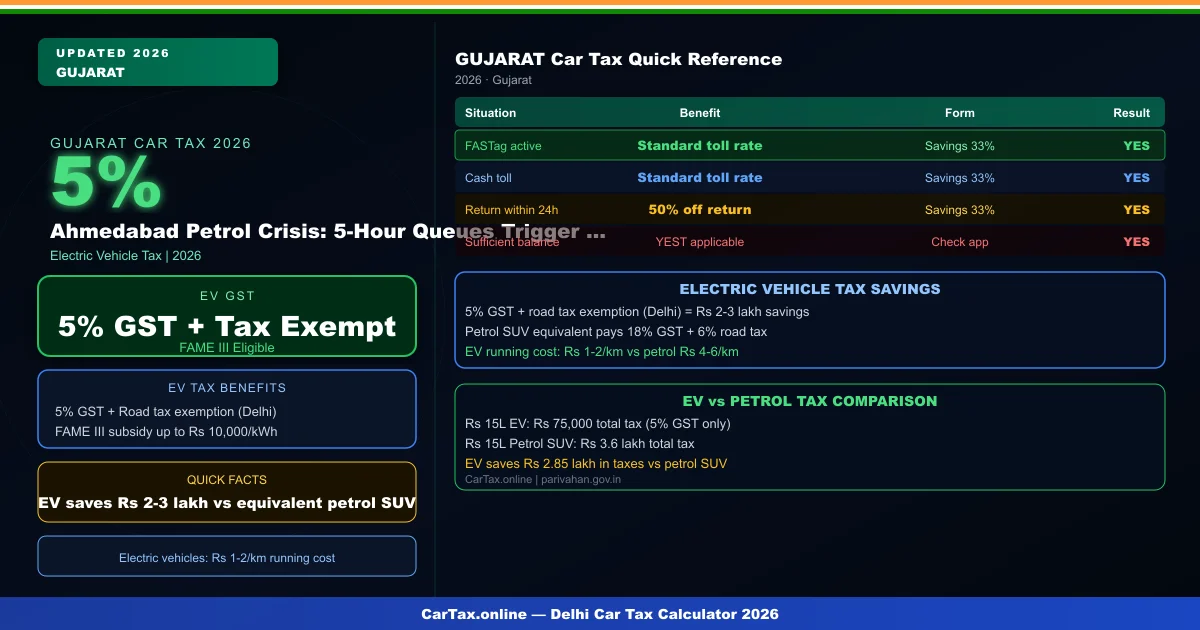
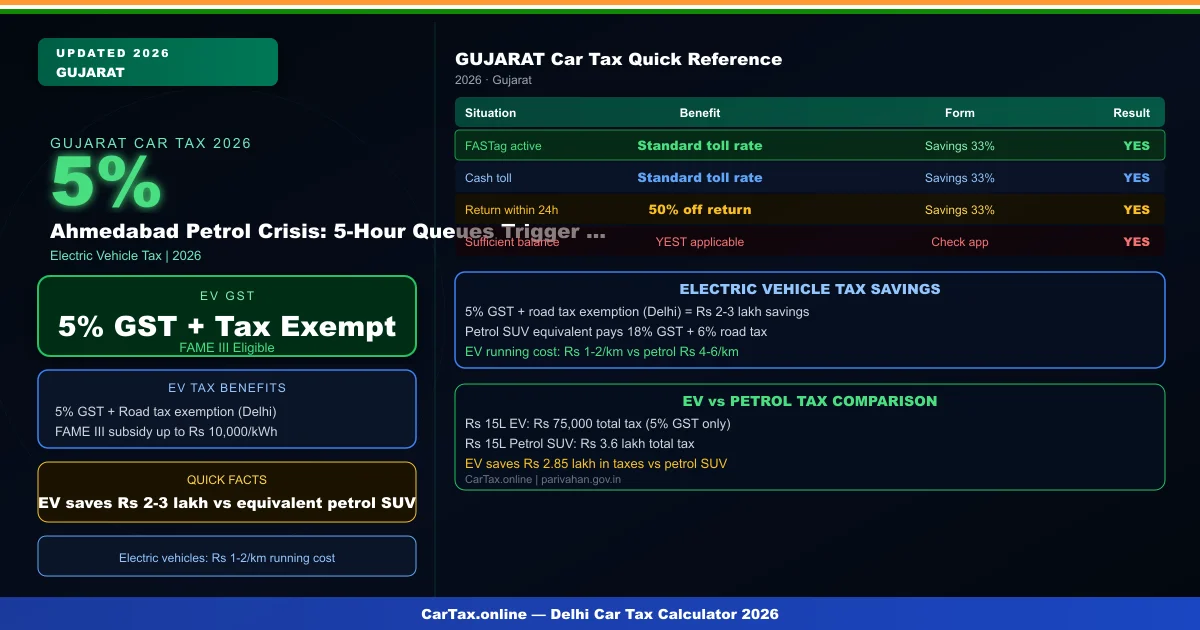
Gujarat offers state EV subsidies plus the standard 5% GST rate. Calculate your exact on-road price including Gujarat road tax and registration before you book.
What Buyers Should Know Before Making a Panic EV Purchase
The fuel shortage is real, but panic buying carries risks. Before rushing to an EV showroom, consider:
- The shortage will end: PNGRB projects normalization within 10–12 days. If you buy an EV purely to escape a short-term shortage, make sure the economics work for you long-term — not just for the next two weeks.
- Check home charging feasibility first: EVs are most economical if you can charge at home. If you live in a flat without a designated parking spot or a building that has not approved EV charging, your running costs will be much higher (public charging is 2–4× more expensive than home charging).
- Negotiate April bookings carefully: During panic buying periods, dealers may reduce or eliminate standard discounts. The same Tiago EV that was available at ₹8,000 below ex-showroom in February might have no discount today. The Gujarat supplemental grant (₹5,000 for two-wheelers) partially compensates, but verify before signing.
- Wait for the Maruti e-Vitara (Q2 2026): If your budget is ₹16–21 lakh and you can wait 2–3 months, Maruti Suzuki's e-Vitara — the most anticipated EV launch of 2026 — may offer better value and Maruti's unmatched service network.
Frequently Asked Questions
Is Gujarat petrol fully unavailable today, or just short?
The shortage is regional and queue-based, not a complete absence of fuel. Urban petrol stations in Ahmedabad's central areas are reporting longer waits (1–3 hours) rather than complete dryout. Rural and highway pumps in 14 districts are more severely affected. HPCL and BPCL have activated emergency supply protocols — check their station locator apps for real-time availability in your area.
Which Gujarat districts are worst affected by the fuel shortage?
As of April 7, the most severely affected districts include Anand, Kheda, Mehsana, Sabarkantha, and parts of Banaskantha — all within the primary supply radius of the Koyali refinery. Surat, Bharuch, and Ahmedabad city are experiencing wait times rather than complete unavailability. The Gujarat government's fuel helpline at 1800-233-7555 (state toll-free) provides real-time district-level availability updates.
For the latest EV pricing in Gujarat including state subsidies and on-road calculation, use our India on-road price calculator. Check the Gujarat EV Policy portal at gevpc.gujarat.gov.in for official subsidy claim procedures.
Frequently Asked Questions
Q: What is the current road tax rate for cars in India 2026?
Road tax rates in India vary by state and vehicle category. For new cars, GST is charged at 5% for EVs, 18% for hybrids under 1,200cc, and up to 28% for petrol/diesel SUVs. State road tax is charged separately and varies from Rs3,000-15,000 annually depending on the state's slab system. Check your specific state's RTO website for current rates.
Q: How do I calculate my car road tax online in India?
You can calculate your car road tax using online calculators available on state RTO portals and CarTax.online. The calculation considers your vehicle's ex-showroom price, fuel type, engine capacity, and state of registration. Road tax is payable annually or for the vehicle's lifetime depending on your state's rules.
Q: Is GST included in the road tax for new cars in India?
No — GST and road tax are separate charges. GST is a central tax charged by the vehicle manufacturer at the time of purchase. State road tax is a separate annual or one-time charge levied by your state's transport department. Both apply at the time of first registration, and annual road tax continues for subsequent years.
Q: Do electric vehicles get tax benefits in India 2026?
Yes — electric vehicles in India qualify for a reduced GST rate of 5% (down from 28% for petrol cars). Under FAME-III subsidies, EVs may also qualify for additional state-level incentives, reduced road tax, and free registration in many states. The exact benefits vary by state.
Q: What happens if I don't pay my car road tax on time?
If you don't pay road tax, your vehicle's registration can be flagged in the Vahan database, preventing renewal of fitness certificates and creating legal liability during police checks. Penalties range from Rs200-500 per day of default in most states. Road tax is a legal requirement under the Motor Vehicles Act.