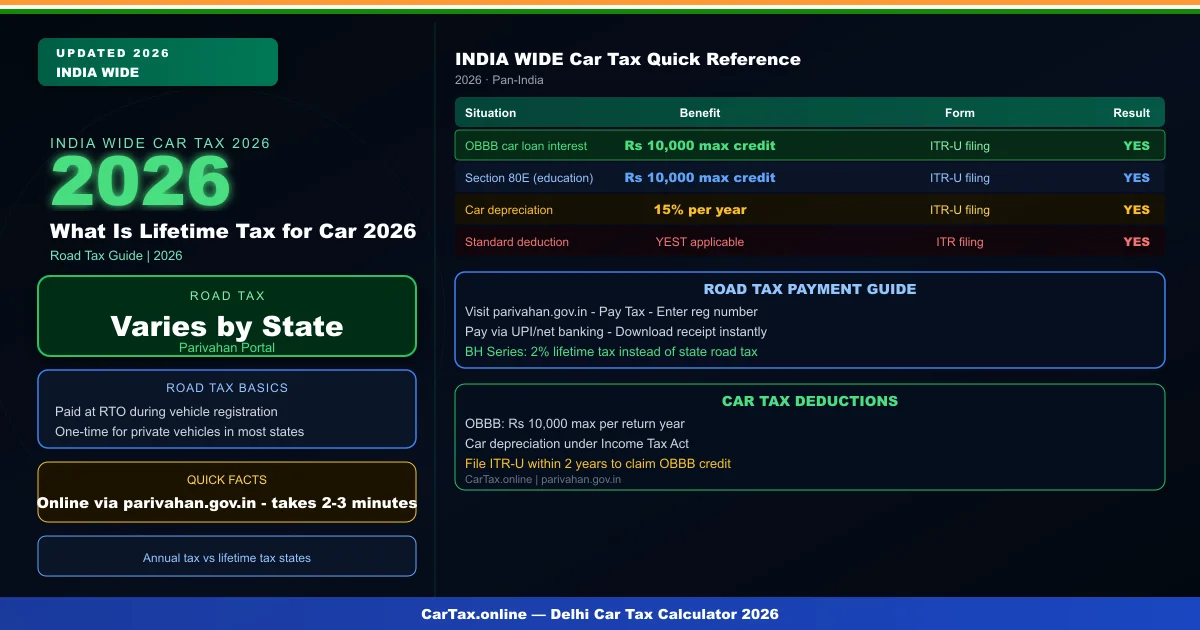
The lifetime tax system for cars in India represents a significant difference in how states collect road tax from vehicle owners. While some states charge road tax annually and require yearly renewal, others have adopted a one-time lifetime tax model that eliminates future payment obligations.
In states following the lifetime tax model, the entire road tax is calculated and collected at the time of first registration. West Bengal, Odisha, Jharkhand, and most northeastern states use this system. The tax is calculated as a percentage of the vehicle's ex-showroom price based on engine capacity and vehicle type. Once paid, the owner has no further road tax obligations for the lifetime of the vehicle in that state.
For example in West Bengal, private petrol cars up to 1000cc pay 8% of ex-showroom as lifetime road tax while those above 1500cc pay 12%. The payment is made at the time of registration and the RC book reflects this as lifetime tax paid. No renewal fees or annual tax demands are generated by the state transport department. This provides long-term cost certainty as owners know their total tax burden upfront.
Annual tax states like Delhi, Maharashtra, Karnataka, Tamil Nadu, and Gujarat require vehicle owners to renew their road tax each year. The annual tax is calculated as a percentage of the vehicle's assessed value which may be revised periodically. Owners receive renewal notices and can pay online through the state transport department portal or via Parivahan. Failure to renew attracts late fees and in some cases vehicle seizure.
The annual vs lifetime distinction creates interesting dynamics for car buyers in border areas. Purchasing a vehicle in a lifetime tax state and registering it there means paying tax only once. Owners who later shift to an annual tax state may face road tax assessment again based on the vehicle's current age and value.
For budget planning purposes, lifetime tax states are generally more favourable for long-term vehicle ownership as the one-time payment is usually less than what cumulative annual payments would total over 10-15 years of ownership. However the exact comparison depends on the specific rate slabs and the vehicle's expected usage period.
Frequently Asked Questions
1. What is the lifetime tax for cars in India?
Lifetime tax for cars is a one-time road tax payment made at the time of first registration in certain Indian states. Instead of paying annual road tax, owners pay a lump sum calculated as a percentage of the vehicle ex-showroom price. States like West Bengal, Odisha, Jharkhand, and most northeastern states use this system. Once paid, no further road tax is required for the lifetime of the vehicle in that state.
2. Which states in India charge lifetime road tax instead of annual tax?
States using the lifetime road tax system include West Bengal, Odisha, Jharkhand, Assam, and most northeastern states (Nagaland, Meghalaya, Mizoram, Arunachal Pradesh, Sikkim, Tripura, Manipur). States following the annual road tax model include Delhi, Maharashtra, Karnataka, Tamil Nadu, Gujarat, Rajasthan, Kerala, Punjab, Haryana and Uttar Pradesh.
3. How is lifetime road tax calculated in West Bengal?
In West Bengal, lifetime road tax for private cars is calculated based on engine capacity. Petrol cars up to 1000cc pay 8% of ex-showroom price, cars between 1000-1500cc pay 10%, and cars above 1500cc pay 12%. For diesel vehicles the rates are 10%, 12%, and 14% respectively. This is a one-time payment covering the entire registration period.
4. If I move from a lifetime tax state to an annual tax state, do I pay tax again?
Yes, if you transfer your vehicle registration from a lifetime tax state to an annual tax state, the destination state may assess road tax based on the vehicle age and current value. The amount paid in the original lifetime tax state is not transferable or refundable. The new state road tax is calculated on the vehicle current assessed value or ex-showroom price reduced for age.
5. Is lifetime tax more economical than annual tax?
For most vehicles, lifetime tax states are more economical over the long term. The one-time payment in lifetime tax states is typically equivalent to 5-7 years of annual tax payments in high-rate annual tax states. However this varies by the specific rate slabs in each state and the expected ownership period. For vehicles expected to be sold within 5 years, annual tax may work out cheaper if the vehicle is registered in a low-rate state.
⚠ Financial & Legal Disclaimer
All information provided in this article is for educational and informational purposes only. The content is synthesized based on verbal communications, extensive internet research, and official government website data as of the date of publishing. Tax laws and insurance policies are subject to frequent changes by the authorities. We strive for accuracy, but we recommend that you consult a qualified professional (CA, CPA, or Tax Consultant) before making any financial decisions. For personalized assistance, you can also connect with our in-house experts through our Contact Us page.
⚠ वित्तीय एवं कानूनी डिस्क्लेमर
इस लेख में दी गई सभी जानकारी केवल शिक्षा और सूचना के उद्देश्य से है। यह कंटेंट इंटरनेट रिसर्च, सरकारी वेबसाइटों के आंकड़ों और मौखिक चर्चाओं पर आधारित है। टैक्स नियम और इंश्योरेंस पॉलिसियां सरकार द्वारा समय-समय पर बदली जा सकती हैं। हालांकि हम सटीकता का पूरा ध्यान रखते हैं, फिर भी हम सलाह देते हैं कि कोई भी वित्तीय निर्णय लेने से पहले आप किसी योग्य विशेषज्ञ (CA, CPA या टैक्स सलाहकार) से परामर्श जरूर लें। व्यक्तिगत सहायता के लिए आप हमारे विशेषज्ञों से हमारे संपर्क करें (Contact Us) पेज के माध्यम से भी जुड़ सकते हैं।
Ready to calculate your car tax?
Use our free calculator to get an instant, accurate estimate for your country and state.
Open Car Tax Calculator →