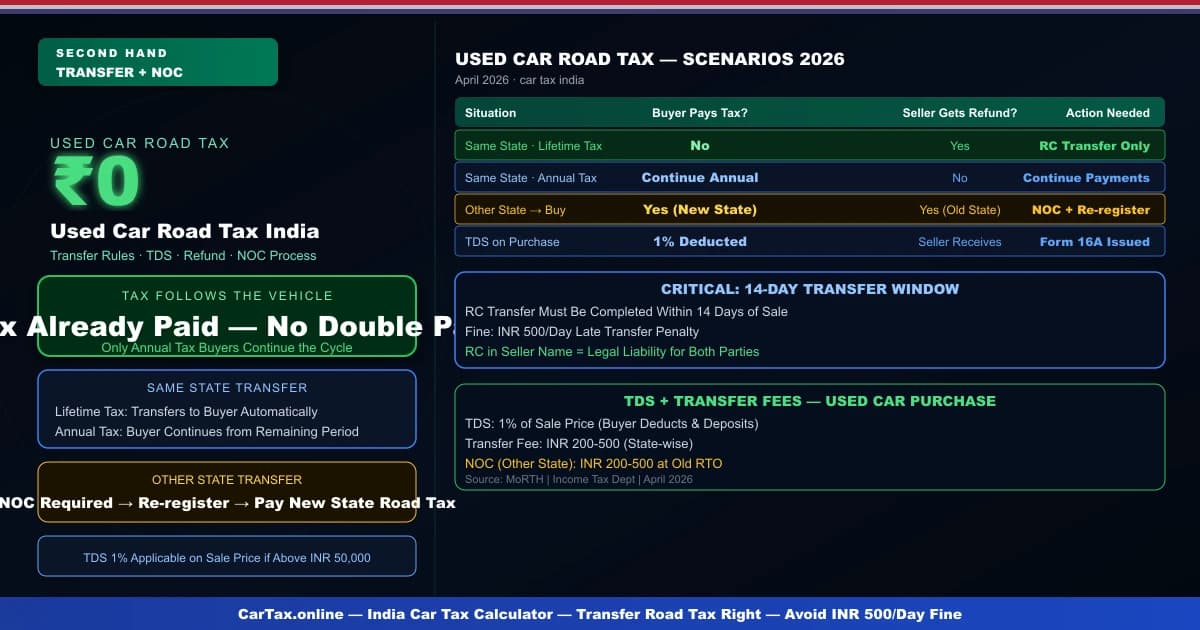
Buying a used car in India involves more than just the purchase price. Understanding how used car road tax works in India for 2026 is essential to avoid surprises, ensure legal compliance, and sometimes even recover money when you sell your vehicle.
As of April 18, 2026, India's road tax framework for pre-owned vehicles has evolved significantly, especially with TDS provisions under Section 194Q and inter-state transfer rules becoming stricter. This guide covers everything you need to know about paying, transferring, and reclaiming road tax on used cars in India.
How Road Tax Works on Used Cars in India
Road tax on vehicles in India is levied by state governments under the Motor Vehicles Act, 1988. Unlike GST, which applies uniformly across the country, road tax varies significantly from state to state. When you buy a used car, the road tax implications depend on whether you're buying within the same state or transferring from another state.
For used cars purchased from a registered dealer, GST applies on the margin — the difference between the dealer's purchase price and the sale price. However, road tax is a separate state-level charge that you must pay when re-registering the vehicle in your name. Related: Used Car Road Tax Transfer India 2026 — Complete 5-Step Guid | BH Series Car Tax India 2026 | BH Series Car Tax India 2026 | Used Car Tax UK 2026.
Paying Road Tax for Second-Hand Cars
When purchasing a second-hand car, you inherit the vehicle's tax history. The previous owner's road tax may have been paid for the remaining period of the registration, and this residual value can sometimes be transferred to you. However, the process varies by state.
In most states, you need to visit the Regional Transport Office (RTO) with the sale certificate, RC book, valid insurance, pollution certificate, and Form 28 (No Objection Certificate) if applicable. The road tax for the remaining period is calculated and you either pay the difference or the full amount depending on the state's policy.
Some states like Maharashtra, Karnataka, and Delhi have specific provisions for used car road tax that require you to pay based on the vehicle's age and remaining useful life. The tax is typically calculated as a percentage of the vehicle's assessed value, which may be determined by reference to ex-showroom price minus depreciation.
Inter-State Transfer with NOC
Transferring a used car from one state to another requires a No Objection Certificate (NOC) from the originating state. This is one of the most critical documents in the inter-state used car purchase process. Without an NOC, you cannot legally re-register the vehicle in the destination state.
The NOC process involves clearing all pending road tax dues, traffic challans, and ensuring no legal disputes are attached to the vehicle. The original owner must apply for the NOC from their state's RTO, which typically takes 15 to 30 days to process. Once obtained, the buyer uses this NOC to register the vehicle in the new state.
It's important to note that after April 2025, many states have tightened inter-state transfer rules. Some states now require the vehicle to be physically present for inspection before issuing an NOC. Additionally, road tax re-calculation in the destination state may result in additional payments if the destination state's tax rates are higher than the origin state.
Getting a Road Tax Refund When Selling Your Car
If you've paid road tax for a full year or longer and decide to sell your vehicle, you may be entitled to a refund of the unused portion. This is one of the most overlooked aspects of used car road tax in India. The refund claim must be filed at the original RTO where the tax was paid, and only the registered owner can claim it.
The refund calculation is straightforward — if you paid for 12 months but only used the vehicle for 6 months before selling, you're entitled to a refund for the remaining 6 months. However, processing times vary significantly. Some states process refunds within 30 days while others can take up to 6 months. Keeping all tax receipts and payment confirmations is essential for a smooth refund process.
Important: If you sell to a buyer in a different state and obtain an NOC, the refund process from the origin state remains your responsibility. The NOC does not automatically transfer your tax credit to the buyer.
TDS Rules for Used Car Purchases in 2026
Since July 1, 2021, TDS provisions under Section 194Q of the Income Tax Act apply to used car purchases. If you're buying a used car from a registered dealer and the transaction value exceeds ₹10 lakhs, the buyer must deduct TDS at 0.1% of the purchase consideration. This is a critical compliance requirement that many buyers are unaware of.
For transactions below ₹10 lakhs, no TDS deduction is required, but you should still obtain a receipt and maintain records. For purchases from non-resident sellers or certain other categories, different TDS rates may apply under Section 206C(1H).
As a buyer, you must ensure that the TDS certificate (Form 16A) is issued to you and that the deducted amount is deposited with the government. The dealer or seller will usually handle the compliance, but verifying this protects you from future liability.
Taxes on Buying a Used Car: A Complete Checklist
- GST on Margin: For dealer sales, GST applies on the margin. This is usually 18% of the difference between purchase and sale price.
- State Road Tax: Payable at the time of re-registration. Rates vary by state and vehicle type.
- Registration Fee: One-time charge at the RTO. Typically ranges from ₹600 to ₹1,200 depending on the state.
- TDS Deduction: 0.1% on transactions above ₹10 lakhs from registered dealers.
- Transfer Fee: Charged by the RTO for processing the ownership transfer. Usually ₹50 to ₹100.
Frequently Asked Questions
Do I need to pay road tax again when buying a used car?
Yes, when you transfer ownership of a used car, you typically need to pay road tax based on the vehicle's current assessed value in your state. The previous owner's tax may cover the remaining registration period, but re-registration usually requires a fresh assessment.
Can I claim refund of unused road tax when selling my car?
Yes, you can claim a refund for the unused portion of road tax when you sell your vehicle. Apply to the original RTO with the sale deed, original tax receipts, and NOC if applicable. The refund is calculated from the date of sale.
How long does inter-state transfer of a used car take?
Inter-state transfer with NOC typically takes 4 to 8 weeks total. The NOC from the origin state takes 15 to 30 days, followed by re-registration in the destination state which takes another 1 to 2 weeks under normal circumstances.
Is TDS applicable on all used car purchases?
TDS at 0.1% under Section 194Q applies only to purchases from registered dealers where the transaction value exceeds ₹10 lakhs. Private sales and transactions below ₹10 lakhs are exempt from this requirement.
What happens if I don't transfer the road tax after buying a used car?
Failing to transfer road tax and registration within the stipulated time can result in fines, compounding fees, and in some cases, the vehicle may be flagged in the Vahan database. It's essential to complete the transfer within 14 days of purchase to avoid penalties.
Understanding used car road tax in India for 2026 helps you budget accurately, avoid penalties, and even recover money when selling. Whether you're buying from a dealer or a private seller, or navigating an inter-state transfer, knowing your tax obligations ensures a smooth and legally compliant transaction.
Official Resources: Parivahan Portal | Vahan Road Tax | India GST Portal | FAME-III Scheme
Frequently Asked Questions
Q: What is the current road tax rate for cars in India 2026?
Road tax rates in India vary by state and vehicle category. For new cars, GST is charged at 5% for EVs, 18% for hybrids under 1,200cc, and up to 28% for petrol/diesel SUVs. State road tax is charged separately and varies from Rs3,000-15,000 annually depending on the state's slab system. Check your specific state's RTO website for current rates.
Q: How do I calculate my car road tax online in India?
You can calculate your car road tax using online calculators available on state RTO portals and CarTax.online. The calculation considers your vehicle's ex-showroom price, fuel type, engine capacity, and state of registration. Road tax is payable annually or for the vehicle's lifetime depending on your state's rules.
Q: Is GST included in the road tax for new cars in India?
No — GST and road tax are separate charges. GST is a central tax charged by the vehicle manufacturer at the time of purchase. State road tax is a separate annual or one-time charge levied by your state's transport department. Both apply at the time of first registration, and annual road tax continues for subsequent years.
Q: Do electric vehicles get tax benefits in India 2026?
Yes — electric vehicles in India qualify for a reduced GST rate of 5% (down from 28% for petrol cars). Under FAME-III subsidies, EVs may also qualify for additional state-level incentives, reduced road tax, and free registration in many states. The exact benefits vary by state.
Q: What happens if I don't pay my car road tax on time?
If you don't pay road tax, your vehicle's registration can be flagged in the Vahan database, preventing renewal of fitness certificates and creating legal liability during police checks. Penalties range from Rs200-500 per day of default in most states. Road tax is a legal requirement under the Motor Vehicles Act.