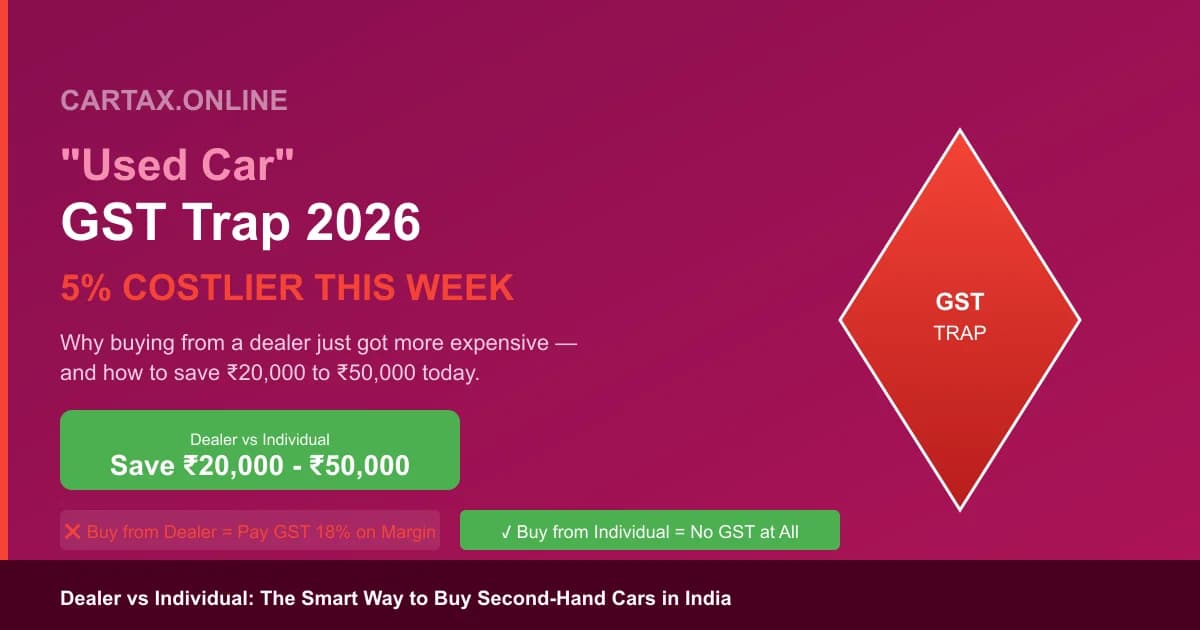
Buying a used car from a registered dealer just got 5% costlier this week in India due to changes in the GST margin scheme for pre-owned vehicles. As of April 18, 2026, dealers are now required to collect and remit GST on their margin at the full 18% rate on the difference between their purchase price and sale price, a change that has been passed on to buyers through higher asking prices.
For buyers in the market for a second-hand car, this development creates a significant price gap between purchasing from a registered dealer versus an individual seller. Understanding this "GST trap" and how to navigate it can save buyers anywhere from ₹20,000 to ₹50,000 depending on the vehicle price and category. This is particularly relevant for buyers searching for pre-owned vehicles as the April to June period traditionally sees increased demand as families look to purchase before the new financial year.
Understanding the New Used Car GST Rules
Under the GST framework for pre-owned vehicles, registered dealers who sell used cars are required to collect GST on their margin — the difference between the price at which they purchased the vehicle and the price at which they sell it. The previous interpretation allowed dealers to calculate margin based on a formula that often resulted in a lower GST burden. The updated guidance released in April 2026 clarifies that the full GST rate of 18% applies to the dealer margin, effectively increasing the tax on dealer-sold used cars.
For a dealer who purchases a used car for ₹5 lakh and sells it for ₹6 lakh, the margin is ₹1 lakh. Under the new rules, GST at 18% on this ₹1 lakh margin amounts to ₹18,000, which dealers are now required to collect from the buyer and remit to the government. This ₹18,000 is added to the vehicle's price, making dealer-purchased used cars more expensive than they were just days ago. Related: GST Reform on Cars India 2026 | Used Car Road Tax India 2026 — Transfer & Payment Guide | Used Car Road Tax Transfer India 2026 — Complete 5-Step Guid | Car Insurance Tax India 2026 — GST & Income Tax Benefits.
Why Individual Sellers Are Now the Better Deal
Individual-to-individual used car sales fall outside the GST framework entirely in India. When you buy a pre-owned car directly from the previous owner, no GST is applicable because the transaction is not in the course of business. The seller transfers the vehicle registration to your name at the RTO, paying only the transfer fee of approximately ₹50 to ₹100 and any applicable road tax adjustments. This means buying from an individual seller can be ₹20,000 to ₹50,000 cheaper than buying the same vehicle from a dealer for a vehicle in the ₹20 lakh to ₹50 lakh range.
The trade-off is that individual purchases come without the warranty, verification, and after-sales support that registered dealers provide. Certified pre-owned programmes from authorised dealerships offer inspection reports, warranty coverage, and buyback guarantees that provide peace of mind. For buyers on a tighter budget who are comfortable with the additional due diligence required, buying directly from an individual seller represents the smarter financial decision in the current GST environment.
The "Zero Dues Certificate" — Why It Matters More Than Ever
Whether buying from a dealer or an individual, the Zero Dues Certificate has become an essential document in used car transactions. This certificate, issued by the RTO, confirms that the vehicle has no pending road tax, traffic challan, or other financial obligations attached to it. Buying a vehicle with outstanding dues can result in the buyer inheriting those obligations, creating unexpected costs and legal complications.
When purchasing from an individual, insist on obtaining the Zero Dues Certificate from the seller before completing the transaction. This requires the seller to visit the RTO where the vehicle is registered and apply for the certificate, which is typically issued within 3 to 5 working days. The cost of the certificate is minimal, typically around ₹50, but it protects the buyer from inheriting tax or challan liabilities that could amount to thousands of rupees.
RTO Transfer Fees and New Charges in 2026
The RTO transfer process for used cars in 2026 includes several fees that buyers should budget for. The ownership transfer fee at the RTO is approximately ₹50 to ₹100 for the standard process. For priority or same-day processing through authorised agents, fees can reach ₹500 to ₹1,500. Additionally, if the vehicle is being transferred from another state, the NOC processing fee and the new state's road tax payment add significant costs to the transaction.
For inter-state transfers, budget an additional 4 to 8 weeks for NOC processing and ₹1 to ₹2 lakh for any additional road tax that may be applicable if the destination state's rates are higher than the origin state. The RTO transfer fee is the same whether buying from a dealer or an individual, so the GST savings from buying direct more than cover these processing costs for most vehicle categories.
Certified Pre-Owned vs Individual Purchase: Making the Right Choice
Deciding between a certified pre-owned vehicle from a dealer and an individual purchase requires weighing the financial savings against the peace of mind that dealer certification provides. Certified pre-owned programmes from authorised dealerships of Maruti, Hyundai, Honda, and Tata offer inspection reports, warranty coverage, and verified service history that significantly reduce the risk of purchasing a vehicle with hidden problems.
For vehicles priced under ₹5 lakh, the GST trap impact is relatively modest at approximately ₹9,000 for a ₹5,000 margin on a ₹4 lakh purchase and ₹5 lakh sale. In this segment, the added assurance of a dealer purchase often justifies the modest price premium. For vehicles priced between ₹10 lakh and ₹30 lakh, the GST savings from individual purchase can exceed ₹30,000, making the financial case for individual purchase much stronger if the buyer has the knowledge and confidence to assess the vehicle's condition themselves.
Frequently Asked Questions
Why did used car prices increase from dealers this week?
New GST guidance released in April 2026 requires dealers to collect and remit 18% GST on their full margin amount, where previously a lower rate interpretation applied. This additional GST cost has been passed on to buyers through higher asking prices for dealer-sold used cars.
Can I avoid GST by buying from an individual seller?
Yes, individual-to-individual used car sales fall outside the GST framework in India. No GST is applicable when buying directly from the previous owner because the transaction is not considered a business activity. You only pay the RTO transfer fee of approximately ₹50 to ₹100.
What is the Zero Dues Certificate and why do I need it?
The Zero Dues Certificate confirms that the vehicle has no pending road tax, traffic challan, or other financial obligations. It is issued by the RTO where the vehicle is registered and protects the buyer from inheriting outstanding dues on the purchased vehicle.
How much can I save by buying from an individual vs a dealer?
For a vehicle with a dealer margin of ₹1 lakh, the new GST at 18% adds approximately ₹18,000 to the purchase price. For higher-priced vehicles with larger margins, the savings can exceed ₹30,000 to ₹50,000 compared to buying from a registered dealer.
What are the RTO transfer fees for a used car in 2026?
Standard ownership transfer fee is approximately ₹50 to ₹100. Priority processing through agents costs approximately ₹500 to ₹1,500. For inter-state transfers, additional NOC processing fees and possible road tax differences in the destination state apply.
Official Resources: Parivahan Portal | Vahan Road Tax | India GST Portal | FAME-III Scheme
Frequently Asked Questions
Q: What is the current road tax rate for cars in India 2026?
Road tax rates in India vary by state and vehicle category. For new cars, GST is charged at 5% for EVs, 18% for hybrids under 1,200cc, and up to 28% for petrol/diesel SUVs. State road tax is charged separately and varies from Rs3,000-15,000 annually depending on the state's slab system. Check your specific state's RTO website for current rates.
Q: How do I calculate my car road tax online in India?
You can calculate your car road tax using online calculators available on state RTO portals and CarTax.online. The calculation considers your vehicle's ex-showroom price, fuel type, engine capacity, and state of registration. Road tax is payable annually or for the vehicle's lifetime depending on your state's rules.
Q: Is GST included in the road tax for new cars in India?
No — GST and road tax are separate charges. GST is a central tax charged by the vehicle manufacturer at the time of purchase. State road tax is a separate annual or one-time charge levied by your state's transport department. Both apply at the time of first registration, and annual road tax continues for subsequent years.
Q: Do electric vehicles get tax benefits in India 2026?
Yes — electric vehicles in India qualify for a reduced GST rate of 5% (down from 28% for petrol cars). Under FAME-III subsidies, EVs may also qualify for additional state-level incentives, reduced road tax, and free registration in many states. The exact benefits vary by state.
Q: What happens if I don't pay my car road tax on time?
If you don't pay road tax, your vehicle's registration can be flagged in the Vahan database, preventing renewal of fitness certificates and creating legal liability during police checks. Penalties range from Rs200-500 per day of default in most states. Road tax is a legal requirement under the Motor Vehicles Act.