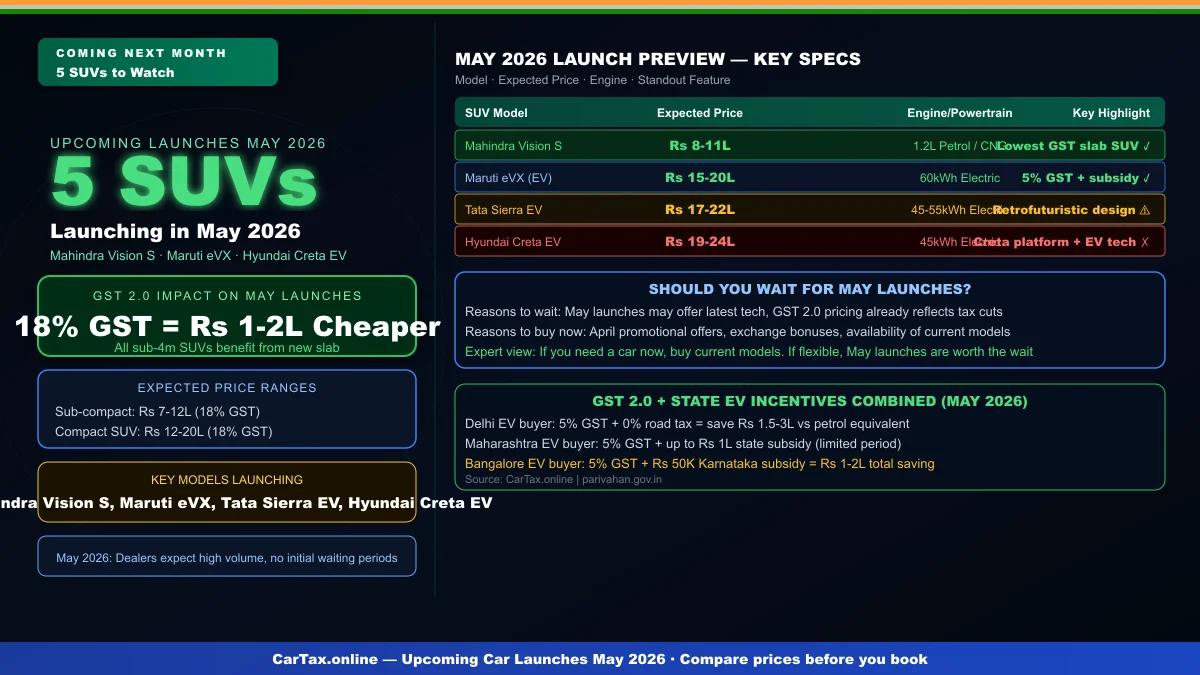
May 2026 is shaping up to be the most consequential month for India's SUV market since the sub-compact SUV category was redefined by the Tata Punch in 2021. Five significant launches — Mahindra Vision S, Maruti eVX, Tata Sierra EV, Hyundai Creta EV, and the national rollout of MG Windsor EV — will land in Indian showrooms within weeks of each other, creating a competitive intensity that buyers have not seen since the BS6 transition. For buyers who have been watching the market, the question is urgent: should you lock in an April purchase with current promotional offers, or hold out for the May 2026 launch wave? The answer depends on which segment you are targeting, how urgent your need is, and whether the Rs 1-3 lakh in potential savings from competitive pricing post-May justifies waiting 4-6 weeks.
What makes May 2026 particularly significant is the collision of two forces: the new GST 2.0 tax structure effective April 2026 (which has already repriced all 2026 launches) and the natural timing of new model introductions that automakers plan 18-24 months in advance. The result is a rare window where both tax reform benefits AND new competitive models are arriving simultaneously. For sub-compact SUV buyers, the Mahindra Vision S at Rs 8 lakh with 18% GST versus the Tata Punch at Rs 7 lakh with 5% GST creates a fascinating comparison that did not exist 3 months ago. For EV buyers, the Maruti eVX entry into the market at Rs 15-20 lakh fundamentally changes the competitive dynamics of the affordable EV segment.
May 2026 Launch Preview: All 5 Key Models
1. Mahindra Vision S — Sub-Compact SUV at Rs 8-11 Lakh
Mahindra's most anticipated budget SUV of 2026, the Vision S, is confirmed for a May 2026 launch. Positioned below the XUV3XO, the Vision S targets first-time car buyers and urban families transitioning from hatchbacks to SUVs. Its sub-Rs 10 lakh positioning exploits the 18% GST threshold (vehicles priced below Rs 10 lakh ex-showroom attract 18% GST versus 28% for vehicles above Rs 10 lakh with engine over 1,500cc). The 1.2L petrol engine with 82bhp and 5-speed manual/AMT options makes it accessible for buyers who want an SUV experience without the complexity of an EV. A CNG variant is expected within 6 months of launch, addressing demand from commercial buyers and CNG-conscious urban families.
2. Maruti eVX — Maruti's First Mass-Market Electric SUV at Rs 15-20 Lakh
The Maruti eVX represents Maruti Suzuki's most significant product launch in a decade — the company's first purpose-built electric vehicle designed for the Indian market. Built on a new EV-specific platform, the eVX will launch with a 60kWh battery pack delivering a claimed range of 500km (WLTP), with a shorter-range 45kWh variant expected to follow. At Rs 15-20 lakh ex-showroom, the Maruti eVX will compete directly with the Tata Nexon EV Max and MG Windsor EV. Maruti's massive distribution network (over 4,500 showrooms versus Tata's 1,800+) means after-sales service accessibility that newer EV brands cannot match. The 5% GST on EVs plus Maruti's expected competitive pricing could make the eVX the bestselling EV of 2026.
3. Tata Sierra EV — The Icon Returns as an Electric SUV at Rs 17-22 Lakh
The Tata Sierra EV is perhaps the most emotionally anticipated new car launch of 2026. Tata Motors has confirmed that the iconic Sierra nameplate — which defined Indian SUV culture in the 1990s — will return as an electric vehicle in May 2026. The Sierra EV will use Tata's proven Ziptron electric powertrain with 45-55kWh battery options delivering 400-500km range. Expected pricing of Rs 17-22 lakh positions it between the Nexon EV Max and the upcoming Toyota Ebella in the mid-range EV segment. The retro-futuristic design language — blending the Sierra's boxy 90s silhouette with modern EV design cues — is expected to attract buyers who want an SUV with character and heritage, not just specifications.
4. Hyundai Creta EV — Creta Platform Goes Electric at Rs 19-24 Lakh
Hyundai's Creta has been India's bestselling compact SUV for 5 consecutive years. The Creta EV translates this winning formula to an electric powertrain — using a 45kWh battery pack with 400km+ claimed range, built on the same platform as the petrol Creta. At Rs 19-24 lakh, the Creta EV will compete with the Toyota Ebella and Tata Sierra EV. Hyundai's advantage lies in the familiarity of the Creta ownership experience — existing Creta service infrastructure, parts, and knowledge transfer directly to the EV version. For buyers who trust the Creta brand and want to move to electric with minimal disruption to their service experience, the Creta EV is the most familiar path to EV ownership.
5. MG Windsor EV — National Launch and Deliveries from May 2026
While the MG Windsor EV was announced earlier, May 2026 marks the pan-India launch and commencement of mass deliveries. MG's Battery as a Service (BaaS) model makes the Windsor EV accessible at an effective price of Rs 14.99 lakh (excluding battery) with Rs 3,299/month battery rental. This pricing model targets buyers who cannot afford a Rs 18 lakh upfront payment but can manage the monthly rental comfortably. For budget-conscious EV adopters and first-time electric vehicle buyers, the Windsor EV BaaS model represents the lowest barrier to EV entry in the 2026 market.
GST 2.0 Impact on May 2026 Launch Pricing
The GST 2.0 reform effective April 2026 creates a fundamentally different pricing landscape for May 2026 launches compared to even 6 months ago. The impact varies by segment:
Sub-Compact Petrol SUVs (Vision S, Punch, Fronx): 18% GST on sub-4m vehicles under Rs 10 lakh ex-showroom saves buyers Rs 1-1.5 lakh compared to the pre-GST 2.0 rate of 28%. This makes the Vision S at Rs 8 lakh approximately Rs 80,000 cheaper in GST alone versus if it had launched before April 2026.
Electric SUVs (eVX, Sierra EV, Creta EV, Windsor EV): 5% GST on all battery-operated vehicles saves buyers Rs 3-6 lakh compared to equivalent petrol vehicles at 18-28% GST. A Rs 20 lakh electric SUV carries Rs 1 lakh in GST versus Rs 3.6-5.6 lakh for an equivalent petrol SUV — a saving that fundamentally changes the value proposition of going electric.
Should You Buy Now or Wait Until May 2026?
The decision to buy in April 2026 or wait for May 2026 launches depends on your specific vehicle target:
Buy now if you need a car in the next 4-6 weeks — the April promotional offers (0% processing fee, exchange bonuses of Rs 50,000-1.5 lakh, extended warranties) are time-limited and are expected to be replaced by May launch promotional offers that may not be as generous.
Wait for May 2026 if: you are in the market for an EV and the Maruti eVX or Tata Sierra EV specifically appeals to you (these did not exist until May); you want the widest comparison of options before committing; and you have flexibility on delivery timing.
For non-EV buyers targeting petrol SUVs, April 2026 is a strong time to buy — the GST 2.0 benefits are already reflected in current pricing, and dealer promotional offers are at their seasonal peak ahead of the May launch wave.
For accurate comparisons of on-road prices for May 2026 launch vehicles including the new GST 2.0 rates, state road tax calculations, and EMI comparisons, use the CarTax.online upcoming SUV calculator — updated with April 2026 expected launch pricing for all May 2026 models.
Official Resources: Mahindra Auto | Maruti Suzuki | Tata Motors | Hyundai India | India GST Portal