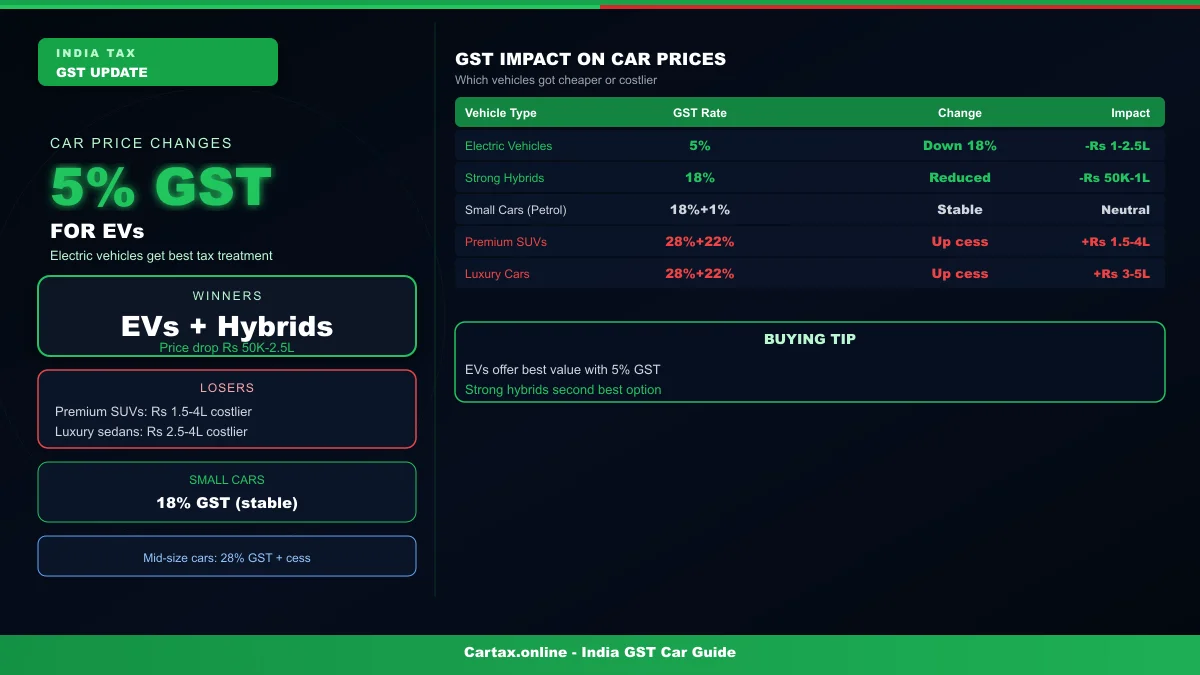
The Goods and Services Tax (GST) regime continues to evolve for the automobile sector in 2026. While some vehicle categories benefit from reduced tax burden, others face increased costs due to revised cess rates. Understanding these changes helps buyers make informed decisions about car purchases.
GST Structure for Cars in India
Current GST Rates
Electric Vehicles (EVs):
- GST Rate: 5% (reduced from 18%)
- Additional Cess: Nil
- Effective Rate: 5%
Small Cars (Petrol/CNG):
- GST Rate: 18%
- Additional Cess: 1%
- Effective Rate: 19%
Small Cars (Diesel):
- GST Rate: 18%
- Additional Cess: 3%
- Effective Rate: 21%
Mid-size Cars and SUVs:
- GST Rate: 28%
- Additional Cess: 17-22%
- Effective Rate: 45-50%
Luxury Cars and SUVs:
- GST Rate: 28%
- Additional Cess: 20-22%
- Effective Rate: 48-50%
Winners: Cars That Became Cheaper
Electric Vehicles
The biggest beneficiaries of GST revision are electric vehicles:
Price Impact:
- Tata Nexon EV: Price reduced by Rs 1.2 lakh
- MG Comet: Price reduced by Rs 80,000
- Tata Tiago EV: Price reduced by Rs 1 lakh
- BYD Seal: Price reduced by Rs 2.5 lakh
Hybrids and Strong Hybrids
Strong hybrid vehicles received favorable cess revisions:
- Toyota Innova Hycross: Reduced by Rs 50,000
- Toyota Camry Hybrid: Reduced by Rs 1 lakh
- Honda City Hybrid: Reduced by Rs 75,000
Small BS-VI Cars
Entry-level small cars with BS-VI compliance:
- Maruti Alto 800: Marginal reduction
- Maruti Swift: Reduced by Rs 15,000
- Hyundai Grand i10: Reduced by Rs 20,000
Losers: Cars That Got Costlier
Premium SUVs
Large SUVs and premium vehicles saw cess increases:
Price Impact:
- Toyota Fortuner: Increased by Rs 1.5 lakh
- Ford Endeavour: Increased by Rs 2 lakh
- BMW X1: Increased by Rs 3 lakh
- Mercedes GLA: Increased by Rs 4 lakh
Luxury Sedans
- Audi A4: Increased by Rs 2.5 lakh
- BMW 3 Series: Increased by Rs 3 lakh
- Mercedes C-Class: Increased by Rs 3.5 lakh
Pickup Trucks
- Isuzu D-Max: Increased by Rs 1 lakh
- Mahindra Bolero Pickup: Increased by Rs 15,000
GST Impact on Different Segments
Budget Segment (Under Rs 10 Lakh)
Winner: Small EVs and hybrid variants
- Best deals on Tata Tiago EV and MG Comet
- Small petrol cars remain competitively priced
- CNG variants offer best value for daily commute
Mid Segment (Rs 10-25 Lakh)
Mixed impact depending on fuel type
- SUVs in this segment saw increases
- Sedans relatively stable
- Strong hybrids offer tax benefits
Premium Segment (Above Rs 25 Lakh)
Loser: Most vehicles saw price hikes
- Premium SUVs most affected
- Luxury sedans saw significant increases
- EVs in this segment still benefit from 5% GST
How GST Affects Car Loan EMI
EMI Impact Calculation
For a Rs 2 lakh price increase:
- Loan Amount: Rs 10 lakh (vs Rs 9.8 lakh after GST)
- Interest Rate: 8.5%
- Tenure: 5 years
- EMI Impact: Approximately Rs 400 per month extra
Tips for Buyers
- Consider EVs to maximize GST savings
- Strong hybrids offer good value proposition
- Avoid premium SUVs if budget-conscious
- Negotiate based on ex-showroom, not on-road price
The Bottom Line
GST revisions in 2026 clearly favor electric and hybrid vehicles while increasing costs for premium SUVs and luxury cars. For value-conscious buyers, EVs and strong hybrids offer the best value proposition with lower effective tax rates. Premium vehicle buyers should factor in the additional cess when calculating total ownership costs.