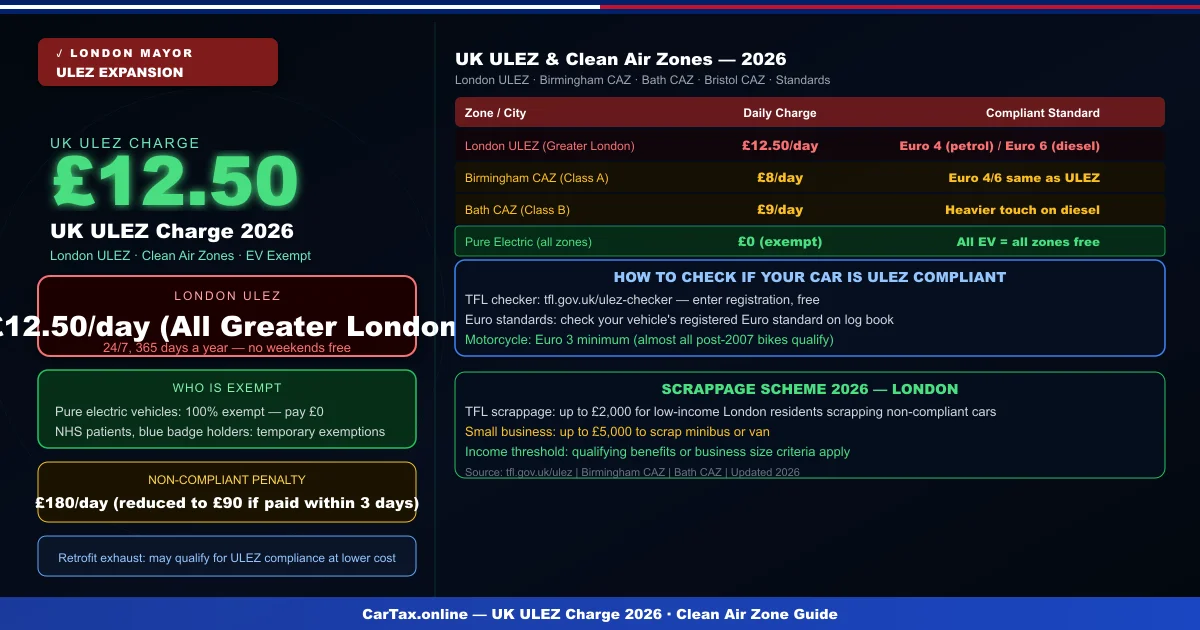
The United Kingdom's Clean Air Zone framework has created a growing patchwork of urban low-emission areas that charge drivers of non-compliant vehicles for entering. Understanding which zones apply, what the charges are, and how to check your vehicle's compliance status is essential knowledge for drivers across England.
UK drivers face a wide range of tax obligations that apply from the moment a vehicle is purchased through to its entire lifespan on British roads. Understanding how UK car tax works in 2026 is essential for budgeting, legal compliance, and making informed decisions about vehicle purchases. Whether you drive a petrol hatchback, a diesel SUV, or a pure electric vehicle, the tax rules affect your wallet directly.
## How Does UK Car Tax Work in 2026?
The primary form of car tax in the United Kingdom is Vehicle Excise Duty (VED), commonly called road tax even though the Road Fund it was originally tied to was abolished in 1937. VED is an annual charge applied to most vehicles registered for use on public roads. The amount you pay depends on several factors including the vehicle type, its CO2 emissions at the point of first registration, its list price, and whether it qualifies for any exemptions.
The standard rate for most cars registered after April 2018 is £190 per year from year two onwards. The first-year rate is calculated based on official CO2 emission grades, ranging from £0 for zero-emission vehicles to £2,605 for the highest-emitting cars. Pure electric vehicles enjoy a significant advantage, paying nothing for the first five years of registration. This makes choosing an electric car one of the most effective ways to reduce motoring costs in the long term.
Different rules apply to other vehicle categories. Motorcycles fall into their own VED bands based on engine size, with rates starting as low as £21 per year for machines under 150cc. Vans are taxed separately from cars, with light goods vehicles currently paying £320 per year. Larger goods vehicles over 3.5 tonnes gross weight are classified as heavy goods vehicles and face different rates including the HGV Road User Levy.
### The London Ultra Low Emission Zone
London's Ultra Low Emission Zone represents the most expansive and impactful clean air charge in the United Kingdom. Operating 24 hours a day, 365 days a year with no exemptions for weekends or public holidays, the ULEZ covers the entire area of Greater London. Non-compliant vehicles are charged £12.50 per day for each day they are driven within the zone.
The ULEZ compliance standard requires petrol vehicles to meet Euro 4 emissions standards (roughly equivalent to vehicles registered from 2006 onwards) and diesel vehicles to meet Euro 6 standards (vehicles registered from September 2015 onwards). Motorcycles must meet Euro 3 standards, which almost all post-2007 bikes satisfy.
Vehicle compliance is verified automatically through number plate recognition cameras linked to DVLA and the TfL vehicle checking database. Drivers do not need to register in advance unless they believe their vehicle qualifies on different grounds. Automatic reminders are sent by TfL to registered keepers of non-compliant vehicles.
### Other UK Clean Air Zones
Birmingham's Clean Air Zone launched in June 2021 as a Class A zone, primarily affecting buses, coaches, and heavy goods vehicles. Passenger vehicles including cars and vans are not currently subject to charges within the Birmingham CAZ, though the situation is subject to ongoing review.
Bath's Clean Air Zone, operating since March 2021, applies Class B charges to buses, coaches, and taxis, with passenger cars currently exempt. As with Birmingham, Bath's zone is designed primarily to target the highest-emitting fleet vehicles.
Bristol has implemented a Clean Air Zone targeting the most polluting buses, taxis, and heavy goods vehicles. Drivers of non-compliant passenger cars should monitor local authority announcements as zone boundaries and charge categories can be adjusted in response to air quality monitoring data.
### The ULEZ Penalty and Scrappage Scheme
Drivers of non-compliant vehicles who fail to pay the daily charge face a penalty notice of £180, reduced to £90 if paid within three days. The charges accumulate daily, making an undiagnosed non-compliant vehicle a potential financial liability for regular London drivers.
Transport for London operates a scrappage scheme offering financial assistance to low-income London residents and small businesses scrapping non-compliant vehicles. Individual residents can receive up to £2,000 toward a ULEZ-compliant vehicle or £5,000 for small businesses scrapping a minibus or van.
## Frequently Asked Questions
**Is the ULEZ charge the same in all London boroughs?**
Yes. The ULEZ charge applies uniformly across all London boroughs, from Hillingdon in the west to Bexley in the east and from Barnet in the north to Croydon in the south. There are no zone variations or reduced-rate inner and outer areas.
**Do pure electric cars pay the ULEZ charge?**
No. All zero-emission vehicles are automatically ULEZ compliant and can enter the zone free of charge. This includes pure electric cars, electric vans, and electric motorcycles.
**Can NHS patients claim ULEZ exemption?**
Certain patient transport vehicles and blue badge holders may qualify for temporary or ongoing exemptions. TfL provides specific guidance for disability-related exemption applications on their website.
**Do visitors from outside London need to pay the ULEZ charge?**
Yes. The charge applies to all vehicles entering the Greater London boundary regardless of where the vehicle is registered, unless the vehicle qualifies for an exemption or has already been registered for a TfL auto-pay account.
Disclaimer: CarTax.online provides general information for guidance purposes only. Tax rules and rates are subject to change. Always verify current rates with gov.uk or HMRC before making financial decisions. This guide was last reviewed in 2026.
Frequently Asked Questions
Q: How much is car tax (VED) in the UK 2026?
Car tax rates in the UK depend on your vehicle's CO2 emissions and list price. Standard rates start from £190 per year for petrol and diesel cars, with zero-rated VED for EVs. First-year rates vary from £0 to £2,605 depending on emissions. Additional premiums apply for vehicles over £40,000.
Q: How do I check if my car is taxed online?
You can check your vehicle's tax status for free on the Gov.uk website at gov.uk/check-vehicle-tax. You'll need your vehicle's registration number (number plate). You can also check via the Motor Insurance Database to verify road tax and insurance status simultaneously.
Q: Can I get a refund on car tax if I sell my vehicle?
Yes — if you sell or scrap your vehicle, you can claim a refund on any full months of remaining road tax. Contact DVLA with the V11 reminder letter or apply online at gov.uk. Refunds are usually processed within 4-6 weeks. Related: ULEZ Expansion UK 2026 | London Congestion Charge 2026 | Big Car Tax Changes Coming to UK 2026 | 5 Clever Ways to Tax My Car Online and Save Money.
Q: Is road tax refund available when transferring ownership?
No — road tax does not transfer with the vehicle. When you sell your car, the tax is automatically cancelled and any remaining months are refunded to you by DVLA. The new owner must tax the vehicle immediately. As a buyer, always verify the vehicle's tax status before purchasing.
Q: What is the luxury car tax threshold in the UK 2026?
The additional rate for vehicles over £40,000 (list price) adds £410 per year to standard VED rates for years 2-6 of registration. This surcharge brings the annual cost for high-emission vehicles over £40,000 to around £600-690 per year. Pure EVs under £40,000 pay zero VED.
⚠ Financial & Legal Disclaimer
All information provided in this article is for educational and informational purposes only. The content is synthesized based on verbal communications, extensive internet research, and official government website data as of the date of publishing. Tax laws and insurance policies are subject to frequent changes by the authorities. We strive for accuracy, but we recommend that you consult a qualified professional (CA, CPA, or Tax Consultant) before making any financial decisions. For personalized assistance, you can also connect with our in-house experts through our Contact Us page.
Ready to calculate your car tax?
Use our free calculator to get an instant, accurate estimate for your country and state.
Open Car Tax Calculator →