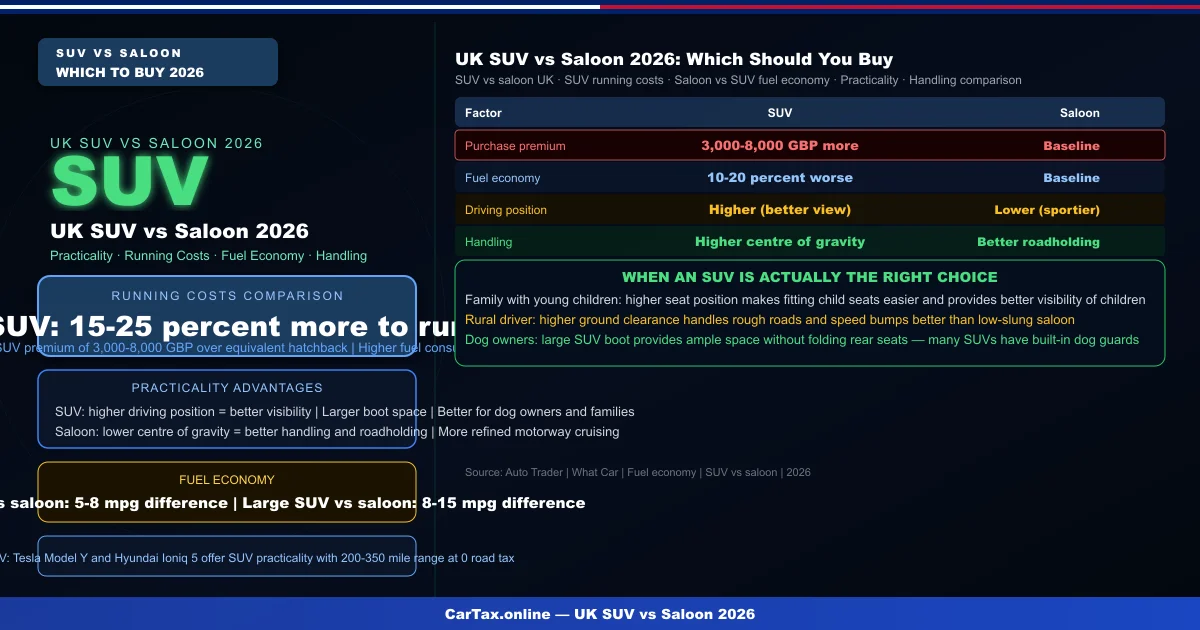
The choice between an SUV and a saloon car involves trade-offs across purchase price, running costs, practicality and driving dynamics. Understanding these differences helps buyers choose the vehicle type that best matches their priorities and usage patterns.
Running Costs Comparison
SUVs carry a purchase premium of 3,000 to 8,000 GBP over equivalent hatchback or saloon models. Higher kerb weight reduces fuel economy by 10 to 20 percent compared to an equivalent saloon, adding approximately 200 to 400 GBP per year in fuel costs at current prices. Higher insurance groups (due to higher replacement costs and rollover risk profiles) add a further 100 to 300 GBP annually.
Practicality Advantages
SUVs offer a higher driving position providing better visibility over traffic. Larger boot space and higher loading lip make it easier to load heavy items. Higher ground clearance handles speed bumps and rough roads better. Family-friendly features including ISOFIX points in all three rear seats are more common in SUVs. Dog owners benefit from larger boots with fewer awkward corners.
Saloon Handling and Refinement
Saloon cars offer a lower centre of gravity, providing better roadholding, more responsive steering and more composed handling at speed. Motorway refinement is typically superior due to the more aerodynamic shape. For drivers who prioritise driving enjoyment, a saloon or estate provides a more engaging experience. Related: Andhra Pradesh Road Tax Calculator 2026 — AP Vehicle Rates | ATO Tax Deduction Car Australia 2026 | Luxury Car Tax Threshold Australia 2026 | Bangalore Road Tax Calculator 2026 — Karnataka Vehicle Guide.
When an SUV Is the Right Choice
Families with young children benefit from the higher seating position and easier child seat installation. Rural drivers on rough roads benefit from higher ground clearance. Dog owners benefit from larger boots. Those who regularly carry large or heavy loads benefit from larger boots and higher payload ratings.
Frequently Asked Questions
Is an SUV more expensive to run than a saloon? Yes. SUVs cost 15-25 percent more to run due to higher purchase prices, worse fuel economy (10-20 mpg difference), higher insurance premiums and typically higher maintenance costs.
Official Resources: GOV.UK Check Vehicle Tax | GOV.UK Vehicle Tax | DVLA Online | MOT Check
Frequently Asked Questions
Q: How much is car tax (VED) in the UK 2026?
Car tax rates in the UK depend on your vehicle's CO2 emissions and list price. Standard rates start from £190 per year for petrol and diesel cars, with zero-rated VED for EVs. First-year rates vary from £0 to £2,605 depending on emissions. Additional premiums apply for vehicles over £40,000.
Q: How do I check if my car is taxed online?
You can check your vehicle's tax status for free on the Gov.uk website at gov.uk/check-vehicle-tax. You'll need your vehicle's registration number (number plate). You can also check via the Motor Insurance Database to verify road tax and insurance status simultaneously.
Q: Can I get a refund on car tax if I sell my vehicle?
Yes — if you sell or scrap your vehicle, you can claim a refund on any full months of remaining road tax. Contact DVLA with the V11 reminder letter or apply online at gov.uk. Refunds are usually processed within 4-6 weeks.
Q: Is road tax refund available when transferring ownership?
No — road tax does not transfer with the vehicle. When you sell your car, the tax is automatically cancelled and any remaining months are refunded to you by DVLA. The new owner must tax the vehicle immediately. As a buyer, always verify the vehicle's tax status before purchasing.
Q: What is the luxury car tax threshold in the UK 2026?
The additional rate for vehicles over £40,000 (list price) adds £410 per year to standard VED rates for years 2-6 of registration. This surcharge brings the annual cost for high-emission vehicles over £40,000 to around £600-690 per year. Pure EVs under £40,000 pay zero VED.