Most UK drivers pay road tax annually or monthly without realising they may be entitled to a refund. Vehicle Excise Duty (VED) refunds apply when road tax is cancelled partway through a tax period and the remaining months have not been used. Understanding when and how to claim a refund can save you money — and failing to claim when entitled means you simply lose out. This guide covers all refund scenarios, the application process, and the key rules you need to know for 2026.
When do you get a road tax refund?
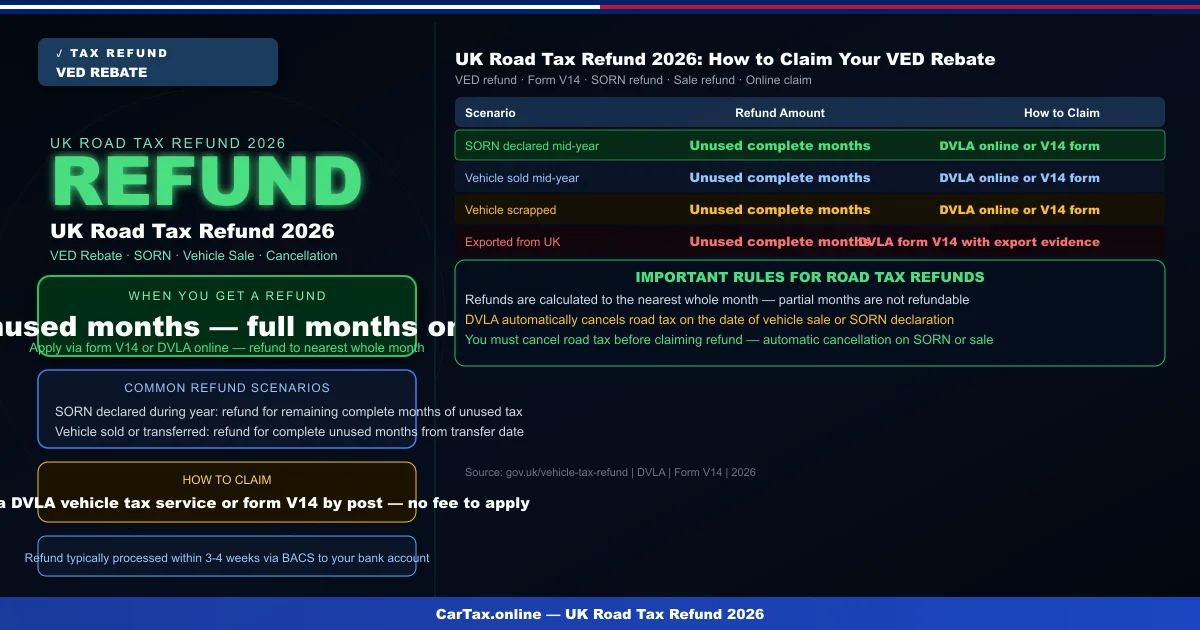
You are entitled to a road tax refund whenever VED is cancelled before the end of a paid tax period and you will not be using the vehicle for the remaining complete months. The most common scenarios are: declaring a SORN (Statutory Off Road Notification), selling the vehicle, having the vehicle scrapped, exporting the vehicle from the UK, or the DVLA revoking the licence for another reason. The refund is always calculated to the nearest whole month — partial months at the start or end of a tax period are not refundable. For example, if you sell a vehicle with three months and two weeks of tax remaining, you receive a refund for three complete months.
The four main refund scenarios
SORN declared during the year
If you declare a SORN for your vehicle during an active tax period, you can claim a refund for the remaining complete months of road tax. The refund is processed automatically when you declare the SORN — DVLA will calculate the refund amount based on your paid tax period and the date the SORN takes effect. You can declare a SORN online via the DVLA vehicle tax service or by submitting form V11 by post. The SORN takes effect immediately upon declaration.
Vehicle sold or transferred
When you sell a vehicle, you must notify DVLA using section 2 of the V5C registration certificate. Once DVLA processes the change of ownership, the road tax on that vehicle is automatically cancelled and a refund for any unused complete months is generated and sent to the previous keeper by BACS. You do not normally need to apply separately — the refund is processed automatically. However, if you receive no refund within 6 weeks of notifying DVLA, you can follow up using form V14. Related: Andhra Pradesh Road Tax Calculator 2026 — AP Vehicle Rates | Bangalore Road Tax Calculator 2026 — Karnataka Vehicle Guide | Car Tax Refund India 2026 — How to Claim Your Money | Chennai Road Tax 2026 — Tamil Nadu Vehicle Calculator.
Vehicle scrapped
If your vehicle is officially scrapped at an Authorised Treatment Facility (ATF), you will receive a Certificate of Destruction (CoD) from the scrapyard. You must send this to DVLA — they will cancel the road tax and issue a refund for any unused complete months. Do not assume the scrapyard will notify DVLA on your behalf. It is your responsibility to notify DVLA. Until DVLA receives notification, you remain the registered keeper and are liable for any offences involving the vehicle.
Vehicle exported from the UK
Exporting a vehicle from the UK permanently requires notification to DVLA. You will need to provide evidence of export — such as a Bill of Lading, export documentation, or a letter from the overseas destination. Send this evidence to DVLA along with the V5C registration certificate and a covering letter requesting a refund. DVLA may take longer to process export refunds as they require additional verification. The refund covers complete unused months from the date the vehicle left the UK.
How to claim: online vs form V14
The fastest way to claim a refund is online via the DVLA vehicle tax service at check-vehicle-tax.service.gov.uk. If you sold the vehicle and received the new keeper slip (section 6 of the V5C) back from the buyer, you can notify DVLA of the sale online and the refund will be processed automatically. For other scenarios — particularly scrapping, exporting, or where online notification is not possible — you will need to complete form V14 (Application for a Vehicle Licence Refund) and send it to DVLA, Swansea, SA99 1AD. Form V14 can be downloaded from gov.uk. There is no fee to apply for a refund.
Key rules for road tax refunds
- Refunds are calculated to the nearest whole month only
- Partial months are not refundable — timing matters
- DVLA automatically processes refunds on vehicle sale and SORN declaration
- Form V14 needed for scrapping, exporting, and delayed refunds
- Refunds paid by BACS within 3-4 weeks of application
- You must notify DVLA before claiming — automatic cancellation applies on sale/SORN
- No refund is available if a vehicle is stolen and recovered — tax continues during recovery
- Overpaid tax: if DVLA made an error and charged you too much, claim back via form V14
What happens if you do not claim?
If you do not actively claim a refund when entitled, the money simply does not come back to you. DVLA does not proactively search for refund recipients — with the exception of automatic refunds on vehicle sales. If you scrap a vehicle without notifying DVLA, if you export without providing evidence, or if you simply let road tax lapse without a SORN declaration, you will not receive the refund you are owed. Keeping records of tax payments, V5C notifications, and any correspondence with DVLA is important for ensuring you can claim what is due to you.
Disclaimer
This article provides general information about VED refunds as of April 2026. Tax refund rules and procedures are subject to change. Always verify current procedures at gov.uk/vehicle-tax-refund or contact DVLA directly for your specific situation. This article does not constitute financial or legal advice.
Official Resources: Vehicle Tax Guide | Car Tax Calculator
Frequently Asked Questions
Q: How is car tax calculated in 2026?
Car tax is calculated based on your vehicle's value, engine capacity, fuel type, emissions, and state or country of registration. Tax rates vary significantly between regions — check your local transport authority website or use an online car tax calculator for an accurate estimate for your specific vehicle.
Q: Can I pay my car tax online?
Yes — most regions allow online road tax payment through their transport department portal. In India, use parivahan.gov.in. In the UK, use gov.uk. In the USA, check your state's DMV website. Have your vehicle registration number and insurance certificate ready for online payments.
Q: What happens if I don't pay car tax?
Driving without valid road tax is illegal in most jurisdictions and can result in fines, vehicle seizure, or number plate clamping. Penalties range from a percentage of the tax owed to fixed daily amounts. Always ensure your vehicle is taxed before driving — even short lapses can accumulate significant penalties.
Q: Are there tax exemptions for electric or hybrid vehicles?
Most countries offer tax benefits for EVs and hybrids including reduced GST/VAT rates, road tax exemptions, and purchase subsidies. In India, EVs attract 5% GST versus 28% for petrol cars. In the UK, EVs are exempt from VED. Check your country's specific EV incentive programs for current rates and eligibility.
Q: Can I claim tax relief on car expenses for business use?
Business vehicle owners can typically claim deductions for fuel, maintenance, insurance, depreciation, and interest on car loans. Methods vary: standard mileage rates, actual expense tracking, or lease deduction. Keep detailed records including mileage logs, receipts, and business purpose documentation for all trips.