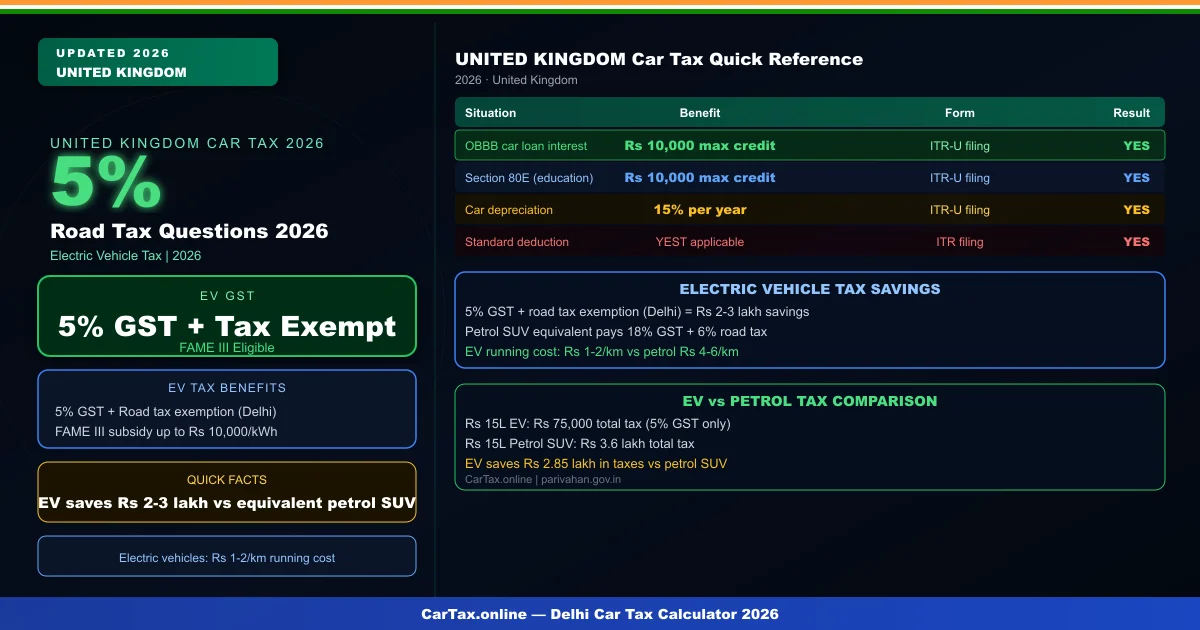
Every UK driver has questions about road tax. Whether you have just bought your first car, are switching to electric, or simply want to understand what the law requires, Vehicle Excise Duty (VED) — commonly called road tax — affects every vehicle on UK roads. This guide answers the most commonly searched questions about road tax in 2026, from the basics to the exemptions and special cases that catch many drivers out.
Do I need road tax?
Yes — almost every vehicle kept or used on a public road in the United Kingdom must be taxed. The only exceptions are vehicles declared Statutory Off Road Notification (SORN), vehicles that qualify for specific exemptions (such as vehicles over 40 years old, or certain disability vehicles), and vehicles under a very short grace period after a change of ownership. Driving without road tax is illegal and will result in a Fixed Penalty Notice of 80 GBP (reduced to 40 GBP if paid within 36 days). The Driver and Vehicle Licensing Agency (DVLA) uses Automatic Number Plate Recognition (ANPR) cameras to automatically detect untaxed vehicles on public roads.
Is road tax the same as car insurance?
No — road tax and car insurance are two completely separate legal requirements. Road tax is a charge levied by the DVLA for the use of public roads, while car insurance is a financial protection product that covers you against damage you may cause to other people, vehicles, or property. You cannot drive without both: insurance is required before you can tax a vehicle, and both are mandatory before you can legally drive on public roads. Many new drivers confuse these — thinking that having insurance means they can tax or that road tax alone permits driving. Both must always be valid simultaneously.
Does road tax transfer when I sell my car?
No — road tax does not transfer when a vehicle is sold or given away. When the seller notifies DVLA of the change of ownership using the V5C registration certificate, the road tax on that vehicle is automatically cancelled. The seller will receive a refund for any unused complete months of tax. The new keeper must tax the vehicle immediately using the new keeper slip (section 6 of the V5C) before driving on any public road. You cannot drive an untaxed vehicle to the post office or DVLA office to tax it — this is illegal. Related: Andhra Pradesh Road Tax Calculator 2026 — AP Vehicle Rates | Bangalore Road Tax Calculator 2026 — Karnataka Vehicle Guide | Chennai Road Tax 2026 — Tamil Nadu Vehicle Calculator | Delhi Road Tax Calculator 2026 — NCT Rates That Save You Mon.
Can I claim a road tax refund?
Yes — you can claim a refund for road tax when you cancel the tax before it expires. The most common reasons for a refund are: declaring a SORN, selling the vehicle, scrapping the vehicle, or exporting it from the UK. The refund is always calculated to the nearest whole month — partial months are not refundable. You can apply for a refund online via the DVLA vehicle tax service or by submitting form V14 by post. The refund is paid by BACS to your bank account within 3-4 weeks. Note that DVLA will automatically process the refund when you notify them of a change of ownership or declare a SORN — you do not always need to apply separately.
Do electric cars pay road tax?
Pure electric vehicles registered from April 2017 onwards pay zero road tax for the first five years of registration. This applies to all pure EVs regardless of list price — they qualify for Band A (0g/km CO2), meaning zero first-year VED and zero annual VED for the first five years. From year six onwards, they pay the standard annual rate of 190 GBP per year (or 325 GBP per year if the list price was over 40,000 GBP). Plug-in hybrids with CO2 emissions between 1 and 50g/km also qualify for the Band A first-year rate, but they do not benefit from the five-year zero-annual-VED exemption.
Can I tax a car I just bought?
Yes — you can tax a newly purchased vehicle immediately. You will need the new keeper slip (section 6 of the V5C logbook), valid insurance, and optionally an MOT certificate if the vehicle is over three years old. You can tax online using the DVLA vehicle tax service. If you are buying from a dealer, they often tax the vehicle on your behalf as part of the purchase process. If buying privately, use the new keeper slip to tax online immediately — driving the vehicle on a public road before it is taxed is illegal, even if you have just bought it.
What vehicles are exempt from road tax?
Several categories of vehicles qualify for VED exemption. The main categories are: vehicles over 40 years old (pre-1986 registrations in 2026) — permanently exempt; disabled drivers — may qualify for 100% exemption; vehicles used solely by or for the Secretary of State for Defence; agricultural vehicles in certain circumstances; and electric vehicles registered from April 2017 — zero VED for five years. Classic car exemption (vehicles over 40 years old) is claimed using DVLA form V112. The exemption is permanent — once granted it does not need to be renewed annually.
What is a SORN and when do I need one?
A Statutory Off Road Notification (SORN) is a declaration that a vehicle is kept off public roads. You need a SORN when you want to keep a vehicle without paying road tax — for example, during winter storage of a classic car, while restoring a vehicle, or when a car is temporarily off the road. A SORN can be declared online via the DVLA vehicle tax service or using form V11. While a SORN is active, no road tax is due. Once you want to return the vehicle to the road, you must tax it first — then the SORN is automatically cancelled. Note that a SORN vehicle on a public road is still illegal.
Quick reference: road tax rules for 2026
- Standard annual rate: 190 GBP per year (year 2 onwards for most cars)
- Luxury supplement (list price over 40,000 GBP): additional 325 GBP per year, years 2-6
- Diesel surcharge: plus 25 GBP first-year VED vs equivalent petrol car
- Pure EV (registered from April 2017): 0 VED for first 5 years
- Vehicles over 40 years old: permanently exempt
- Untaxed vehicle penalty: 80 GBP Fixed Penalty Notice
- Road tax does not transfer on sale — must be re-taxed by new keeper
- SORN: declares vehicle off road — no tax due while active
- Insurance required before you can tax any vehicle
- MOT required to tax vehicles 3 or more years old
Disclaimer
VED rates and rules are subject to annual review. This article reflects government policy as of April 2026. Always verify current rates at gov.uk/vehicle-tax or consult a qualified vehicle taxation professional before making financial decisions. This article does not constitute legal or financial advice.
Official Resources: Vehicle Tax Guide | Car Tax Calculator
Frequently Asked Questions
Q: How is car tax calculated in 2026?
Car tax is calculated based on your vehicle's value, engine capacity, fuel type, emissions, and state or country of registration. Tax rates vary significantly between regions — check your local transport authority website or use an online car tax calculator for an accurate estimate for your specific vehicle.
Q: Can I pay my car tax online?
Yes — most regions allow online road tax payment through their transport department portal. In India, use parivahan.gov.in. In the UK, use gov.uk. In the USA, check your state's DMV website. Have your vehicle registration number and insurance certificate ready for online payments.
Q: What happens if I don't pay car tax?
Driving without valid road tax is illegal in most jurisdictions and can result in fines, vehicle seizure, or number plate clamping. Penalties range from a percentage of the tax owed to fixed daily amounts. Always ensure your vehicle is taxed before driving — even short lapses can accumulate significant penalties.
Q: Are there tax exemptions for electric or hybrid vehicles?
Most countries offer tax benefits for EVs and hybrids including reduced GST/VAT rates, road tax exemptions, and purchase subsidies. In India, EVs attract 5% GST versus 28% for petrol cars. In the UK, EVs are exempt from VED. Check your country's specific EV incentive programs for current rates and eligibility.
Q: Can I claim tax relief on car expenses for business use?
Business vehicle owners can typically claim deductions for fuel, maintenance, insurance, depreciation, and interest on car loans. Methods vary: standard mileage rates, actual expense tracking, or lease deduction. Keep detailed records including mileage logs, receipts, and business purpose documentation for all trips.