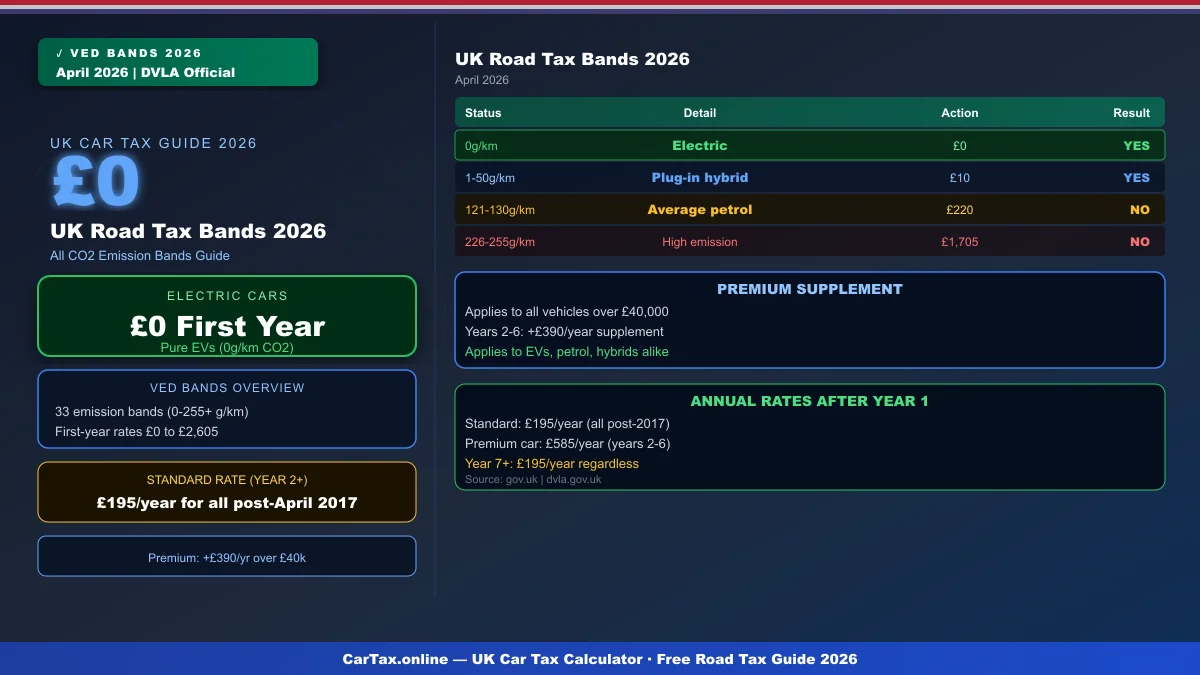
Understanding how UK road tax bands work is essential for every vehicle owner and buyer. Road tax, officially called Vehicle Excise Duty (VED), is calculated using a CO2 emission banding system that places every car into one of 16 categories. Each band carries a specific first-year rate, and once the first year passes, all vehicles fall into a standard annual rate. This article provides the complete 2026 UK road tax bands table alongside practical guidance on finding your vehicle's CO2 figure and applying the correct rate.
How UK Road Tax Bands Work in 2026
UK road tax bands are determined primarily by your vehicle's carbon dioxide (CO2) emissions measured in grams per kilometre (g/km). The DVLA assigns each registered vehicle to a specific CO2 band, and that band determines the first-year road tax rate you pay when you first register the car. After the first year, all vehicles fall into standard rates regardless of their original CO2 band.
The system was reformed significantly in April 2017, and vehicles registered from that date onwards use the current banding structure. Older vehicles registered before April 2017 use a different system based on engine size rather than CO2 emissions, which is why it is important to know your vehicle's registration date.
Electric vehicles and zero-emission cars occupy the top position in the banding table, paying £0 for both the first year and all subsequent years. This makes them the most favourable option from a road tax perspective, and the savings compound significantly over a multi-year ownership period.
Complete UK Road Tax Bands Table 2026
The following table shows all 16 CO2 emission bands used by the DVLA for vehicles registered from April 2017 onwards, with their corresponding first-year road tax rates for 2026:
VED CO2 Bands and First-Year Road Tax Rates 2026
| Band | CO2 Emissions (g/km) | First-Year Rate | Example Vehicles |
|---|---|---|---|
| A | 0 | £0 | Pure electric (Tesla Model 3, Nissan Leaf, BMW i4) |
| B | 1 - 50 | £10 | Plug-in hybrids (Toyota Prius Prime, Mitsubishi Outlander PHEV) |
| C | 51 - 75 | £30 | Self-charging hybrids (Toyota Corolla Hybrid, Honda Jazz Hybrid) |
| D | 76 - 94 | £130 | Efficient petrol (Toyota Yaris, Honda Civic 1.0L) |
| E | 95 - 99 | £135 | Efficient family cars (Skoda Octavia 1.5 TSI) |
| F | 100 - 109 | £155 | Average efficient (Ford Focus 1.0L EcoBoost) |
| G | 110 - 119 | £175 | Moderate emission (VW Golf 1.4 TSI) |
| H | 120 - 129 | £195 | Average emission (Vauxhall Astra 1.4L) |
| I | 130 - 139 | £215 | Above average (BMW 3 Series 320i) |
| J | 140 - 149 | £255 | Higher emission (Mercedes A-Class A180) |
| K | 150 - 164 | £645 | High emission (Audi Q5 40 TDI, BMW X3 xDrive20d) |
| L | 165 - 175 | £1,040 | Very high emission (Range Rover Evoque D180) |
| M | 176 - 185 | £1,565 | Ultra high emission (BMW X5 xDrive30d) |
| N | 186 - 200 | £2,080 | Very high emission (Mercedes E-Class E220d) |
| O | 201 - 225 | £2,605 | Highest emission (BMW X7 xDrive30d, Audi Q7) |
| P | 226 - 255 | £4,705 | Extremely high emission (performance SUVs) |
| Q | Over 255 | £2,605 | Highest emission band (large luxury SUVs, sports cars) |
Note: Band Q vehicles (over 255 g/km) attract the same £2,605 first-year rate as Band O, but with a different classification. This band applies to the most powerful and least efficient vehicles on the market.
Standard Annual Road Tax Rates After Year 1
Once the first year has passed, every vehicle transitions to standard annual road tax rates. For 2026, the DVLA has confirmed the following standard rates that apply from year 2 onwards:
- Band A (0 g/km, electric): £0 per year
- Alternative fuel vehicles (hybrid, bioethanol): £185 per year
- Petrol and diesel vehicles: £190 per year
Alternative fuel vehicles benefit from a £5 annual reduction compared to petrol and diesel cars. While this is a modest saving, it adds to the overall cost-of-ownership advantage that hybrids offer alongside their reduced fuel consumption.
Premium Rate for High-Value Vehicles
Vehicles with a list price exceeding £40,000 at the time of first registration pay an additional premium rate of £325 per year for five years, starting from the second year of ownership. This means petrol cars in this price bracket pay £515 annually for years 2 through 6.
Electric vehicles are exempt from this premium rate entirely, regardless of their purchase price. A £100,000 Tesla Model S pays the same £0 annual road tax as a budget electric city car. This creates a significant ongoing tax advantage for premium electric vehicles that is not available to equivalent petrol or diesel models.
How to Find Your Vehicle's CO2 Emissions
Your vehicle's CO2 emissions figure is shown on the V5C registration certificate (log book) in section 1.1. This is the official WLTP (Worldwide Harmonised Light Vehicle Test Procedure) figure that manufacturers are required to use for all vehicles registered from 2018 onwards.
Finding CO2 on the V5C Document
Open your V5C and look for the section titled "CO2 emissions (g/km)" near the top of page 2. This figure is mandatory for all post-April 2017 registrations. For older vehicles registered before this date, the V5C may show a differentNEDC figure, which the DVLA will have converted to an equivalent WLTP value.
Where Else to Find CO2 Information
Beyond the V5C, you can find your vehicle's CO2 emissions on the vehicle's registration certificate from the manufacturer, the sales invoice or paperwork when you bought the car, the manufacturer's official website or brochure specifications, and on the vehicle's fuel economy label displayed in showrooms.
For verification, the official DVLA vehicle tax rate tables provide a comprehensive reference for all CO2 bands and their associated rates.
Road Tax Bands for Pre-2017 Registered Vehicles
Vehicles registered before April 2017 use a different road tax banding system that is based on engine size rather than CO2 emissions. The DVLA assigns these vehicles to a default band using engine size data.
Pre-2017 Road Tax Bands
- Petrol cars under 1546cc: £185 per year
- Petrol cars 1546cc and over: £200 per year
- Diesel cars under 2000cc: £185 per year
- Diesel cars 2000cc and over: £200 per year
- Alternative fuel vehicles: £175 per year
These rates are significantly lower than the current standard £190 rate for post-April 2017 vehicles, reflecting the older taxation system. However, pre-2017 diesel vehicles that do not meet RDE2 (Real Driving Emissions Step 2) standards pay a supplement on these rates.
Comparing Real Cars Across Road Tax Bands
To put the road tax bands table into practical context, here is how some popular UK car models compare across the banding structure:
Real Car Examples Across Road Tax Bands
| Vehicle | CO2 (g/km) | Band | Year 1 | Standard |
|---|---|---|---|---|
| Tesla Model 3 RWD | 0 | A | £0 | £0 |
| Toyota Yaris 1.5 Hybrid | 89 | D | £130 | £190 |
| VW Golf 1.5 TSI 130 | 115 | G | £175 | £190 |
| Ford Focus 1.5 EcoBoost 150 | 136 | I | £215 | £190 |
| BMW 3 Series 320d | 152 | K | £645 | £190 |
| Range Rover Sport 3.0D | 194 | N | £2,080 | £190 |
| Porsche Cayenne E-Hybrid | 261 | Q | £2,605 | £185 |
This comparison demonstrates the dramatic range of first-year road tax costs across different vehicle types. The difference between buying a pure electric vehicle and a high-performance luxury SUV can exceed £2,600 in the first year alone.
Calculate Your Total Road Tax Costs
Once you have identified your vehicle's CO2 band and first-year rate, you can project the total road tax cost over your ownership period. Use our UK car tax calculator to compare different vehicles, account for premium rates on high-value cars, and factor in electric vehicle exemptions.
Frequently Asked Questions
What road tax band is my car if I do not know the CO2 figure?
If your V5C does not show a CO2 figure, it may be because your vehicle was registered before CO2 labeling became mandatory (March 2001) or is exempt from the standard calculation. In such cases, the DVLA assigns a default band based on engine size and fuel type. Contact the DVLA directly with your registration number to confirm your assigned band.
Do WLTP CO2 figures affect my road tax band?
Yes. All vehicles registered from April 2018 onwards use WLTP CO2 figures, which are generally higher than the older NEDC figures because they reflect more realistic real-world driving conditions. The WLTP figure shown on your V5C is the official value used by the DVLA to determine your road tax band.
Can road tax bands change after initial registration?
No. Your vehicle's road tax band is fixed at the point of first registration and does not change over the vehicle's lifetime. Even as emissions standards evolve and newer, cleaner vehicles enter the market, your vehicle retains its original band and rate structure.
Do imports from other countries use the same road tax bands?
Vehicles imported from the EU and registered in the UK for the first time use their WLTP CO2 figure for band assignment, just like domestically registered vehicles. Imported vehicles may need to pass additional DVLA inspections to confirm their specifications match the documentation provided.
What is the highest road tax band in the UK?
Band Q covers vehicles with CO2 emissions over 255 g/km and carries a first-year road tax rate of £2,605. However, vehicles with a list price over £40,000 pay an additional £325 annual premium for five years from year 2, bringing the maximum annual cost to £2,930 in those circumstances.
Do motorcycles have their own road tax bands?
Motorcycles use a separate taxation system based on engine capacity rather than CO2 emissions. The rates range from £12 for bikes under 150cc to £71 for motorcycles over 500cc. The road tax bands described in this article apply to cars and goods vehicles only.
Disclaimer: This article provides general information about UK road tax bands and CO2 VED rates for 2026. CO2 emission figures, road tax bands, and associated rates are subject to change by the DVLA and Treasury. Always verify your vehicle's specific road tax band and applicable rates using official government sources, including gov.uk/vehicle-tax-rate-tables. Consult a qualified professional for advice on your specific vehicle and circumstances.