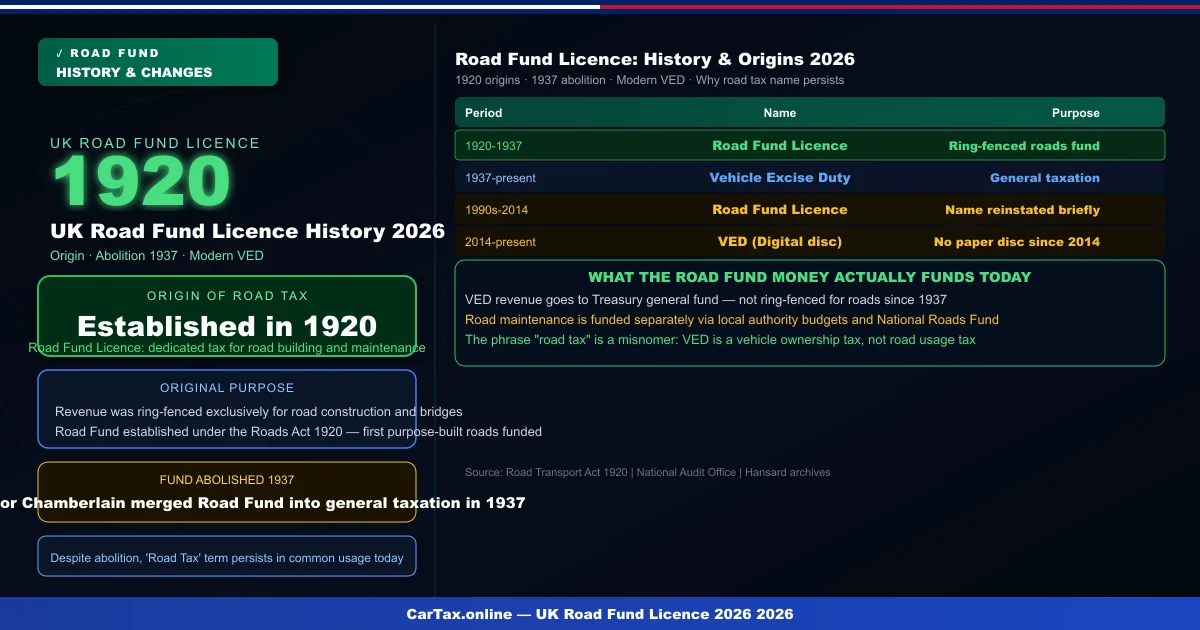
The Road Transport Act 1920 established the Road Fund as a dedicated revenue stream for road construction and maintenance. Revenue from vehicle licensing was ring-fenced to build and maintain British roads, establishing the philosophical foundation for the modern vehicle excise duty system that persists in modified form nearly a century later.
## Road Fund Licence Rates and Regulations
Although the Road Fund Licence name was discontinued in its original form, the annual VED rates established under the 1920 Act established the precedent of annual vehicle taxation that continues today. The modern standard rate of £190 per year represents the evolution of these original road fund principles.
### The Abolition of the Road Fund in 1937
The Road Fund was abolished by Chancellor Neville Chamberlain in 1937, with vehicle licence revenue merged into general taxation. The decision reflected the practical difficulty of ring-fencing specific revenues for specific expenditure in a period of expanding government spending on social programmes. Despite the technical restoration of the name Road Fund Licence in the 1990s, the underlying principle of ring-fenced road funding was never reinstated.
The legacy of the 1937 decision is visible in the ongoing debate about sustainable road funding. With fuel duty receipts declining due to electric vehicle adoption and improved fuel efficiency, the Treasury faces structural pressures on motoring-related revenue that echo the fiscal debates of the 1930s.
### The Paper Tax Disc Era
The physical paper tax disc was introduced in 1921 and remained a mandatory display item on vehicle windscreens for over 90 years. The bright orange disc became a familiar sight on British roads and remains a powerful cultural symbol even though it was abolished in 2014. The disc was abolished as part of DVLA's digitisation programme, which replaced physical enforcement with electronic records accessible to police through ANPR systems.
### Modern Digital Road Tax Enforcement
DVLA's digital enforcement systems identify untaxed vehicles through automatic number plate recognition cameras operated by police forces and local authorities across the United Kingdom. These systems cross-reference vehicle registrations against the DVLA's electronic licensing database, flagging untaxed vehicles for enforcement action including immediate vehicle clamping and removal.
The transition to digital enforcement has made the UK one of the most effective countries in the world at identifying and penalising vehicle tax evasion, with clamping teams able to respond to ANPR-identified untaxed vehicles within hours of detection.
## Frequently Asked Questions
**Does any money from fuel duty go to road maintenance?**
No. All fuel duty and VED revenue goes to the Treasury's general fund. Road maintenance is funded separately through the Department for Transport's road investment programme and local authority highways budgets, which compete with other government spending priorities.
**Why do people still call it road tax if it was abolished?**
The term road tax persists in common usage because it accurately describes the practical effect of the charge, even though the ring-fenced fund it originally funded was abolished nearly 90 years ago. The historical persistence of the term reflects its intuitive clarity rather than any technical accuracy.
**Is VED proportional to road damage caused?**
No. VED is based on CO2 emissions and list price rather than actual road usage or damage contribution. Heavy goods vehicles pay additional vehicle excise duty and the HGV Road User Levy that more closely relates to infrastructure wear, but passenger car taxation bears no direct relationship to actual road usage.
**Did the Road Fund build Britain's motorway network?**
The Road Fund contributed to road improvements throughout the interwar period, but the modern motorway network was built primarily under post-war governments using general taxation. The M1 motorway opened in 1959, long after the Road Fund's abolition in 1937.
Disclaimer: CarTax.online provides general information for guidance purposes only. Tax rules and rates are subject to change. Always verify current rates with gov.uk or HMRC before making financial decisions. This guide was last reviewed in 2026.
Frequently Asked Questions
Q: How much is car tax (VED) in the UK 2026?
Car tax rates in the UK depend on your vehicle's CO2 emissions and list price. Standard rates start from £190 per year for petrol and diesel cars, with zero-rated VED for EVs. First-year rates vary from £0 to £2,605 depending on emissions. Additional premiums apply for vehicles over £40,000.
Q: How do I check if my car is taxed online?
You can check your vehicle's tax status for free on the Gov.uk website at gov.uk/check-vehicle-tax. You'll need your vehicle's registration number (number plate). You can also check via the Motor Insurance Database to verify road tax and insurance status simultaneously.
Q: Can I get a refund on car tax if I sell my vehicle?
Yes — if you sell or scrap your vehicle, you can claim a refund on any full months of remaining road tax. Contact DVLA with the V11 reminder letter or apply online at gov.uk. Refunds are usually processed within 4-6 weeks. Related: Road Fund Licence History UK | UK Road Tax Bands 2026 | UK Motorbike Road Tax 2026 | UK Road Tax.
Q: Is road tax refund available when transferring ownership?
No — road tax does not transfer with the vehicle. When you sell your car, the tax is automatically cancelled and any remaining months are refunded to you by DVLA. The new owner must tax the vehicle immediately. As a buyer, always verify the vehicle's tax status before purchasing.
Q: What is the luxury car tax threshold in the UK 2026?
The additional rate for vehicles over £40,000 (list price) adds £410 per year to standard VED rates for years 2-6 of registration. This surcharge brings the annual cost for high-emission vehicles over £40,000 to around £600-690 per year. Pure EVs under £40,000 pay zero VED.
⚠ Financial & Legal Disclaimer
All information provided in this article is for educational and informational purposes only. The content is synthesized based on verbal communications, extensive internet research, and official government website data as of the date of publishing. Tax laws and insurance policies are subject to frequent changes by the authorities. We strive for accuracy, but we recommend that you consult a qualified professional (CA, CPA, or Tax Consultant) before making any financial decisions. For personalized assistance, you can also connect with our in-house experts through our Contact Us page.
Ready to calculate your car tax?
Use our free calculator to get an instant, accurate estimate for your country and state.
Open Car Tax Calculator →